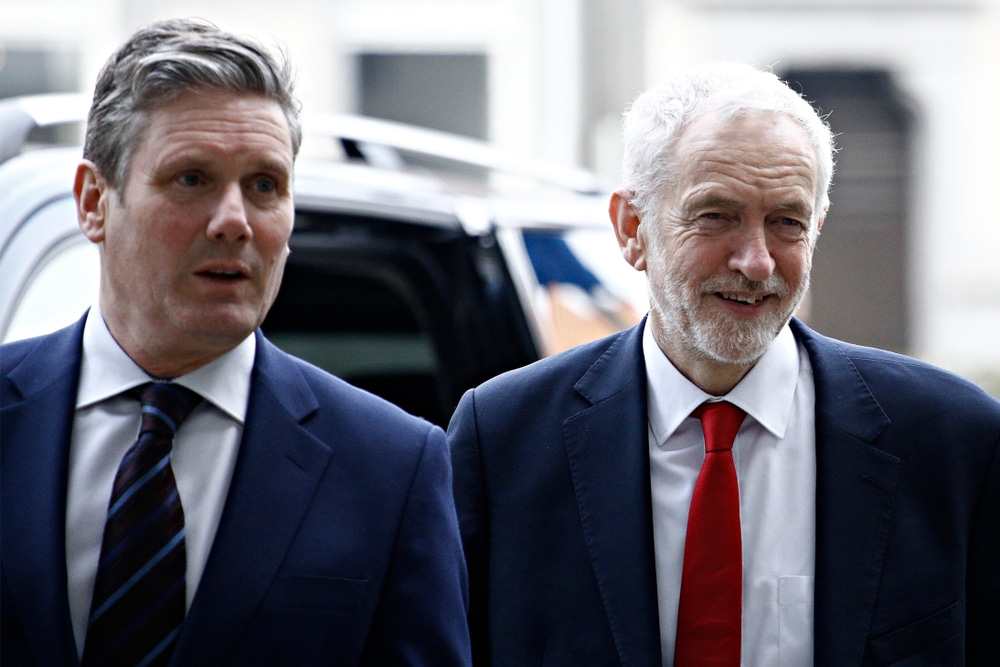
With Palestine Action proscribed this week as a terrorist organisation, Zarah Sultana announced plans for a new party to the left of Labour with Jeremy Corbyn, but it has gotten off to a shaky start.
On July 3, 2025, MP Zarah Sultana formally quit the Labour Party and announced her intention to co-lead a new left-wing party with Independent MP Jeremy Corbyn. This move doesn’t come as a surprise for many, as Sultana had the whip removed a year ago over her outspokenness against Labour’s two-child benefit cap. Corbyn, too, had his membership suspended over allegations of antisemitism in 2020.
This new party, to the left of Labour, would unite in its opposition to the genocide in Gaza and Reform anti-immigrant rhetoric. Above all, the announcement, made a day short of a year from Labour’s General Election victory, is a rejection of Prime Minister Keir Starmer and his brand of Labour.
What we know
Sultana made the announcement on Thursday evening, taking the mainstream media by surprise. She seems to have taken her new partner by surprise too. In a post on social media, he congratulated Sultana on her ‘principled decision’. He also expressed that he was ‘delighted that she will help us build a real alternative’. Nonetheless, Corbyn doubled-down on the need for an alternative to Labour. Discussions were ‘ongoing’ to establish ‘the democratic foundations of a new kind of political party’. ‘Arise’ and ‘The Collective’ are possible party names. There is no timeline at present, though the pair may try and field candidates at May 2026’s local elections.
Today, after 14 years, I’m resigning from the Labour Party.
— Zarah Sultana MP (@zarahsultana) July 3, 2025
Jeremy Corbyn and I will co-lead the founding of a new party, with other Independent MPs, campaigners and activists across the country.
Join us. The time is now.
Sign up here to stay updated: https://t.co/MAwVBrHOzH pic.twitter.com/z91p0CkXW0
Corbyn isn’t forthcoming with details and there appears to have been little coordination between the two. Sultana has been a thorn in Labour’s side for nearly two years; some suspect the pair are improvising and that she was merely jumping before she was pushed.
Real change is coming. pic.twitter.com/PjMPhxUJz7
— Jeremy Corbyn (@jeremycorbyn) July 4, 2025
The Sunday Times has reports that leaked texts from a group chat show that Sultana took Corbyn by surprise and that he is furious, but has reined in his anger so as to not provide ammunition to his rivals.
Jeremy Corbyn
Corbyn is a seasoned politician. He has been a Member of Parliament for my constituency, Islington North, since 1983. He served as Leader of the Labour opposition from 2015 until 2020. In the 2017 General Election, Corbyn led Labour to increase its vote share by 10%, the largest increase since the 1945 General Election. Though he lost the election, he won a greater share of the popular vote (40%), and with a significantly higher number of votes (12,877,918) than Keir Starmer did when he won in 2024 (34%, 9,708,716 votes).
Corbyn resigned in 2020 under heavy criticism for endemic antisemitism in the party, something which he has always strongly denied. Constituents highly respect him in Islington North. Corbyn is regularly spotted walking or cycling in the constituency, frequently appearing at community initiatives and religious centres. He has, for the best part of a decade now, come to embody what the socially conservative fear in inner city, metropolitan, multicultural London: a bogeyman of sorts.

Despite being 76 years old, his progressive views on gay marriage, social welfare, and crucially, permissive attitude towards other faiths mean he is very popular among Gen Z. This positions him as a dangerous force – or catalyst – to destabilise the status quo. As a vocal proponent for a free Palestine, it is suspected by some that the antisemitism allegations against Corbyn were started by pro-Israel lobbies.
Constituents in Islington North recognise Corbyn’s value as an elected representative. After the general election was called in May 2024, he was not allowed to stand as a Labour candidate and was expelled from the party. Despite a Labour landslide in the election, Corbyn beat his Labour replacement in the constituency by a comfortable 7,000 majority.
Zarah Sultana
On the other hand, Sultana has only served as an MP for her constituency Coventry South since 2019. She was little-known before the escalation of conflict between Israel and Palestine in October 2023. She frequently faces racist comments. Since then, she has gained notoriety from some and admiration from others. Throughout, she has experienced the mirth of the British media system.
I have followed Sultana on X since late 2023. Unlike many career politicians and especially Keir Starmer, you get the impression that she actually composes her own posts. The same can be said for her press releases, which give you a sense of her voice and authenticity.
She is also a vociferous voice in the Commons. There, she has put to Starmer on more than one occasion her constituents’, and sympathetic Britons’ concerns for two issues: the wellbeing of Palestinians and the two-child benefit cap.
Kneecap and Bob Vylan
Corbyn and Sultana have tapped into public support for Palestinians and anger over biased and opaque reporting from the mainstream media. This misplacement of emphasis by the media is perhaps best reflected in the UK’s music scene.
Belfast-based rap trio Kneecap has, for months now, been the victim of a campaign by the media to classify them as terrorist sympathisers after the group chanted ‘up Hamas, up Hezbollah’. Last week, Bob Vylan, a previously little-known duo performed at Glastonbury where they chanted ‘death, death to the IDF’.
Kneecap was already popular with younger people and Bob Vylan emerged from the controversy as a household name. Both Vylan and Kneecap are now being investigated by the police. Voters are enraged by the media’s preoccupation with artists and its comparably little coverage of the plight of Palestinians.
The BBC’s role
Novara Media recently exposed this, finding that the BBC, ‘Gives Israeli Deaths 33 Times More Coverage’. The purpose of the BBC, has for a century been to provide accurate, impartial and comprehensive news and information. The BBC’s mission, values and public purposes declares that ‘the BBC should provide duly accurate and impartial news, current affairs and factual programming to build people’s understanding of all parts of the United Kingdom and of the wider world.’ Any notion of BBC impartiality is dead. The rhetorical imbalance in the media needs to change.
Sultana hopes to capitalise on this irreconcilable divide between Labour centrists and those on its left. On July 2, MPs voted overwhelmingly (385 to 26) to proscribe the activist group Palestine Action as a terrorist organisation. Once the amendment to the Terrorism Act 2000 comes into effect, ‘supporting Palestine Action will become a criminal offence’. This will be punishable by up to 14 years in prison, the BBC reports.
The censorship playbook
Labour peer Peter Hain was one of the outspoken few in the House of Lords, where the amendment was passed. Hain, a noted anti-apartheid campaigner in the 1970s, notes that Palestine Action’s tactics are moderate by comparison to the suffragettes’. Suffragettes ‘attacked shop windows, government buildings and political party offices, sometimes using hammers, stones or iron bars. They also set fire to unoccupied buildings … intending to cause material loss without causing personal injury.’ He continues: ‘Palestine Action members spraying paint on military aircraft in [RAF base] Brize Norton seems positively moderate by comparison with what the suffragettes did.’
Hain notes the generational divide between those in power and Gen Z activists, criticising the decision to treat
‘young people as terrorists because they feel frustrated about the failure to stop mass killings and bombings of Palestinians in Gaza.’
‘Real terrorism’
Supporting Palestine Action will soon be a terrorist offence. In fact, the Metropolitan Police have already begun arresting Palestine Action protestors under these new offences. Perhaps preempting this, Hain felt the need to say: ‘I’ve never supported their activity, [but there is a] great difference between that and terrorism. And if you start labelling people willy-nilly “terrorists” right across the board, you’re going down a very very dangerous route.’ For those his peers who somehow don’t seem to understand what constitutes terrorism, Hain elucidated:
‘Al Qaeda members suicide attacked New York’s Twin Towers on the 11th of September 2001 killling 2,753 people – real terrorism.’
Hain ends, saying: ‘this government is treating Palestine Action as equivalent to Islamic State or Al Qaeda, which is intellectually bankrupt, politically unprincipled and morally wrong. Frankly I’m deeply ashamed.’
In the most 2025 form of censure possible, Musk’s X has removed Palestine Action’s account, where they had over 250,000 followers. In the digital age, burning books has been replaced by burning accounts.
Palestine Action’s statement after being shamefully proscribed a “terrorist organisation” in the UK. Their page has been taken down.
— Jennine K (@jennineak) July 5, 2025
“With repression always comes more resistance.” pic.twitter.com/k3Gy1gVk2G
Effects across the political spectrum
The effect that Sultana’s and Corbyn’s new party will have awaits response; we can only speculate about how the political landscape will change.
I spoke to a worried Green Party councillor. They had hoped to attract voters from Labour’s left at the next election, as ‘the vote will now be split’.
Though Corbyn and Sultana remain popular with left-wing voters, the first-past-the-post system likely means they will struggle to win outright in many constituencies. What’s more, as a new party, it is unlikely that they will be able to gain much traction before the next General Election, though Reform has proven that it can be done. Going off half-cocked, the new party seems as though it will only add another ingredient to the political crucible, with critics claiming ‘the new venture thus succumbed to the great left tradition of splitism’.
One thing is for certain. In the twenty-first century, discourse surrounding activism has changed, brought into focus most pressingly by Israel’s punitive collective punishment of Palestinians. With comparable movements in the past – the suffragettes and anti-apartheid protests – actors were vilified, and occasionally incarcerated. In 2025, a much larger percentage of the public has some involvement in activism, though often through more diffuse means – likes on social media and online petitions. With the proscription of Palestine Action we are in the process of a rhetorical shift. Activists are no longer classified as mere villains; now they are terrorists. Crucially, this is a move where power can censure and prosecute discontents to the full heft of the law.