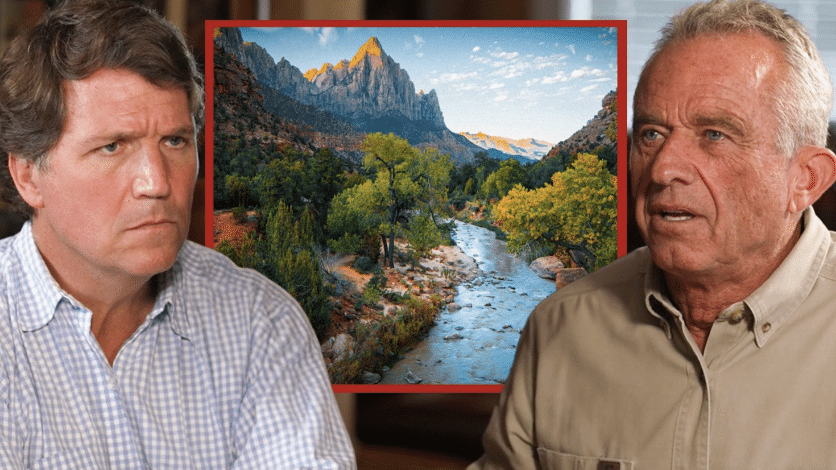
Just over 26 years ago, in 1998, Robert F. Kennedy Jr. was named one of TIME Magazine’s Heroes of the Planet, a two-year series that profiled those working tirelessly to “save our national heritage.”
TIME essayist and esteemed writer Roger Rosenblatt covered Kennedy’s profile: Fresh Waters: Let the Rivers Run Deep. Rosenblatt rode down the Hudson River with “Riverkeepers” and close friends John Cronin and RFK Jr. in Cronin’s sportfishing patrol boat. Together, the two had brought over 150 legal actions against polluters. One particular battle led the Environmental Protection Agency (EPA) to set concrete safety standards for power plants on the banks of the Hudson.
Kennedy’s motivations for protecting the river were simple. “To me,” he told Rosenblatt, “this is a struggle of good and evil—between short-term greed and ignorance and a long-term vision of building communities that are dignified and enriching and that meet the obligations of future generations.”
Two and a half decades later, RFK Jr. is the Secretary of Health and Human Services under the Trump Administration, following a failed 2024 third-party presidential run. He’s attained internet virality a number of times, for unique stints like swimming in Washington D.C.’s Rock Creek and challenging Pete Hegseth to a pull-up and push-up competition. Kennedy is also an outspoken vaccine skeptic. He was heavily scrutinized in a recent Senate hearing after having fired a 17-member Advisory Panel on Immunization Practices at the Centers for Disease Control and Prevention, and cutting funding to mRNA research.
Kennedy’s entire life has been analyzed by the ever-critical public eye. From Robert F. Kennedy’s son to an Independent presidential candidate to Secretary of Health and Human Services; the layers of Kennedy’s reputation are so diverse that they now find themselves at odds with each other.
The introspective environmentalist of the 80s now acts at the behest of Donald Trump, champion of the phrase “drill, baby, drill.” The cultivation of Kennedy’s conservationist image may have stemmed from a genuine passion for the outdoors. But since TIME named him a Hero of the Planet, Kennedy has used his environmentalist persona as a stepping stone to power, forsaking the Earth along the way.
Outdoorsman, conservationist, and environmental advocate
Kennedy’s commitment to environmental conservation and sustainability took root in the 1980s, forged by personal upheaval. In 1983, in the midst of an ongoing battle with addiction, Kennedy overdosed on heroin in the plane bathroom on a flight from Minneapolis to Rapid City, South Dakota. He’d previously released a statement through the office of his uncle, then Massachusetts Senator Edward M. Kennedy, stating, “With the best help I can find, I am determined to beat this problem.” A twenty-nine-year-old Kennedy made national headlines when he was arrested on the tarmac.
Before spending nearly half a year in a rehab facility, he pled guilty to drug possession and was sentenced to fifteen hundred hours of community service alongside two years of probation. As part of his community service, Kennedy made a name for himself volunteering for the National Resources Defense Council.

Founding NRDC director John Adams helped the young lawyer get a job with the Hudson River Fishermen’s Association, working for Robert Boyle. The Association had just recently founded Riverkeeper, a patrol boat that reported polluters on the banks of the Hudson River.
“He realized that this was his ticket back to legitimacy,” Boyle said of Kennedy’s involvement with the project in an interview with the New Yorker.
Regardless of Kennedy’s motivations, he left a profound impact on the environmentalist community. His star power drew celebrities like Uma Thurman and Alec Baldwin to the Association’s case. He co-founded the Waterkeeper Alliance, an organization that works to preserve clean water by connecting local grassroots leaders in order to address threats to water quality. He even offered his talents to an environmental law clinic at Pace University.
Kennedy’s campaign website lists his involvement in various lawsuits targeting bigshot polluters, such as Columbia Gas Company and SoCal Gas, as well as his protesting stint against the Keystone Pipeline. But it was his work with the Riverkeeper that solidified his reputation as a moral crusader—a conservationist and nature-lover wielding the weight of the Kennedy name for the good of the Earth.
His collaboration with Cronin and the Riverkeeper also earned him the aforementioned profile in Time Magazine by Roger Rosenblatt. In Fresh Water: Let the Rivers Run Deep, Rosenblatt portrayed Kennedy as an upstanding citizen whose call to action embodied the common man. As the trio sailed down the Hudson amidst ducks, a blue heron and sprinkles of endearing anecdotes, Rosenblatt remarked that the charming Kennedy “[had] made [him] forget his lineage,”.
Rosenblatt asked Kennedy why he had chosen to focus on the Hudson River rather than other worthy human causes. The wise Kennedy responded, “The environment cannot be separated from the economy, housing, civil rights and human rights. How we distribute the goods of the earth is the best measure of our democracy.”
A failed presidential campaign
RFK Jr. leaned heavily on his activist past during his 2024 presidential run. As part of his campaign, Kennedy released a video called My Environmental Priorities on the Robert F. Kennedy YouTube channel.
The video began with Kennedy explaining how, when he was an environmental lawyer in the 80s, environmentalism wasn’t a politically divisive issue. Nixon, a Republican, signed the Clean Air and Clean Water Acts and crafted the Environmental Protection Agency (EPA). Whether Republican, Democrat or Independent, Kennedy believed the United States could agree that protecting children, health and the wilderness is at the heart of what the people want. Echoing his middle-aged self in his interview with Rosenblatt, he emphasized the interconnectedness of community and environment.
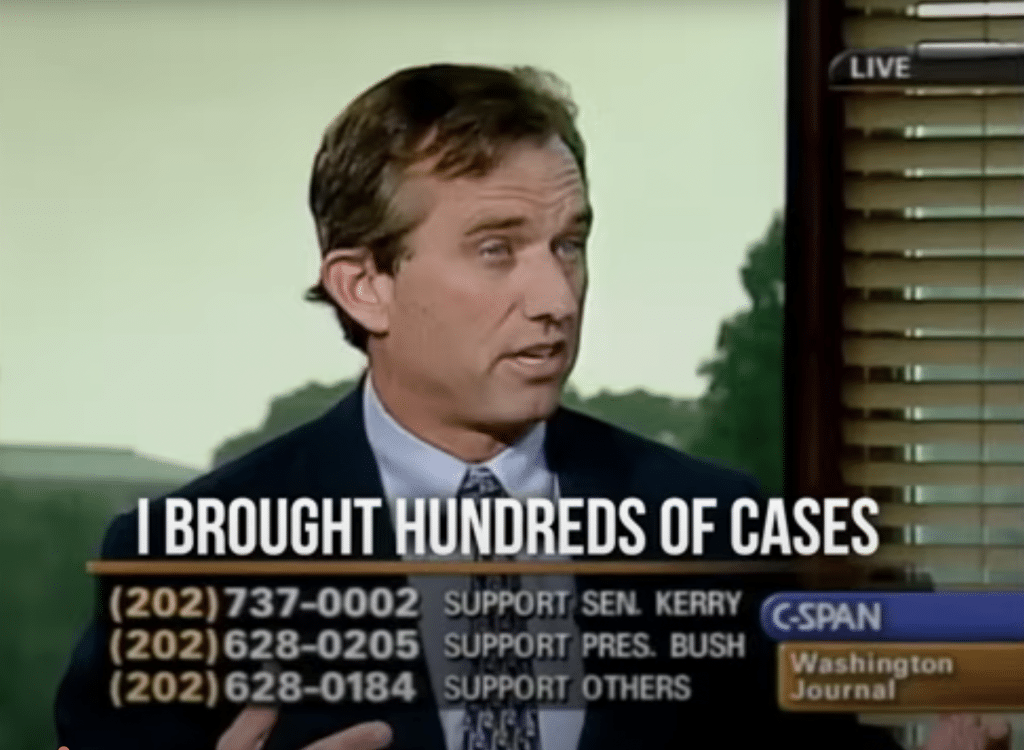
Without laying out any concrete policy proposals, Kennedy made his stance clear: “I want people to understand that in my view, climate change is real. And it is an existential threat.”His administration, Kennedy said, would steer the country towards clean and energy-efficient climate manufacturing and away from fossil fuels.
Though Kennedy calls for a bipartisan environmentalist effort, he’s been outspoken about his dislike for Biden’s Inflation Reduction Act, specifically its quantification of carbon emissions and government subsidies.
The Act includes both the Clean Energy Production Tax Credit and the Clean Electricity Investment Tax Credit. Both credits alter existing tax credits in order to apply to energy generation and storage facilities with a greenhouse gas emissions rate of zero. The Inflation Reduction Act also extended existing tax credits through 2025; the Investment Tax Credit and the Production Tax Credit both enable taxpayers to deduct a percentage of the cost of renewable energy from their federal taxes.
“The Inflation Reduction Act was hijacked by industry, specifically the carbon industry.” Kennedy told CNBC’s Brian Sullivan in an interview on the network’s “Last Call.”
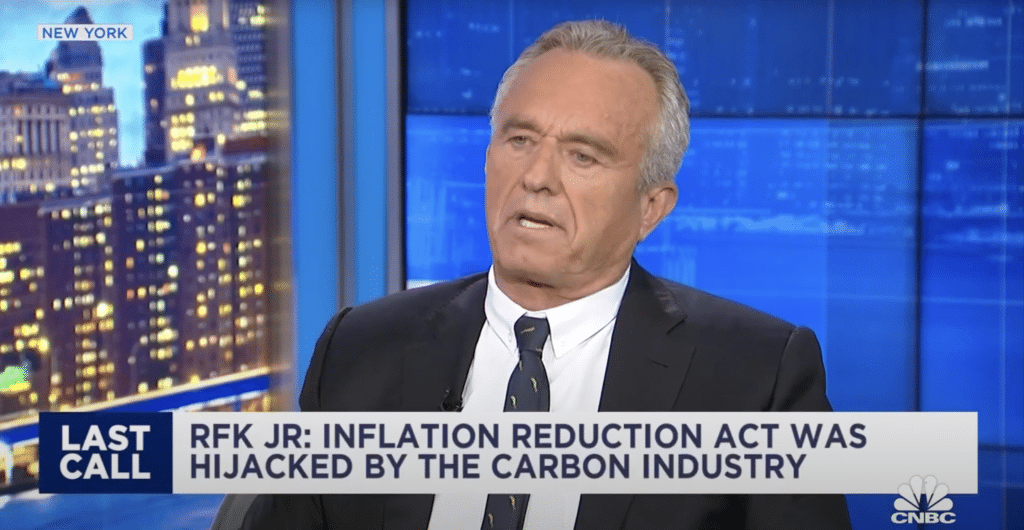
In the same interview, he called for “free market capitalism.” He wanted to end government subsidizing of what he referred to as the carbon industry; CO2 capture technology giants, for instance.
Kennedy, however, offered no alternative policy proposal. Even his campaign website gives no indication of how a Kennedy administration would have addressed climate change; though his biography certainly leverages his carefully cultivated environmentalist image, noting that “[Robert] is an avid outdoorsman, master falconer and white water kayaker.”
In August of 2024, Kennedy suspended his presidential campaign, throwing his support behind President Donald Trump. On February 13th, 2025, RFK JR. was sworn in as the 26th Secretary of Health and Human Services. Trump signed a subsequent Executive Order establishing a federal Make America Healthy Again Commission to be overseen, in part, by Kennedy.
The RFK Jr. of today, and of tomorrow
Despite Kennedy’s election loss, his former campaign website proclaims victory. “WE DID IT,” the site reads, beneath a banner wishing congratulations for President Trump.
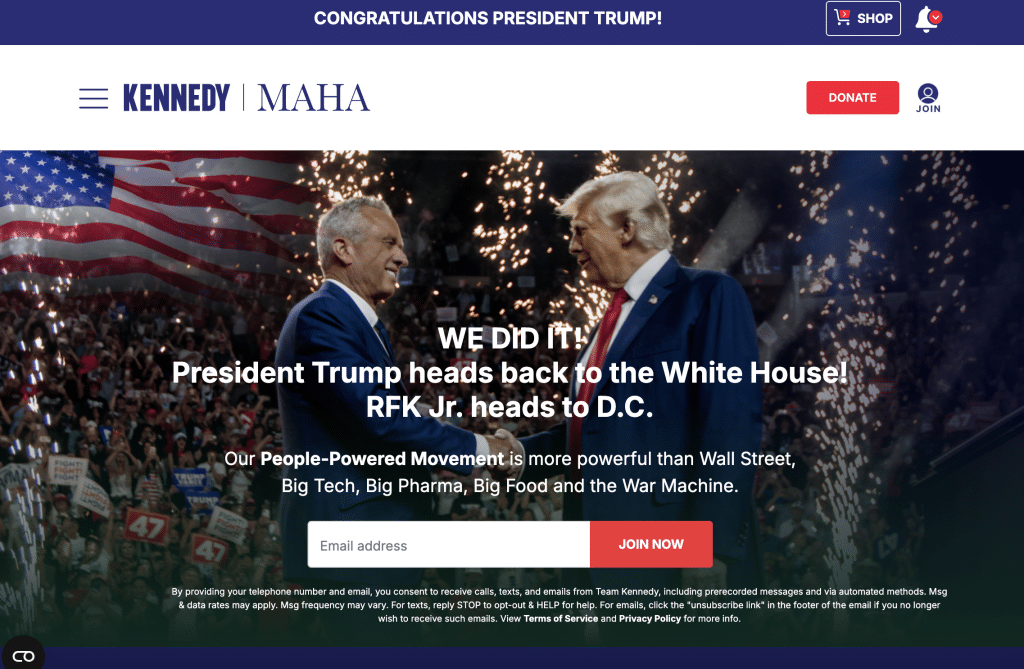
Meanwhile, Trump has begun the process of withdrawing the United States from the 2015 Paris Climate Agreement for the second time. His administration oversaw the Treasury Department’s implementation of broad restrictions on wind and solar tax credits. The Department of Energy released A Critical Review of Impacts of Greenhouse Gas Emissions on the U.S. Climate; a report experts say is ripe with misinformation, severely downplaying the contributions of CO2 emissions to climate change in favor of rolling back science-based climate regulations.
Under EPA administrator Lee Zeldin, the agency has begun what its press office proclaimed to be the biggest deregulatory action in U.S. history. The plan, released in March of 2025, promised the “reconsideration” of a variety of climate rules and regulations, some of which concern: the oil and gas industry, the mandatory Greenhouse Gas Reporting Program, the Steam Electric Power Generating Industry, and the National Emission Standards for Hazardous Air Pollutants. Crucially, Trump’s EPA has pledged to reconsider the Endangerment Finding, which is the science-based determination that greenhouse gases in the atmosphere is a threat to public health. The Endangerment Finding serves as the legal and scientific justification for Nixon’s Clean Air Act.
And this is just the tip of the iceberg. The Trump administration’s rollback to climate regulations and cuts to climate research are extensive and ongoing. So how can grassroots environmentalist, conservationist and “avid outdoorsman” Kennedy claim Trump’s victory as his own?
Perhaps because Trump has entrusted Kennedy with vast and virtually unchecked power by gifting him leadership of the Department of Health and Human Services. Certainly, Kennedy’s loyalty to President Trump doesn’t undo his work as an environmental lawyer, as a Riverkeeper, or as a volunteer with the NRDC. But it does call into question who he is now, and who he was back then in the 80s.
A crude analysis of Kennedy’s life’s work might determine that his conservationist past was merely a facade—a well-timed social justice rebrand to distract the public from his 1883 Rapid City arrest. A more nuanced examination suggests that his passion for nature was genuine. Since then, however, he’s leveraged that passion as a performative badge of honor, as is his right. But by throwing his unwavering support behind Donald Trump, he’s forfeited the right to claim the title of environmentalist.