On September 10th, a wave of protests swept throughout the French Republic. Thousands all across the nation took to the streets and went to the barricades. Young people set up blockades all around France, in a display that many compared to the earlier Yellow Vest protests of the late 2010s. Their aim? Total shutdown of French society, a political strike.
Perhaps overshadowed by the assassination of Charlie Kirk in the United States, these protests were part of a movement called Bloquons tout, or “Block Everything” in English. The protesters placed roadblocks on highways and shut down large tourist attractions. The French Government, led by Emmanuel Macron, deployed 80,000 police and gendarmes, fully kitted out in riot gear to contain these youth in revolt.
In Paris, Black Bloc protestors threw garbage cans at police, and the authorities responded with tear gas. Riot shields were met with umbrellas. Chants of “Free Palestine” coincided with criticisms of Macron and the French Government.
The Block Everything movement is just one example of French political tensions boiling over into street clashes and riots. The Bloquons Tout movement emerged just as France’s government collapsed amid a major political-economic crisis. An issue that affects the majority of the French people, and an issue that will be difficult for Macron to find a solution to.
Budget cuts unite right and left
On September 9th, Prime Minister François Bayrou was removed from office after receiving a vote of no confidence from the French Parliament. Bayrou lasted a mere 9 months in office, and his ousting came after he attempted to pass his plans for the 2026 French Budget.
When it came to allocating funds for the France’s budget, Former PM Bayrou’s major concern was the national debt. Bayrou claimed that not working to reduce France’s debt would create a financial crisis that would harm future generations. This fear of an upcoming fiscal collapse informed how he allotted the public funds in his Budget proposal.
Bayrou’s proposal included a 40 billion Euro budget cut, which targeted many social services, such as public holidays and state pensions, which many working French people are not willing to surrender.
Bayrou’s plans for national belt-tightening was so unpopular that it united the far right and left against him. The calls for Bayrou’s removal were bipartisan. Communists and Nationalists made up just some of the 364 Ministers of Parliament who voted against the Prime Minister.

This was the second time opposition parties successfully implemented a No-Confidence vote against Macron’s prime minister in the last year. Back in December, conservative PM Michel Barnier was removed for similar budgetary concerns.
Political polarization in Paris
Macron, his government, as well as the political parties and MPs that support them, can be largely described as Centrist. While Macron’s coalition still leads the government, they only make up a minority of the French National Assembly.
The Government’s opposition is made up of many different political persuasions. Both the Far-Left and the Far-Right have gathered considerable political strength simply by basking in the unpopularity of the Centrists.
To the French President’s right is the Rassemblement national, or National Rally. Formerly the National Front, the NR traces its origins back to Neo-Fascist organizations in post-war France. Under the leadership of Marine Le Pen, the party has crawled from the political fringes, closer and closer to the Presidency.
During the 2024 National Assembly elections, the French Left snatched a victory from the National Rally in a shocking last-minute alliance. Under the banner of the New Popular Front, progressive political parties banded together to prevent an NR victory. The first “Popular Front” was an alliance between progressive liberals and communists, which occurred during the 1936 election.
Dissatisfaction with the current administration has led many French voters to look to radical politics as an alternative. The right and left have put the centrists in the political hot seat. Macron must answer the question: how do you find a compromise with those whose standpoints are so far apart?
Block everything rages on
Even after Bayrou’s removal, the Block Everything protests have continued to gain momentum. 8 days after the first day of action, the students and workers of France again took to the streets to protest the budget cuts being pushed by the current administration.
While Trade Unions had a more passive approach to the initial Block Everything protest, representatives of the General Confederation of Labor would use the occasion to call for a general strike on the 18th. The strike shut down pharmacies, crippled public transport, and later led to French police clashing with striking workers.
The general strike came after a brief lull period, in which the new Prime Minister, and former armed forces minister Sébastien Lecornu, was appointed. Despite the downtime, Lecornu’s first day had an escalation of the protests.
More barricades, more fires, more flares, more clashes. In Toulouse, students blockaded at least 3 different high schools. As the smoke cleared and the sun set on September 18th, more than 450 people had been arrested, and over 800 actions had occurred across France.
The continued street actions reminded some of the Yellow Vest protests of 2018, which were massive, national days of action occurring over taxation and austerity measures. The very same that got Bayrou kicked out of office.
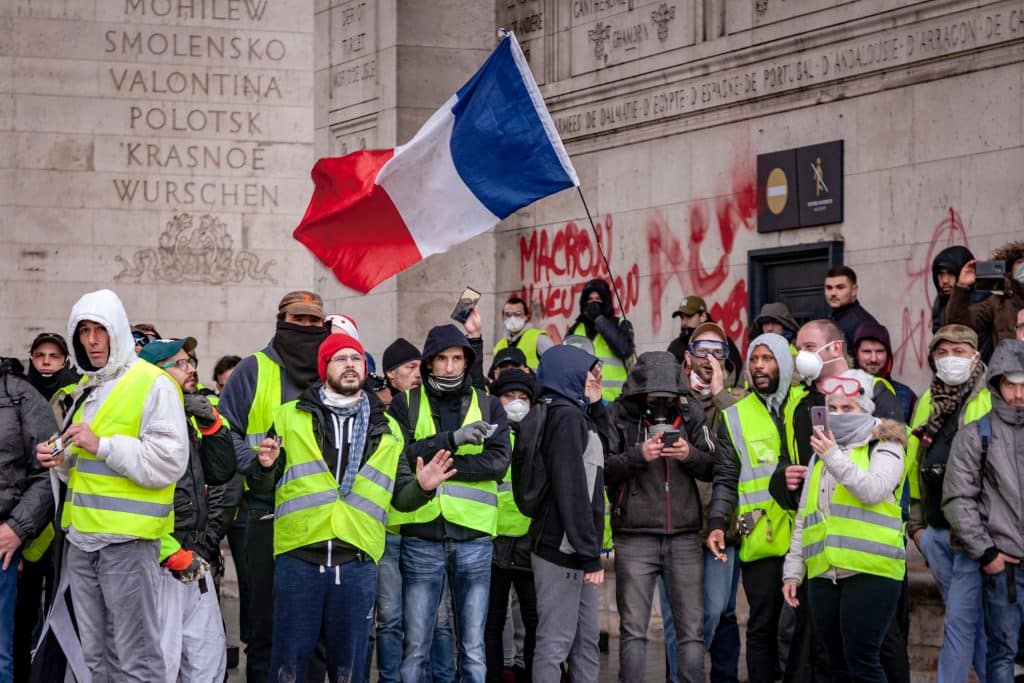
However, the Yellow Vest movement was primarily apolitical and formed on practical economic terms, but Block Everything is far more politically motivated, with its ranks being filled with left-wing students and trade unions. This has led to a significantly smaller turnout for Block Everything,
New prime minister attempts to find compromise
Despite the appointment of Prime Minister Lecornu, the struggle in France goes on. Lecornu is a longtime political associate with President Macron, but promised his budget proposal would be different than his predecessor’s.
Lecornu is in a race against time. In the aftermath of Bayrou’s deposal, France’s credit rating dropped from AA- to A+. For comparison, Germany, a country with one of the highest credit ratings in the EU, has a score of AAA, and Greece, a country with a checkered financial record, has a rating of BBB-. The drop from AA to A- gives France a score comparable to Portugal.
In an attempt to cool political tensions, the new Prime Minister met with several high-level left-wing political leaders. Such as the Socialist Party and Union leaders. The Socialist Party put forward a plan to tax the rich, something that Lecornu might be willing to agree upon.
Despite attempts at a resolution to the ongoing budget crisis, many are dissatisfied on all sides of the French political aisle. In the streets, Left-wing Block Everything activists have expressed frustration, with some saying that they don’t feel like Lecornu will bring any genuine resolution. Right-wing parties, such as the National Rally, have rejected any taxation of France’s upper class.
Block everything spreads to Italy
2025 has been a politically turbulent year, not just for France but for many nations across the world. Several mass uprisings have recently been sparked in Nepal, Moracco, and Indonesia. In other parts of Europe, such as the Netherlands and the UK, large-scale right-wing, anti immigration protests have exploded into violence. The assassination of Charlie Kirk has only worked to increase the polarization of American politics. All around the world, the people are in open rebellion.
The “Block Everything” movement appears to be spreading. On September 22nd, another national day of action occured occured, this time in Italy. Called by major trade union, the Unione Sindacale di Base against Israel’s genocide against the people of Gaza.
France’s political instability is very much a matter of concern for the American government. France is a key Western European ally, going back to the Second World War. If Macron’s minority government continues to collapse, that alliance is threatened. Both the National Rally and the left-wing political parties have reasons to distance themselves from the United States.
Tensions are boiling, with no end in sight. With Unite CGT calling for another mobilization on October 2nd. Only time will tell how the Block Everything protest will continue to develop, and how the Macron government will handle the political crisis.