As the 2026 elections draw closer, challenges from younger, more progressive members of the left are cropping up. Frustration over the Democrats’ poor performance in the 2024 election — along with a feeling that House and Senate Democrats aren’t doing enough to combat the Trump administration — has left younger progressives eager to take the reins, even if it means wrestling them away.
Polling from March of 2024 shows that while most voters worried about President Biden’s age, those between the ages of 18 and 29 were most likely to agree that Biden was too old to run again.
The sentiment that Democrats aren’t doing enough isn’t unique. A recent CBS poll found that 64% of people would use the word ‘weak’ to describe the Democrats. It isn’t even unique within the Democratic party. A poll carried out by Ipsos showed that only 62% of Democrats thought that their party’s position was “about right” compared to 80% of Republicans who said the same of the GOP.
Why younger candidates?
In the social media age, where young political commentators can influence millions through a screen, many see an opportunity for younger candidates to share their message more easily. By engaging voters directly on platforms like TikTok and Instagram, these candidates are bringing issues straight to citizens through their screens.
Texas state Rep. James Talarico, 36, recently launched a U.S. Senate campaign and has 1.4 million followers on TikTok. A video of him opposing the display of the Ten Commandments in public schools went viral, gaining national attention.
His social media presence landed him an interview on one of the most watched shows in media — The Joe Rogan Experience. In the interview, Rogan recounted how a friend had mentioned seeing the video.
“Then I watched and I said, ‘Oh, ok, this is very interesting.’ So I thought we would have a cool conversation,” said Rogan.
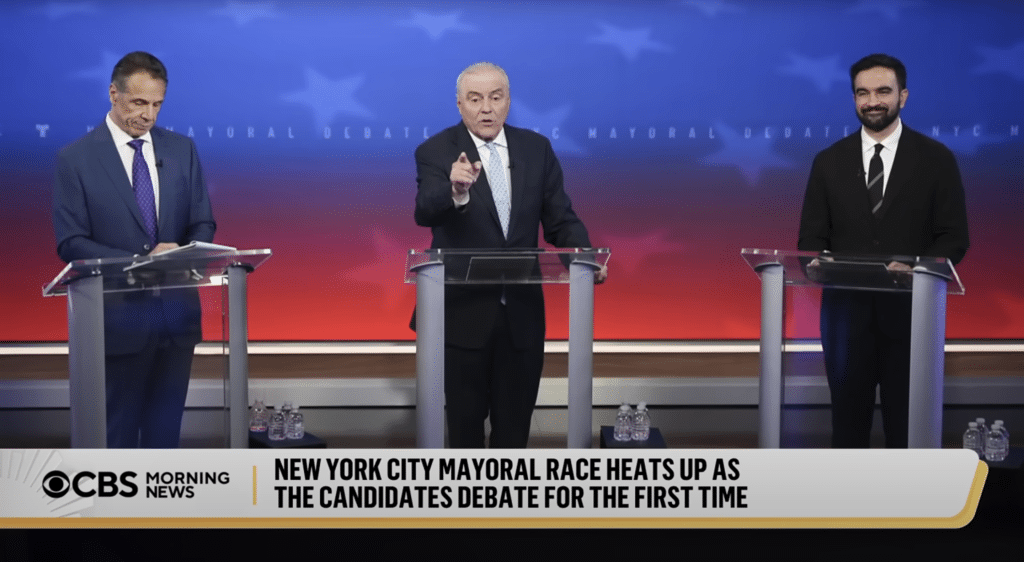
Many saw Zohran Mamdani’s primary win over Andrew Cuomo in the New York mayoral race as a sign that establishment Democrats no longer hold a monopoly on the nomination.

People have praised the 34-year-old Mamdani’s communications strategy for delivering campaign messages quickly and efficiently over TikTok and Instagram. His videos focus on topics relatable to New Yorkers, while hammering home a consistent message: affordability.
One of the prominent critics of the Democratic establishment recently has been David Hogg. The 25-year-old gun control activist decided not to run for re-election as the vice-chair of the Democratic National Committee after his plans to challenge incumbent democrats he described as “asleep at the wheel”, were poorly received by the party establishment. He has since focused his efforts on getting younger candidates elected to office through his group, Leaders We Deserve.
Leaders We Deserve isn’t the only group focusing on younger candidates. Run For Something was founded in 2017 in the aftermath of the 2016 election to elect young progressives to state and local office. Since its founding it has helped elect over 1500 candidates, including Talarico, U.S. Rep. Jasmine Crockett, 44, and U.S. Senate hopeful Mallory McMorrow, 39.
Senior Director of Communications and Marketing at Run For Something, Ally Boguhn, explained why social media was so useful.
“We need more candidates who can break through the political noise if we want to build power and leverage it for change. That means more candidates who can reach people — and young people in particular—through social media. Young progressives have an advantage in this space because they are digital natives who understand how to use it to show up authentically to reach voters.”
Who else is running?
A number of Millennial and Gen Z candidates have already announced their entry into primary races across the country.
33-year-old Michigan state Rep. Donavan McKinney has been explicit in challenging the incumbent Rep. Shri Thanedar, 70, for Michigan’s 13th District. He has accused Thanedar of “buying the seat with his own money” and not paying his “fair share” like working people do. McKinney’s approach reflects the attitude of younger candidates who are fed up of the same political process with his campaign website stating: “I’ve lived with the same bull**** as you my entire life.”
Tech entrepreneur Saikat Charabarti , 39, is running in California’s 11th District to unseat former House Speaker Nancy Pelosi, 85. Though he differs from her on policy, he also emphasizes her age. The welcome page on his campaign website highlights this, stating: “Nancy Pelosi entered politics 45 years ago.” His campaign isn’t shy to progressive policies including promises of a wealth tax, tuition-free college, Medicare for all and affordable housing.
The same goes for 35-year-old volunteer firefighter Harry Jarin who is challenging Rep. Steny Hoyer, 85, in Maryland’s 5th District. His campaign website states: “Steny Hoyer is the longest-serving Democrat in Congress. He’s held this seat since 1981. He’s been in Congress for over 44 years — and he’ll be 89 years old at the end of the next term.” Speaking to the Free Press, he said there wasn’t much ideological difference between him and Hoyer — it was Hoyer’s age that drove his challenge.
Other candidates have joined crowded primaries for vacant seats.
Journalist and influencer Kat Abughazaleh, 26, started her campaign against incumbent Rep. Jan Schakowsky, 81, of Illinois’ 9th District, saying she would bring the fight to Washington. Schakowsky announced she would not be seeking re-election a month later. Abughazaleh’s campaign uses a similar colloquial approach to her social media with the slogan “What if we didn’t suck?”

Many campaigns share similar themes. Some, like those of Jarin and Chakrabarti draw direct attention to their opponents’ age, promising a new generation of leaders. Others, like McKinney and Abughazaleh, use relatable slogans that cut through traditional political jargon.
Can they win?
Many of these races are still months away. The available polling shows a few of the candidates mentioned are trailing. While the numbers suggest some campaigns are gaining traction, it’s unclear how that will translate into votes.
According to a poll released by Abughazaleh’s campaign, her opponent, Evanston Mayor Daniel Biss, leads 17% to her 10%. He also leads in name recognition, 60% to 36%.
With Chakrabarti up against a Democratic party legend, it’s unsurprising that internal polling shows him trailing by 17 points. However, in California’s open primary system, the top two candidates go through to the ballot. In a potential head-to-head between Chakrabarti and Pelosi, the gap narrows.
Campaign finance tells a slightly different story. According to the most recent FEC reports, Abughazaleh leads in total receipts in her race. McKinney has nearly $492,000 in total receipts of which $456,000 are individual contributions. Thanedar’s total receipts more than triple McKinney’s. Reports show he has only about $87,000 in individual contributions, with significant portions coming from Thanedar himself.
Both Abughazaleh and McKinney have received the most small individual contributions in their races.
Chakrabarti has raised almost $1 million. Over $700,000 were loans made by the candidate. However, that amount is less than half of Former House speaker Nancy Pelosi’s campaign war chest. Jarin is behind Quincy Bareebe, another challenger.
Even in Abughazaleh’s case, Biss isn’t far behind. Her campaign total sits around $1.5 million while his comes out to about $1.3 million. Her campaign has been running the longest and her strong social media presence has brought considerable attention. However, she is missing a key component of many candidacies: strong local roots. Most of the candidates mentioned are from the areas they are running in. Abughazaleh only recently moved to Illinois. Furthermore, many of her donations have come from out of state.
But polls can’t always predict the outcome. Mamdani was not favored to win the Democratic primary. He also wasn’t leading polls in the months leading up to the primary election.
Is this the right direction?
David Karol, an associate professor of government and politics at the University of Maryland, spoke about how primaries are often built on coalitions. He explained that young people don’t vote in as high numbers as other generations. While young people can be a part of a winning coalition, they often aren’t enough to win elections on their own.
“Other factors can matter,” Karol said. “Are they someone from my part of the state? Is someone from my religious group or my racial group?”
Kaivan Shroff, a Democratic strategist and 2024 delegate for Kamala Harris, has no issue with searching for younger leaders. He argues that most young people aren’t energized by popular influencers, but by those who have been active in the community.
“To the extent we have younger leaders, it should be based on the distinct lived experiences young people face in this moment for our country,” Shroff said.
Shroff remains skeptical about whether calls from prominent voices to elect younger candidates are actually identifying the best people.
“That’s a good reason to say we need younger voices with different policy ideas and perspectives of how they are going to do it differently. I’m not hearing that from, you know, the David Hoggs and the influencer cohort,” Shroff said.
Yet those who support electing younger candidates often express a similar goal. Shroff’s sentiment mirrors one shared by Boguhn about why Run For Something values young candidates.
“It means that there are more elected officials who are bringing their lived experiences as young people to the policymaking conversations, and those experiences are different than their older colleagues. Young people understand what it means to have grown up with active-shooter drills in schools, to be crushed by student debt that feels insurmountable, and to face a future where home ownership may always be out of reach,” Boguhn said.
Run For Something only endorses candidates in state and local office.
“We believe that hyperlocal work must be front and center and that rebuilding the party and empowering the next generation of leaders has to happen from the ground up,” Boguhn said.
Though Hogg often speaks about the general issues Democrats should prioritize, his recent candidate list is dominated by community leaders and state legislators.
Shroff isn’t the only skeptic. Other commentators have also questioned the substance of some younger candidates, including some backed by Leaders We Deserve.
One prominent election loss for the group was influencer and activist Deja Foxx. Foxx ran in the Arizona’s 7th District special Democratic primary against Adelita Grijalva in July. Her defeat prompted some commentators to point out the risks of relying too heavily on youth and social media.
“If you don’t actually channel progressive policies just simply being young and doing social media hits is not gonna [expletive] carry you across the finish line,” left-wing commentator Hasan Piker said during a stream, speaking about Foxx’s loss.
Shroff contrasted Foxx’s performance with that of Mamdani. Though Shroff is a moderate democrat, he praised the mayoral candidate, arguing that voters want authenticity.
“He shows up. He has the conversations with everyone around. That is super important to then inform what you’re saying on social media,” Shroff said.
Leaders We Deserve endorsed Mamdani during the New York City mayoral primary. The group emphasizes young, progressive candidates, though they’re not all the same.
The group is endorsing Christian Menefee, 37, the Harris County district attorney. He is running in a tight Texas primary for the seat previously held by the late Rep Sylvester Turner’s. Menefee’s campaign, while progressive, uses moderate language compared to other endorsees. He calls for a “common sense” solution to immigration — taking a different tone from the pathway to citizenship for all immigrants, as seen in Donovan Mckinney’s campaign.
His election is only weeks away. Polls released by individual campaigns show mixed results. A September poll for the Jolanda Jones Campaign showed Jones, 59, at least 10 points ahead of Menefee. A poll from Menefee’s campaign showed Menefee and Jones tied for first place. Meanwhile, a University of Houston poll conducted in July showed Menefee at 27% closely followed by Amanda Edwards, 43, at 24%. Menefee also leads his opponents in fundraising.
What do the voters want?
Placing emphasis on authenticity isn’t a new idea. Democrats face larger challenges than the age of their candidates — polls continuously show the biggest worries for Americans are issues like inflation and rising prices.
A recent study from the Center for Working-Class Politics, the Labor institute and Rutgers University found that economic populism is popular in Michigan, Ohio, Wisconsin and Pennsylvania. However, the Democratic party name is not.
Those surveyed associated Democrats with corruption, ineffectiveness and being out of touch. When presented with identical economic populist campaigns, independents outperformed Democrats by eight points across the four states.
How progressives will combat this remains to be seen. In collaboration with Bernie Sanders, Run For Something changed its selection criteria in August to allow independent candidates.
“This change recognizes that we share a set of values with progressive independent candidates, and it allows us to recruit and endorse more candidates while helping to build even more power and infrastructure for the fights ahead,” Boguhn said.
The future
For Democrats, there is still some soul-searching. David Hogg has made it clear he plans to usher in the next generation of Democrats. Kaivan Shroff believes it’s time for debate.
“Now’s the time to get together and have those conversations and allow some disagreement and move forward from there because that’s how people are going to figure it out,” Shroff said.
Only time will tell. In the meantime, the outcomes of two races are expected in November: the New York mayoral election and the Texas 18th Congressional District special election.