Everest. Some see the mountain as a representation for what humans are capable of accomplishing. Others view its challenges as a cautionary tale to not push the limits of nature. After all, over 350 lives have been lost on its peaks.
Considering the danger, one might think that summiting would be accomplishment enough.
Some brave souls, however, attempt to take it a step further.
Just last year, in May 2025, former British special forces soldiers ascended Everest in only five days. This accomplishment might forever change how people can ascend Everest, and who would be able to accomplish this once in a lifetime experience.
How four ex-marines and one doctor changed the status quo
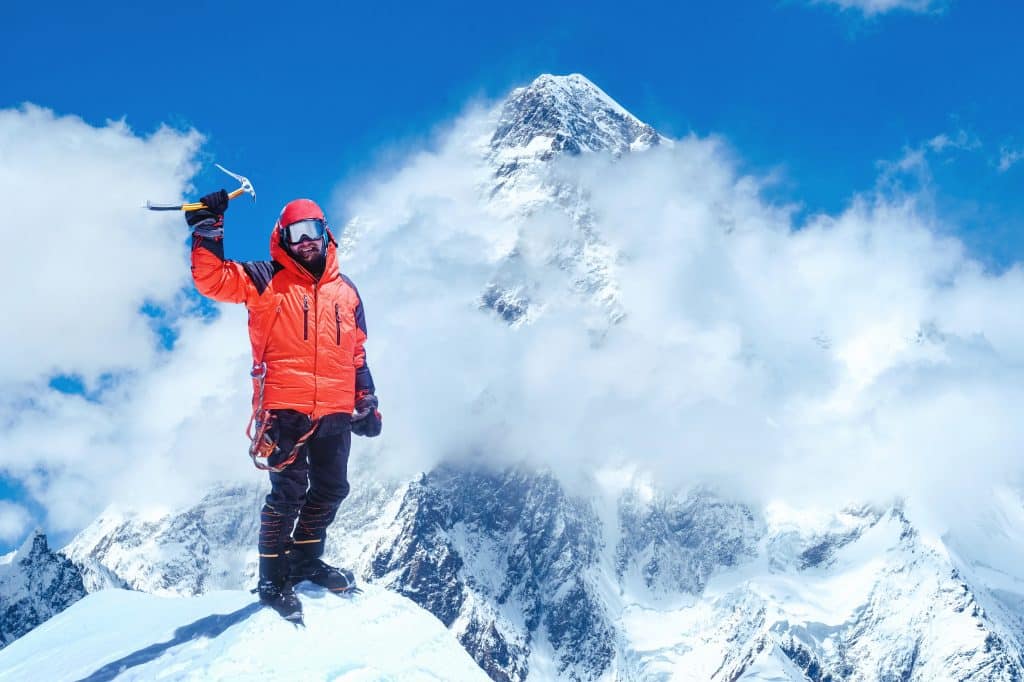
Generally, summiting Everest takes about six to eight weeks, with the majority of time being spent at Base Camp and slowly ascending to camps 1, 2, and 3. After each ascent, you descend back into Base Camp. While seemingly tedious, these steps are necessary for preventing altitude sickness, which has already been responsible for about 10% of deaths on Everest.
Instead of adjusting to the altitude at base camp, these men trained at home, adjusting themselves to a low-oxygen environment by sleeping in hypoxic tents for about ten weeks.
Next, they went to a clinic in Germany, working with a doctor by the name of Lukas Furtenbach. At his clinic, they were lightly sedated, and for less than an hour inhaled xenon gas.
Soon after, they took a helicopter to base camp, skipping the 7-12 day trek that most hikers take, and summiting Everest five days later.

Due to this success, Furtenbach has mentioned that he hopes to offer more climbers the option of using xenon gas on their trek. He anticipates that, on average, his clients would be able to hike Everest there and back in only two weeks.
According to him, this method,
“Can be the future of commercially guided mountaineering on Mount Everest.”
Is using xenon to climb Mount Everest dangerous?

Many are hesitant about this new accomplishment.
Once hearing the news of the four men’s ascent, The International Climbing and Mountaineering Federation (UIAA) issued a statement, explaining why hikers should not use xenon for climbing.
A study that the UIAA reviewed found that mountaineers who use xenon gas at the recommended amount for high altitude excursions felt as though they were heavily sedated. The UIAA states that even being slightly sedated on a high mountaineering excursion is dangerous.
They also mentioned that xenon gas has been a banned substance from the World Anti-Doping Agency (WADA) since 2014. While this rule does not necessarily apply to high altitude mountaineering, (since it does not count as a competitive sport), they highly discourage any mountaineers to use xenon for their treks.Dr. Peter Hackett, “a pioneer in altitude research” according to NPR, also has some hesitation about xenon. While he believes that the substance is safe for the most part, allowing the general population to have access to this substance would be a bad idea since they might not know how to handle it properly.
“Here’s the danger. The danger is that word gets out that xenon is helpful, and then next thing you know, people can buy it on TikTok, you know, or somewhere and use it unsupervised, a wrong concentration, wrong amount of time, and they could easily kill themselves. So it has to be done in a safe environment, and then it’s perfectly safe.”
-Dr. Peter Hackett
From these warnings, it is clear that using this substance for mountaineering up Everest needs to be handled with extreme caution, if even used at all.
Could xenon be helpful?

One benefit that Furtenbach emphasized was that since the expedition would be much quicker, more and more people will be able to scale the mountain than ever before.
Alistair Carns, one of the four men who used xenon, would not have had the time to scale Everest normally, since he is a member of the British Parliament.
He states that by using xenon gas and by getting used to the altitude outside of Everest,
“We’ve proven that you can reduce the timeline safely.”
Dr. Furtenbach also cites that shortening the trip might help improve Everest’s environment.
There is a reason that Mount Everest is called the “world’s highest garbage dump.” According to the BBC, the average Everest climber leaves behind about 12kg, or 26 lbs of waste on the mountain. The majority of this waste is tents, packaged food, and empty drink cans. Numerous oxygen tanks have also been found left behind in each of the camps.
While this is largely due to overcrowding, the fact that people are spending about two months on the mountain could largely contribute to there being so many things left behind.
Furtenbach argues that,
“Shorter expedition also means less garbage, less resources, less human waste in this sensitive environment.”
With all of these factors in mind, perhaps giving people more access to xenon could be very beneficial to Everest as a whole.
The dilemma of 2026
Whether or not you believe that using xenon gas for this kind of a climb is safe or ethical, it is no doubt incredible to see how using this substance might forever change mountaineering on Everest as a whole.
With this substance potentially becoming more available in 2026, many might question whether they should take Furtenbach’s offer, or play it safe and climb the mountain at a normal rate.
Even so, this addition might make 2026 on Everest a wild year!