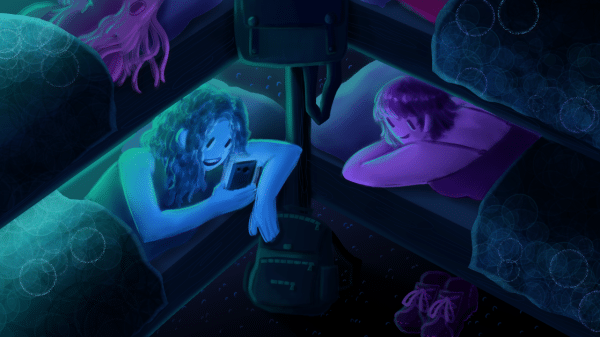
TikTok can be a time-and-soul-sucking app where you doom scroll for hours when you don’t want to do anything. It’s cheap dopamine at its finest; like eating an entire bag of chips in one sitting and becoming sluggish the rest of the day.
Feeding your brain with a quick hit of dopamine is a recipe for disaster—especially when you already have a chemical imbalance. But with the right tools, you can get your life back on track. You can start all the hobbies you’ve wanted to, read all the books on your shelf that are racking up dust, and have a nice time away from your phone.
A personal curriculum may be the key for you.
But first. . .
What is a personal curriculum?
The basic premise of a personal curriculum—started by Elizabeth Jean (@xparmesanprincessx on TikTok)—is to have fun learning new things that interest you. There’s no rulebook to start your own, though if you want a step-by-step guide, there are plenty of TikToks you can find.
There’s also no set number of “classes” you need to take. Your curriculum can be as small or as big as you want. Though I advise you to take less than your brain says, because this road can quickly lead to burnout.
And as for the type of “classes,” you get to choose! Watched a video about knitting and now you’re 5 feet deep in yarn that you bought at Michaels? Add it to your curriculum. Have a dozen unread books in your room? Add them to your curriculum. Hyperfixated on a TV show, and now you want to make a slideshow about how much you love it? Add it to your curriculum!
How to actually start and keep it going
As ADHDers, we can get intimidated and often freeze when starting a big project. Breaking down your curriculum into manageable assignments will get some of that stress off. Breaking down those assignments will make it easier.

Your environment is also a huge factor in your journey of starting. If your surroundings are chaos, your mindset will reflect that. So before starting any part of your personal assignments, put on some calming music and tidy your workspace. Put some cozy lighting on, make a to-do list, and remind yourself why you decided to start a personal curriculum.
Keeping the ball rolling is also a huge roadblock in any journey we start. Whether it’s keeping yourself engaged in a study session or in the long run, there are ways to keep your motivation. The key is novelty, fixation, accountability, and structure.
Novelty
Our attention is always veering towards the new, shiny thing—so why not work within that system?
Make each assignment and module completely different from the one before. Use different methods; maybe you’ve already watched and taken notes on a YouTube video related to the parts of the brain, and now you want to learn about neurotransmitters. To keep the ball rolling, you can choose another method of study, like reading a magazine and writing a song about it.
Another method to keep novelty is switching “classes” every month. Maybe October is the month of learning about poetry writing, and November is the month of learning art history. You can use this to your advantage by avoiding burnout and making assignments to combine what you learned in those classes.
For example, you can write a poem relating to one of Frida Kahlo’s portraits. Or maybe the other way around: painting your own self-portrait and writing a poem about it.
Fixation
Have you ever wondered why it’s so painfully boring to write a 2-page essay on a poem you don’t care about, but thrilling to dive into a 10-page essay on the symbolism in your favorite book series? It’s because ADHD brains have interest-based nervous systems. If we’re interested in something, it’s easier to focus on it because it gives us the dopamine our brains crave.
So what do we do with this information? Include variety in your curriculum. Don’t force yourself to learn things that bore you, even though they could come in useful. Learn about the things you like. And if art history doesn’t suit you right now, have a backup plan for when it eventually falls through.
Rank all your class ideas in terms of how much you crave to learn about them in the moment. And for the individual assignments? Write out a list of things that you’d like to learn, and find your resources at the library, YouTube, free course websites, etc.
Accountability
Having someone nudge you to complete what you’ve set out to do is helpful. This can come in the form of posting on social media so your followers can check up on you, or telling your friends and family the game plan so you can be kept accountable.
And if you want to go the extra mile, body doubling while actively doing the task can be very useful to keep your focus and not get sidetracked. It has both a sense of camaraderie and an external anchor that ties you to the present.
Or if you don’t have any immediate people to body double with, the co-working Twitch community is your way to go! Shoutout to @icedviennalatte and @nachoburrit0, some of my current faves.
Structure
Structure is an ADHDer’s lifesaver and enemy. Our brains need it to thrive, but they also hate the boring repetition. The key is: structure and flexibility.
Structure doesn’t have to mean rigid. Your structured routines don’t have to be at the same time every day; you can build them to happen after a certain activity. Your structured assignment list can be as flexible as you want. You can adjust your deadlines as needed, or, like Elizabeth Jean, delete deadlines from your curriculum altogether to reduce stress.
Making education fun
A personal curriculum doesn’t have to mean choosing the same methods of study that you used in school. You don’t have to buy a billion textbooks, make a class schedule, or grade your assignments. Although you can—To each their own.
The key is to make your personal curriculum more like a hobby than a chore. There are many methods you can use to gamify your self-learning: make it a timed challenge with the Pomodoro method, make a reward system to keep you engaged, or hula-hoop while reading a book.
Do whatever brings you a sense of whimsy and focus. Whether it be cozying up in a comfortable chair with your iced coffee and fairy lights or going to a coffee shop just for the aesthetics, if it works, it works.
The black hole of rigidity
We’ve talked about how to keep engaged and how to keep the ball rolling, but what do we do if we hit a wall? What happens when we inadvertently get to the point of executive dysfunction, burnout, or simply not having the motivation at all? Getting ahead of the game and scheduling rest, low-effort review, and passive-learning days is the key.
But if you have already rested and you hit a wall, listen to your body. You don’t need to push through the discomfort and exhaustion if this is something you’re doing for yourself. Schedules can be edited.
Do low-effort, high-fixation hobbies to replenish your soul. And when you’re ready to get back at it, remember why you started your curriculum in the first place. Maybe you want to switch up the subjects, or stick with the ones you already have. Whatever you choose, remember Elizabeth Jean’s words:
At this point, I know how important reading, learning, and exploring things that interest me are crucial to my wellbeing, so I make sure I stay doing those things for myself, not for other people.
Keeping yourself off social media
This can be a hard one. Especially when social media is designed to keep you in a doomscroll for hours until you don’t have the energy to do anything else.
But it’s not impossible.
Think of it like a game: every focus session you would originally spend scrolling is now a victory. Make it a streak, and every day you spend off of social media, reward yourself. It doesn’t have to be big, just something that has meaning to remind you that this challenge is worth it.
Conclusion: much more than a trend
Personal curriculum isn’t just a “silly TikTok trend.” It’s a way to combat brainrot, exercise our brains, and get the dopamine we need in a healthy manner.
So, if you’re looking for something to fill your cup instead of draining it, start a personal curriculum with me. Let it be a sanctuary, not a chore—a journey into a goldmine of knowledge where every discovery is like a treasure.