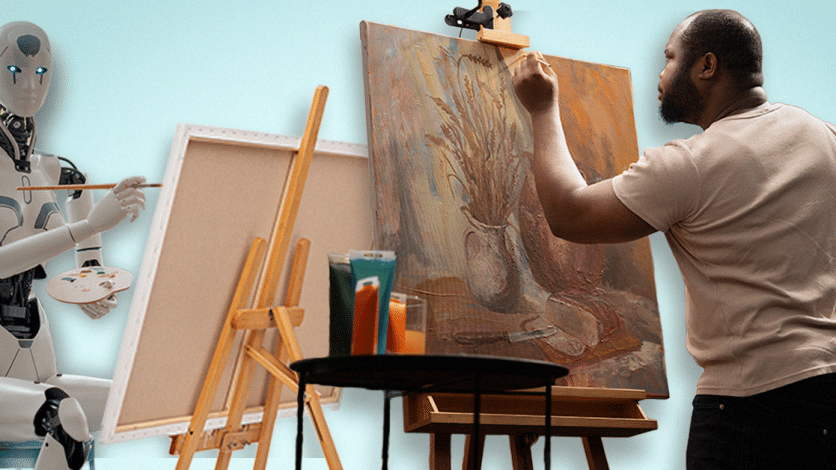
“Creative” AI is here, and like it or not, it can do almost anything you can do. There is a new player in the game, and they don’t mind stealing to produce their ‘art’.
AI-generated material can present several risks. Large language models often use data taken from writers, artists, and researchers without permission, effectively reproducing their work without credit or payment. This practice raises serious concerns about copyright, originality, and fairness in creative industries, while also spreading potentially inaccurate or misleading information…Blah Blah Blah
The above text is boring as hell right? I know I’d hate to read it. It’s obviously inhuman, detached, and uninteresting.
Unfortunately, that paragraph was generated with a simple string of prompts, and a couple of clicks doesn’t truly capture the harrowing and even morally ambiguous implications of the products of LLMs in creative writing, journalism, and artistic expression.
Let’s jump into the wild west of the AI landscape and explore the risks of AI, who’s affected by it, and why you should look at ChatGPT with apprehension, not blind enthusiasm.
So What is AI Anyway?
According to Cloudflare, LLMs (Large Language Models) are simply defined as systems that are capable of processing and generating code. They can rationalize unfamiliar prompts that would stymie traditional algorithms.
LLMs are unique in their ability to understand and regurgitate cohesive, mutable, and comprehensive language. They can respond dynamically and change their personalities, responses, and tone based on the desire of the person prompting them.
For example, imagine you wanted to know the best brand of potato chip to purchase based on a subjective detail you feed the AI (Maybe popularity). An LLM would be able to generate an answer and, more impressively, defend its position.

The power to generate large strings of text, images, and other “new” material (We’ll get there) is what separates LLMs and AIs from other tools.
These tools, while relatively new, are very potent and comprehensive in their wide array of applications and utilities. That makes them great for chatbots, programmers, and anyone just looking for a cool little gadget to talk to. But where do AIs get their material.
Stolen Materials
We all know AI can do good, but in the case of image and text generation, AIs are only capable of working off previous materials that were fed to them. So, how would one get material to further glut the technological bellies of their beasts?
Paying, crediting, and supporting the artists whose work appears within their models? Allowing the names of those whom they emulate to be shared and applauded? Absolutely not. Let’s take a look at the case of Kelly McKernan to whet our appetite to hate AIs and their creators, shall we?
According to The New Yorker, in 2022 Kelly McKernan began to notice that their name was coming up quite frequently in AI Discord servers that generated “copyright-free” work.
Looking at some of the artwork that the AIs had “made” they were quoted “It just got weird at that point. It was starting to look pretty accurate, a little infringe-y,”. They noted that the works shared many of the hallmark characteristics of their unique art style! Just disgusting, and a symptom of AIs hoarding the works of artists, and emulating them without credit or acknowledgement.
Why Do People Use AI Art?
So why use an AI model if supporting artists is moral, just, and reasonable? Well, ease of access and cost are two large concerns. It is far, far more economical to use a free or relatively cheap image generator than to commission an artist to design something for you.
AI art is also available upon demand, with an extraordinary turnaround. In my personal experience, an AI image can be generated using ChatGPT in less than five minutes, with revisions taking far less time.
AI art isn’t the issue; the issue is people stealing art and justifying the practice as “ok” because AI is a new technology. As more legislation prohibiting the perversion of copyright laws in the interest of supplementing big AI companies, I hope that artists will once again feel safe to share their work online without the risk of it being fed to an AI.
The Fallout
Later, McKernan would join in the filing of a class action lawsuit against Stable Diffusion, Midjourney, and Dreamup; three platforms that worked off of Laion-5B a non-profit, public dataset containing the work of millions of artists.
Their attorney stated that the wrongdoing of the AI designers could be defined in three C’s. The artists did not consent to have their work stolen, they were not compensated after it was stolen, and they didn’t even receive credit once the deed was done.
McKernan’s story is just one of tens of thousands in the vast digital Wild West we currently reside in, with AI legislation being sparse regarding copyright or simply not existing at all. But it pisses me off.
And you should be just as angry as me. The framers of AIs don’t simply possess the inherent right to steal original content and use it to feed their thinly veiled plagiarism machine because they’re creating “revolutionary” technology.
According to The Art Newspaper, McKernan and others successfully received a decision in their favor, tilting the scales to favor artists.
I’m Not an Artist, Why Should I Care?
Many of you reading will point out the obvious fact that not everyone is in the creative field, nor does everyone care about the plights of creatives (sadly). This is certainly true; however, I’d wager that you’ve used Facebook in the last twenty-four hours. Instagram? TikTok?
In fact, Stephanie Rand of Attest states that 81% of Gen Z use social media daily, with 50% using it for more than three hours (that surprised me a little). So what are we viewing on social media? Our relatives sharing a little more than they should? Cat videos? Meme compilations?
Well, Shannon Bond of NPR has noticed a different type of content lately. AI-generated engagement bots. These bots spew images that fill the already-murky waters of social media and dilute the amount of human content on the platform.
You know the type of image. Weird, uncanny, even inhuman.
Images like this obviously have no real thought behind them, nor any reason to exist at all. And yet, they pollute Facebook, Instagram, Twitter, and just about any corner of the Internet you can find.
The Broader Implications
Ok, so maybe AI images are weird and gross, but perhaps they’re not directly damaging to people who view them. So what’s dangerous about AI images and content?
Misinformation and bad actors are manipulating AI to create fake images and headlines. Esther Shittu of TechTarget recently shared an instance of a fake image of a downed B-2 bomber in Iranian territory, with the users who viewed the image making facetious remarks about the implications of an event, and assuming the image was legitimate.
This is just one of many, many occurrences that happen every day.
Information is the most valuable commodity in the world, and AI pollutes true (or at least human) information with excessive slop that is dolled out without concern for those who consume it, or the implications of the content.
Due to AI misinformation, it’s always important to critically think about any piece of media you consume.
Ask yourself: Does this make sense? Is this from a trusted source? Do I believe this is plausible? Always ensure that what you’re taking as accurate actually is, before falling victim to the AI slop machine. Don’t take everything you see as truth without corroboration. Don’t share AI images, don’t gossip until you know it’s true, and please, please don’t spread misinformation on the Internet.
What Can I Do?
Now I know precisely what you may be thinking. “I’m not an artist or an AI designer, and I don’t own Facebook, or some other multi-billion dollar company. This doesn’t affect me, and I can’t do anything to help.” That’s just wrong. There’s always something you can do to help.
Here’s a petition that aims to stop AIs from stealing work. And here’s a petition to require social media platforms to label AI-generated content to prevent misinformation.
Will these work? Well, not directly. People in Washington don’t quite understand how AI works yet, and they hate changing things (especially for the better sometimes), but petitions like this help support lobbyists aiming to pass legislation requiring copyright law to actually be considered in AI (crazy right?).
No matter if you’re a creative, a consumer, or something in between, we can all agree on one thing. We don’t want AI to push real artists out of the spotlight, and we want new, original, and interesting media to be the center of attention, not something an AI spits out in thirty seconds by stealing from millions of artists worldwide.
Be good, be vigilant, and try to avoid AIs pretending to create original content. And don’t let them lie to you. Be better than that. Cross-check anything that seems out of place, and anything that seems perfectly fine. Stay informed. That’s all you can hope to do.