

You’re scrolling through Spotify looking for something new to put on, and you see it: a playlist titled “march,” or “drive home,” or just a string of emojis you can no longer decode. You press play out of curiosity more than anything else, and within four seconds—before the first verse has even started—you are somewhere else entirely. You’re nineteen again, driving down a highway you don’t drive anymore, next to someone you don’t talk to anymore, feeling a version of yourself that you haven’t felt in years. The song hasn’t changed, but you have.
This is not a coincidence, nor is it just nostalgia playing tricks on you. I believe it’s something closer to evidence. That playlist was never really about the music—well, not entirely, anyway. It was a record. A way to pin a feeling to a timestamp so you can find your way back to it later. In the same way, a photograph holds a face, or a journal entry holds an embarrassing thought you couldn’t say out loud.
For a long time, the diary was the default tool for this kind of self-preservation: a notebook where you wrote down what happened and how it felt, dated and private and slightly illegible. But many people, especially the generations who grew up with a music app permanently open in the background of their lives, have swapped the notebook for something else.
They’re not writing down their lives; they’re scoring them. And the result is something we don’t really have a great word for yet, but it functions, almost, like a diary. The personal playlist is not built for a party or a workout, but for a feeling, a person, a stretch of time that mattered and that we didn’t want to lose.
Curating a feeling instead of writing it down
If you ask someone who journals why they journal, you usually get some version of the same answer: it helps them think, or remember, or process something difficult. Ask someone who makes monthly or emotion-based playlists why they do it, and the answers are probably quite similar, at least on the surface. But the mechanics underneath are different in a way worth pulling apart.
Madison Lyman, 20, says, “Each song on [her] playlist is telling [a story], whether it be about summertime or heartbreak.” Different themes and sounds compose each “story.” A playlist on love does not exist without the tempos of sorrow, and a playlist on joy can’t exist without the frequency of anger. “So from that I guess you’d learn that I love mixing different things together and making something beautiful.”
NiKayla Tinker, 20, builds playlists around specific emotional states rather than time periods. “If you listened start to finish, you would learn that I admire emotional depth and authenticity.” When I asked which song she would keep forever, she answered with “Wanna Be Loved” by Jill Scott. “It captures the desire to be fully seen, understood, and appreciated while staying true to yourself.”
What both of these approaches share is something journaling researchers have long pointed to as one of the core benefits of expressive writing: the act of externalizing an internal state, of giving it some shape outside your own head, which makes it easier to hold and easier to eventually set down. A playlist does this without requiring the user to find words for something they can’t describe yet. It is much easier to point to a song and say, “That one. That’s what it felt like,” and have it be true.

What a track list says about a person
Once you start asking people about their playlists, you realize most of them have thought about this far more carefully than you’d expect—not just which songs go in, but the title, the cover art, the order, all of it carrying meaning that’s invisible to anyone scrolling past it.
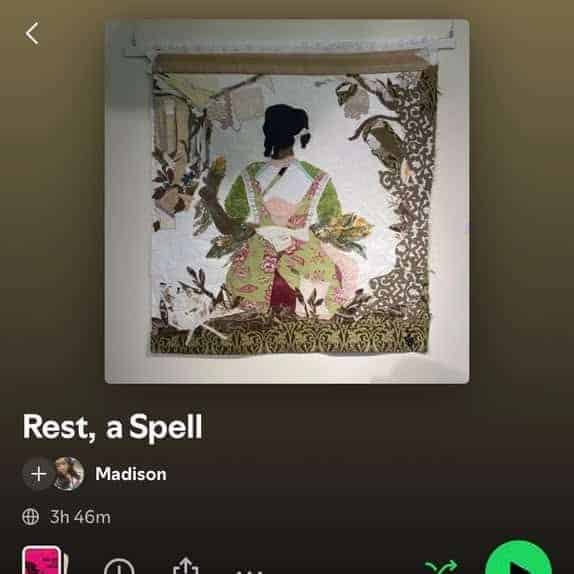
Lyman’s “Rest, a Spell” playlist
A playlist that is especially meaningful to me is called “Rest, a Spell.” I made it for Darlene Taylor, a professor at Howard University and a mentor of mine, for her exhibition Rest, a Spell. It was a solo exhibition of her HEIRLOOMS collage silhouettes at the Pepco Art Gallery.
[Taylor] knew immediately she wanted Nina Simone’s “Four Women,” “Misty” by Ella Fitzgerald, and “A Change Is Gonna Come” by Sam Cooke…With her requests and suggestions, and, most importantly, the soulful essence of her work, I created the jazzy, soulful, smooth playlist, hoping to embody the “rest” she portrayed in the exhibition and the feeling of archived history shown through the passed-down materials she uses in her collage. I wanted the playlist to capture her art.
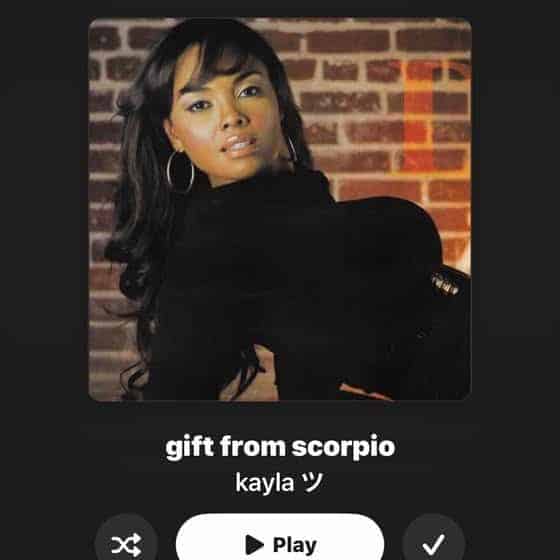
Tinker channels the divine feminine
I created [“gift from scorpio”] as a reflection of the divine femininity that I aspire to embody and am actively creating as I navigate my twenties. This playlist represents softness, vulnerability, confidence, self-respect, and love. As someone who values personal growth and self-discovery, I wanted to create an anthology of songs that reflects the kind of woman I am becoming and the energy I want to carry through life. Rather than representing a specific moment, the playlist represents an aspiration.
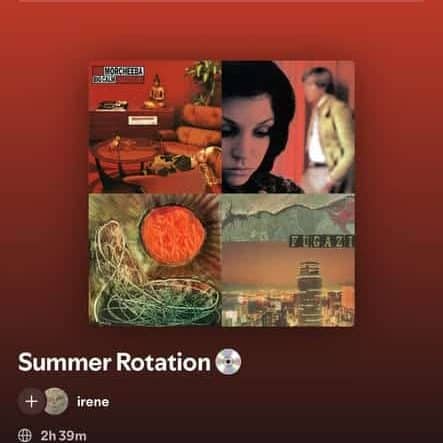
Lasky’s summer mix
I created my most recent playlist, called “Summer Rotation,” to help get me through the transition from college to life after graduation. These tracks sum up the thrill, confusion, and uncertainty of getting older. There are a variety of genres in this playlist, which could tell you that I’m eclectic. I listen to a bunch of different genres daily. Sometimes I’m feeling rock or punk, sometimes jazz, other times folk, etc.
“‘I Have A Woman Inside My Soul” by Cornelia Murr represents the feeling of being disconnected from your body and trying to find your true self. This song especially resonates with me currently as I feel lost trying to navigate a new chapter in my life. “Shooting Star” by Richard In Your Mind has reminded me that no matter where I am, I’ll be okay.
…
Taken together, these playlists function almost like a fingerprint. The genres they chose, the way they title things, whether they use a photo or a color or an exhibition image as cover art—none of it is musical taste in the traditional sense. It’s an autobiography, compressed into a format that fits in your pocket and updates in real time.
Songs get fused to the moments they were played in
There’s a real, well-documented reason songs stick to specific periods of life with this much precision, and it has to do with how memory actually works, not just how it feels.
Psychologists call this the reminiscence bump: the well-established finding that people tend to form unusually vivid and durable memories during adolescence and early adulthood, roughly ages 10–30, compared to other periods of life. This is also, not coincidentally, the exact window in which most people are doing the most new things for the first time: first heartbreak, first apartment, first real friendship that falls apart. New experiences create stronger memories than familiar, repeated ones, because the brain encodes novelty more deeply than routine. The brain associates music absorbed during this window and those memories with unusual strength, which is why a song you haven’t heard in a decade can still drop you back into a specific place, a specific version of yourself, almost instantly.
This is what makes a playlist function as a genuine time capsule rather than just a mood board. A time capsule, in the literal sense, is something a person seals up and buries, hoping that whoever opens it later—usually their own future self—will travel back to a specific moment through the objects inside. A monthly or emotion-based playlist does the same thing, except the “objects” are songs and the “burial” is just hitting save and not listening to it again for a year or two. You’re not making it for right now. You’re making it as a message to a future version of yourself who might need reminding of who you used to be. Or proof that you survived a particular stretch of time. Or just permission to feel something you don’t have a name for yet.
The format changes, but the instinct doesn’t
None of this is really new when you step back from it. People have always tried to pin moments down before they slip away—through photographs, through letters, through diaries with little brass locks that never actually locked anything.
But we’ve changed the material. A generation that grew up with a streaming app instead of a notebook has built its own version of the same old impulse, using the tools it has at hand. You choose songs that feel true and trust that you’ll still understand the feeling later, even after the moment is long gone.
We have an innate desire to keep a version of ourselves from disappearing completely. Whether it’s ink on a page or twelve songs queued up in order, the impulse is the same: I was here, I felt this, and I don’t want to forget it. The format may keep changing, but the reason never does.
So, dear reader, keep listening.