


The intellectual way we’re thinking right now, our modern paradigm, has created a fear of A.I. But we’re missing something.
This semester, I taught my first class to 12 other undergrads about a book called Zen and the Art of Motorcycle Maintenance (ZAMM). It was very challenging.
The most difficult part was how consistently my students misunderstood what I was trying to teach them—especially because I knew them to be smart and capable people. I agonized over it for 10 weeks.
Finally, I’ve figured it out. The problem lies in a difference of paradigms.
What is a paradigm?
Without getting into specifics, ZAMM is unique for its philosophical focus on the non-intellectual. It talks about the things we just know, simply by virtue of being human.
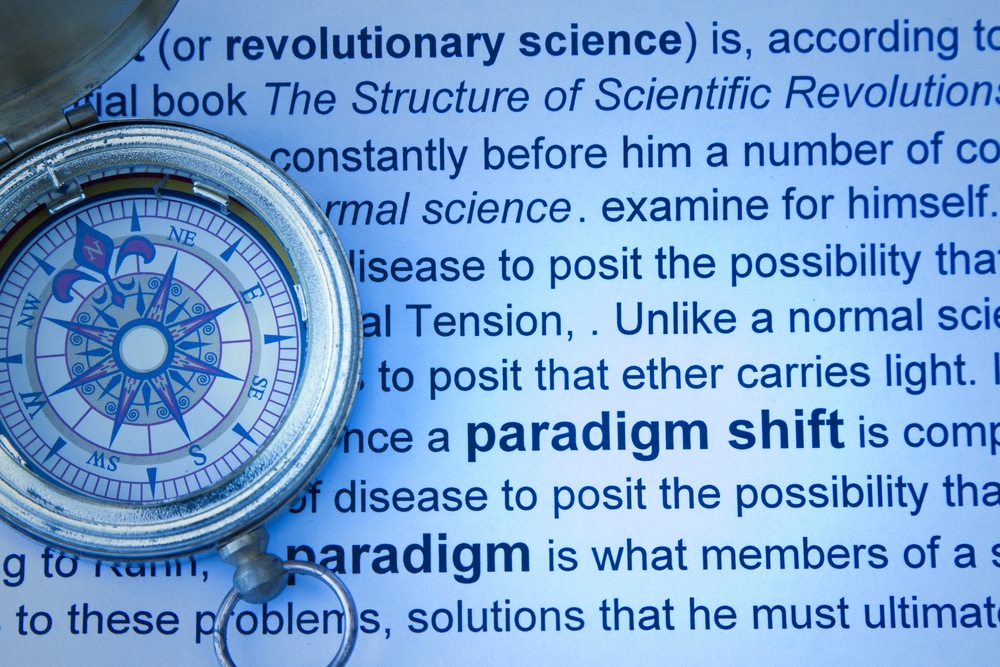
Our current intellectual way of thinking—found most powerfully in universities—has no way to appreciate the non-intellectual. That’s why ZAMM’s non-intellectualness was so difficult for my students.
The philosopher of science Thomas Kuhn argued that two models of thought which are different on an essential level are different paradigms. Separate paradigms are incommensurable. They can’t be understood on the same basis.
No single paradigm is completely wrong nor completely right; they just have different priorities for different circumstances. Usually, when our circumstances and priorities change, our paradigms change to address them.

The concept of a paradigm can explain what happened in my DeCal: the non-intellectual focus of ZAMM was incomprehensible to my students because they were operating within the contemporary intellectual paradigm.
But that leads to other, more significant conclusions.
Our current paradigm is well suited for our circumstances. But thanks to A.I., those circumstances are changing. And, simply put, our paradigm is unprepared. We need a better appreciation for the non-intellectual.
Non-intellectual knowledge
Non-intellectual knowledge isn’t emotion or intuition. It’s more than that. It’s a legitimate and practicable kind of knowledge.
But it’s also, by its nature, hard to grasp intellectually. It can’t truly be defined. However, an intellectual structure can be made which will only make sense it’s filled with your non-intellectual experience as a human.

In 1964, there was a Supreme Court case called Jacobellis v. Ohio.
Jacobellis, an owner of a movie theater, had been convicted for playing an erotic film that violated an Ohio State obscenity law. He felt that the law infringed on his right to free speech. So he sued the state of Ohio and ended up in the Supreme Court.
The court determined that the film wasn’t pornographic and reversed the conviction. About the decision, the iconic Justice Stewart said:
I shall not today attempt further to define the kinds of material I understand to be embraced within that shorthand description [‘porn’], and perhaps I could never succeed in intelligibly doing so. But I know it when I see it, and the motion picture involved in this case is not that.
– Justice Potter Stewart, 1964 (emphasis added)
‘I know it when I see it’ is exactly what I mean by non-intellectual knowledge. None of us can define it, but we know the difference between erotic art and porn.
The phrase ‘there’s an art to it’ also encapsulates non-intellectual knowledge. There’s an ‘art’ to everything, a uniquely non-intellectual art.
Think about something you’re good at. Anything. (Seriously, come up with something right now). Now ask yourself: am I good at this because of the intellectual skills I’ve built? Or is there more? If I had to, could I completely explain why I’m good at this? If I had the time, could I write a guidebook that could completely transfer my skills to whoever read it? The answer is probably no.
When I asked my friend to explain why he was good at writing, he couldn’t. He’s practiced a lot and built certain intellectual skills: he knows proper grammar, how to spell, how to use commas, etc. But he’s built more than that. He’s gotten good at ‘the art of it.’ He’s grown his non-intellectual writing skills, his sense of what words go where and when; that’s what makes him a good writer.
‘The art of it’ is another way to see the non-intellectual. Meditation is yet another.
Why do we meditate? There’s no good intellectual answer. Sure, it can feel good. And maybe it can relieve some stress. But sleep feels good, relieves stress, and is much easier than meditation, so why do we meditate?
Well, the goal of meditation is generally to stop thinking. In other words, to stop being intellectual. It’s not an easy task. But if you were able to pause your thoughts with meditation, you wouldn’t stop existing. Nor would you stop knowing things. Instead, you would know and exist non-intellectually.
I’m not saying we should search for nirvana. Rather, we should intellectually recognize that we are more than our intellectualness. We have a whole hidden lake of non-intellectual knowledge which lies under everything we do.
And unfortunately, our current paradigm completely ignores it.
That’s why, when we run into these non-intellectual things, we tend to convince ourselves that since we can’t explain or define them, we don’t actually know them. But we do. There is a way to know which is unexplainable.
And we rely on this unexplainable knowledge much more than admit. When you see a flower, you don’t summon up an intellectual definition like the coloured part of a plant from which the seed or fruit develops. You rely on your non-intellectual knowledge of flowers, your ‘knowing it when you see it.’

Simply by being human and having a relationship with the world, we know the reality which our words attempt to describe. We can’t really explain it. But we don’t have to explain it to know it.
The problem: artificial intelligence
I’ve heard a lot about A.I. recently. I’m sure we all have. My professors are in a bit of a panic about it; it seems like the whole world is.
We’re scared that A.I. will replace us. That it will write our articles and novels, do our students’ assignments, and totally take over our human thinking until we become like the people in Wall-E: fat, impotent, and controlled by technology.

Of course, A.I. is smart. It’s the perfection of intellectual thinking: it can generate detailed intellectual structures much faster than we can.
We’re all so afraid of the threat of A.I. because our modern intellectual paradigm is incapable of seeing A.I. as anything other than a threat. What separates us humans from A.I. is the non-intellectual—the very same non-intellectual which our paradigm disregards.
(I don’t have time to delve into this here, but transhumanism, a philosophy which includes the idea that humans and artificial intelligence will eventually merge into one, is an extreme example of our paradigm’s denial of the non-intellectual. Check out this video, too.)
We are capable of rationality and language just like LLMs. But unlike A.I., our thinking has deep roots in non-intellectual knowledge. When ChatGPT writes about ‘flowers,’ it isn’t writing about the experience of a flower. It’s writing about other words it’s learned which define flower: petal, stem, pollen, etc. That’s a very hollow kind of knowledge.
As the authors of a recent study published in the National Library of Medicine put it: “[LLMs’] limitation in capturing human-like sensorimotor conceptual understanding […] underscores the importance of grounding for human conceptual knowledge.”
In other words, conceptual or intellectual knowledge requires an embodied, non-intellectual grounding. There’s a growing body of research about this.

A.I. is absolutely going to change things. People will lose their jobs. And I haven’t even mentioned the awful environmental effects.
But A.I. won’t replace human thinking because the non-intellectual knowledge which makes intellectual knowledge meaningful at all is uniquely human. To put it simply: A.I. can’t be non-intellectual.
What we should do
We need to shift our paradigm. We need a paradigm which admits the massive importance of non-intellectual knowledge. A paradigm which does that will be capable of reacting to the A.I. revolution.
We also need this new paradigm to learn what to do with our non-intellectualness. How to use it better. How to use it more.
I recognize, of course, that paradigms don’t shift because someone says they should. Even if I were stupendously famous, nothing I could say would actually cause a paradigm-shift.
It’s more likely that as time goes on, and as A.I. becomes more diffuse in society, it will gradually become clear that it does have limits. That we haven’t been replaced; that being human is more than thinking intellectually. And so our paradigm will naturally shift to better appreciate the non-intellectual.
But of course, that may take years. I guess we’ll have to see.












Betty Pagett
May 3, 2026 at 2:21 am
Would love to talk more. I have two master’s degrees yet have always felt my self at odds with those who want to function only in an intellectual mode.Oma