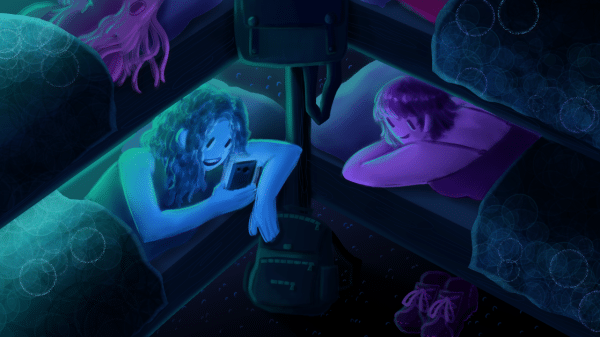
What’s up? I’m your friendly neighborhood Enna, here to tell you that being friendly and socializing is actually really hard. Life is messy, relationships are complicated, and no human is perfect… but that doesn’t mean we can all become hermits.
My entire life, I’ve heard “you need to put yourself out there”—socialize, make friends, make connections, grow our relationships. If you’re anything like me, you’ve heard this your whole life. We heard things like “people are relational,” “we need each other to survive,” “human connection is important,” and “eat your vegetables.” The people who tell us these things seem to make it so simple. After all, you just need to talk to people. How hard can it be? (Wait a minute, did I say something about vegetables?)
I hate to say this, but socialization is really hard. I wish it weren’t. It would be great if we came out of the womb with the natural ability to fit in and have friends already pre-chosen for us. Honestly, I wish it weren’t a constant struggle to keep healthy relationships, socialize, and make friends, and I really wish that I knew what drove some of my closest friends away.
Throughout my life, I’ve moved around a lot — several different schools during middle school, several different states over the years — and I landed at a college sixteen hours from home without knowing anyone. Many of you have had similar life experiences, and even if you haven’t, you have still lost friends along the way.
Sometimes it is very hard to keep going because all we see is the negative. But there is a reason we continue — actually, there are many reasons. I hope you allow me to give you a bit of hope, the realization that socializing is important, and perhaps some motivation to try just one more time.
So why can’t I just stay in my room?
This is a question I often ask myself. I’m a college student, and often it feels easier to hole up in my room with some snacks and the ridiculous amount of homework I have to do. Being an overachiever only further calls me to hide, because it feels important for me to spend so much time on my schoolwork.
I almost feel as if the self-help books I’ve read ruined me. All the advice I’ve received about how to succeed in college usually revolves around “start studying for tests two weeks in advance,” “leave nothing to the last minute,” and “get 8–9 hours of sleep every night.” I’m someone who likes following advice. If there were a five-step, ten-step, or even fifteen-step formula for the perfect life, I would follow it to the letter, determined to achieve.
I’ve heard over and over again it is important not to waste my schooling — to spend time studying and doing homework, to never stop, and always be working ahead. The people around me assumed that my natural instinct would be to socialize, so they didn’t mention it. But for some of us, schoolwork becomes an excuse to hide — to hide from people, to hide from the relationships we really need. And sometimes the habits of hard work and constant studying that we build end up burning us out more than doing important socializing would.

We are made to be in relationships
Staying in my room didn’t work out so well for me. After several months of spending almost all my time doing homework, being in class, or working out, I was completely drained — and I wasn’t even entirely alone during those months. I had two good relationships: my boyfriend and my roommate. They were the ones who held me through those months of mental isolation, but I had built strict walls that stopped them from getting close. It took hard-hitting depression and burnout to finally make me realize that something was wrong.
Many of us try to avoid relationships, though, because they are so hard and often cause a lot of problems. We think: Why bother? It’ll just end in me getting hurt.
What makes relationships so hard? Is it because I’m doing something wrong? Is it because everyone is naturally predisposed to hate one another? Or are we all just so desperate for the perfect person — the perfect friend — that we become disappointed when we realize there is no such thing as a perfect person on Earth ?
As a Christian, I hold the belief that Christ is the only perfect friend; He is the only one who will never let us down. But even Christians need other people. Humans are deeply relational creatures. Our very biology demands it; we need each other to procreate and survive. We’re not like starfish — we can’t just split ourselves apart and create multiple people. (That would be really cool, but also really creepy. I mean, just imagine if— and I’m getting distracted. You didn’t come to read this article to hear all the crazy ideas about clones I could come up with — and trust me, it’s a lot. Anyway, back to what we’re actually talking about here.)
Our relationships with others shape our lives
The people we spend time with affect the rest of our lives. I’m not just talking about romantic relationships. Our society places far too much focus on romance and not enough on friendships or family relationships. When I first watched Frozen, it blew my mind in the best way possible. Finally, as a second grader (wow, I feel old now), I saw a movie that wasn’t centered on finding the perfect romantic partner. It was about two sisters who loved each other and were willing to sacrifice everything for one another.
Friendship makes life happier and healthier, whether romance is involved or not. I once heard an older woman speak about how full her life was, even though she had never married or had children. She didn’t have a romantic partner, but she had deep friendships that she considered a blessing. Romantic relationships are wonderful, but that is one person compared to the many meaningful friendships we may form over a lifetime. People with close, trusted friends are far more content than those without them.
Relationships also teach us. Our parents shape us constantly, often without words. When my mom was stressed, she would clean. As I grew older, I realized she felt better when things were organized — so when she was stressed, I cleaned too. Now, even in college, I try to keep things orderly (to some level), and it benefits me. Friends shape us in similar ways. Having good friends improves your quality of life — it makes you happier, less stressed, helps you change unhealthy habits, and improves the way you see yourself.
Everyone is different… one size does not fit all
People often label themselves as “extroverts” or “introverts.” Recently, those labels have expanded to include “social introverts,” “quiet extroverts,” and “ambiverts.” These labels aren’t necessarily bad. But we all have introverted and extroverted, social and nonsocial parts — and that’s important to remember.
Sometimes we force ourselves to fit a label. If we’re told we’re extroverts, we try to maintain constant energy — always introducing ourselves, always trying to be everyone’s best friend. It drains us. We burn out. Eventually, we grow bitter because we’ve turned friendship into work and feel frustrated when there isn’t the payoff we expected.
When I was younger, people said I made friends easily. My grandma would say I would thrive in college because I loved meeting new people. She assumed that meant I would always naturally put myself out there. While that was partly true, it didn’t take long before I was hurt, and friendships became complicated. We shouldn’t assume connection comes easily to anyone; those who seem confident often carry quiet pain.
If we’re labeled introverts, we sometimes retreat. We hide in corners, convinced people will drain us. We stay in our rooms and say we just don’t enjoy socializing, when really we’re afraid. That’s not always the case — I do love my alone time. But I’ve also let fear push me into isolation.
If a label fits you, that’s fine. Just don’t let it define you. You are far more complex than a single word.
So what am I supposed to do?
“PUT YOURSELF OUT THERE! GET MOVING! DO IT NOW!”
This is usually how articles like this end. They give a nice call to action. The information has been delivered, so it should be simple to stand up, leave our rooms, and go out into the amazing, bright world to socialize with all the other people who just read the same article and can’t wait to meet us. There is some truth to this, and many articles give helpful advice. I recommend reading them — they’re great for socialization tips. But I also understand that it isn’t that easy.
To be honest, it frustrates me when people send me out to socialize, especially when they tell me to talk to specific people. Mainly because I feel fake while doing it. I’ve just been given reasons to be a friend, and suddenly it feels like I’m doing it for selfish gain.
But don’t let those feelings stop you. The first step to changing your feelings is taking action.
Of course, you’re still wondering how to do that. And I wish I could give you the easy five steps I’ve been looking for my entire life, but I can’t. However, I can tell you what I’ve learned.
1. People are just as scared of you as you are of them
This may sound unsettling, but you are not the only one who struggles with this. Many people fear rejection, which means you’re on a mostly equal playing field. They want friends, too, and most people are open to genuine connection.
2. Most people love talking about themselves
Honestly, we all have a few narcissistic tendencies. You know you do. But this can work in your favor. Ask people about themselves and really listen. I’ve learned a lot through others, and everyone appreciates a listening ear.
3. Practice makes permanent
You’ve probably heard the phrase “practice makes perfect.” I think that’s a lie — but that’s a whole different article. What I do believe is that practice makes permanent. The things we practice become what we naturally default to. Socializing is hard at first, especially if you’ve been hurt, and in a way, we all have been hurt. But with time, it becomes a little more natural. The more we do hard things, the more we grow.
4. It is better to lose relationships than not have any
When I first heard the quote “It is better to have loved and lost than to have never loved at all,” by Alfred Tennyson, I thought it was the stupidest thing I had ever heard. Avoiding pain seemed like the obvious choice. But that’s not how life works. After losing a relationship, we sometimes wish we had never met the person. Still, those experiences teach us in ways nothing else can — and we are better for them.
You’re not alone
Let me leave you with this: you are not alone. If you struggle to convince yourself to socialize, if every conversation makes you overthink your choices, or if sometimes you wish you could just stay in your room forever, I want you to know I feel the same way much of the time. I was once an extrovert, and socializing came easily, but now it can feel like a struggle.
Still, it’s a struggle I keep fighting, because life is a battle, and we need people by our side. You can also be honest with others. I once feared I would lose friends if I told the truth about my anxiety around socializing. And I did lose some—but the ones who stayed were incredible. It revealed who truly cared.
You don’t need to become a social butterfly overnight. Every butterfly begins as a caterpillar. Sometimes the first step is simply starting a conversation with a classmate, coworker, or family member. Even one conversation can make your day better.