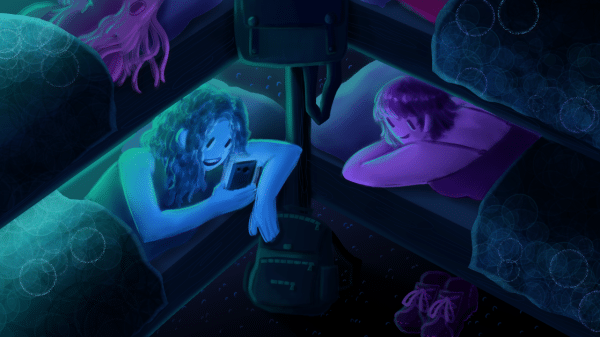


Starting out in college, I was always excited to have a roommate. So many different movies and television shows depicted the college years filled with adventures with your roommate. You were bound to become lifelong friends! This all proved to be a cold, calculated, almost Disney-level of fantastical imagination.
My undergraduate years were fine. I commuted to school and lived at home my freshman year. I had a childhood friend as a roommate my sophomore year, and eventually moved into my sorority house for my junior and senior years. These living situations were bearable, and I found joy in many moments.
I always loved coming home to someone I could talk with for hours. Some of my fondest memories are of sitting around a kitchen table in my sorority house with my sisters and discussing our weekend mishaps. We shared clothes and had dance parties. There was always laughter and someone in each room ready to offer some advice or a shoulder to cry on.
None of that could have prepared me for my grad school years.
A rude awakening
Upon coming to grad school, I was super excited to be in a new city and make new friends. My summer semester was terrific, and I got along with my roommate. But she was only subletting and would be gone for the school year. I held my breath and prayed every day that my next roommate wouldn’t be a nightmare, especially since it would be a random pairing.
Boy, was I in for a treat.
My current living situation is nothing I have ever dealt with before. It can only be described as feeling as though I am “parenting” my newest roommate. I am the only one who cleans the apartment, replaces trash bags and doesn’t stain counters and stoves for days on end. Piles of trash aren’t put in a trash can; no, that would be too simple. My roommate enjoys storing trash in paper bags on the ground.
Whenever I’m gone for a few days, I am always greeted with an absolute mess and horrific smells filling the apartment. I get the kind greeting at 4 a.m. of smells of meals cooking, specifically fish or garlic.
I’m also bombarded with rude texts telling me who I can or can’t have over. I’m yelled at for having my friends come over once a month. My roommate becomes hostile if I use the TV she didn’t purchase in the living room. She enjoys taking loud calls or blasting the TV at midnight, as well as leaving food on the counter for days.
It’s a headache of a situation that I can’t get out of. Trust me, I’ve tried.
It’s a universal experience
Unfortunately, it’s common for people to experience difficult roommates. According to Georgetown University Student Health Services, one-third of college students in the United States have reported problems with roommates. These difficulties with roommates and relationships impact academics in 17% of students.
Many issues relating to roommate conflicts have to do with one person not cleaning, constant bickering, and noise levels. These can all be difficult to live with, especially if you’re a student who needs time to rest, study and have your own privacy.

Sometimes conflicts are unavoidable, especially if two people value different things in life. One person could love partying while the other would rather stay in. One person could be very tidy while the other leaves their dishes in the sink for days.
For one Syracuse University junior, they found themselves in a difficult roommate situation with a friend.
It started great, we were always talking and getting along really well. Then as the first semester progressed, it started to go downhill rapidly.
Apartment Fairy
Labeling themselves as the “Apartment Fairy,” they quickly grew frustrated because they were the only one cleaning in the apartment. They said that their friend hasn’t cleaned since the day they moved in together. Although not minding it at first, this student now sees it more as laziness.
Living with a friend might be a challenge
In high school, it’s common to want your first college roommate to be your friend. You already know each other, and this could be one long sleepover. This all sounds like fun – in theory.
Most people advise that living with your friends might actually be a bad idea. People might start to realize that they are very different from their friends, especially when it comes to living situations. This could lead to lots of conflict and create strains in friendships.
People also might be more hesitant to create boundaries when it’s their friend who is their roommate, leading to unhappy living situations and pentup feelings.
This could turn into a toxic environment and easily end good friendships. Sometimes it might be better to keep your friends as just friends – not roommates.
Struggling with mental health
When dealing with a messy or rude roommate, it might be hard to find excitement when coming home. The kitchen will still be a mess, and there’s now a person with an attitude fuming on the couch. This can be damaging to someone’s mental health, as they might feel like they carry the constant weight of taking care of the apartment and catering to someone’s feelings.
Finding different ways to find positivity in the situation is key to maintaining a healthy mind. It might be beneficial to focus on what can be controlled, especially if all other measures have been exhausted.
For the Apartment Fairy, they find that focusing on their own room can help to escape from the tense apartment environment. They said that they focus on cleaning their own room and watching their favorite movies and TV shows.
“It’s hard not to feel like shit because you’re the only one [who] takes care of [the apartment], so it’s basically your fault,” they said. “But I’m getting better at conquering that feeling.”
While it can be burdensome to emerge from your room to a messy apartment, always relying on yourself to keep it clean can become tiring. It’s important to get out of your apartment as much as you can, go to events or hang out with friends to keep you distracted.
Don’t surround yourself with the mess.
The stubborn roommates
What’s worse than a messy roommate? A stubborn, messy roommate! These people lack so much awareness that it’s almost fascinating. These are the types of people who would rather throw a tantrum than admit that they’ve made mistakes or should learn to clean up after themselves.
Another Syracuse University student said that their two roommates never clean up after themselves and constantly leave messes out for days. Even after expressing what they wanted from each other, these roommates don’t see eye to eye.
They talk about me behind my back because I asked them to clean up after themselves. They both threw tantrums when I told them our apartment is gross.
Syracuse University student
When someone is hostile and doesn’t want to change or admit to their toxic behavior, it can feel as though progress can’t be made. Bringing up a simple issue doesn’t feel like a discussion; it feels like an argument.
These types of roommates can be major barriers when it comes to caring confrontation. Any attempt to restore peace is treated like a personal attack.
Nothing is ever easy, I can’t bring up a minor issue without having a major problem.
Syracuse University student
Solutions
When deciding to take matters into your own hands and have a conversation with a difficult roommate, there are some skills that could help in the situation.
Clinical social worker Kristin Platt said that communicating with your roommate in person, rather than over text, is imperative. When delivering feelings or concerns over text, tone can be taken out of context, and people can become defensive.
When sitting down and trying to manage the situation, Platt said to approach it with some standard conflict resolution skills.
Speaking from a place of ‘I’ statements. ‘I really need to get some sleep’ rather than ‘you’ statements, right? [Avoid] blaming statements of ‘you’re so messy’ or ‘you’re so disrespectful.’
Platt
Platt said that when people are approached with blaming statements, their defenses go up, and it becomes hard to reach them in a meaningful way. Expressing concerns from a calm, personal point of view can allow your roommates to see your concerns without feeling personally attacked.
Active listening is another healthy skill that Platt emphasized.
This skill can put people on the right track to communicating their feelings without getting riled up or hostile. Coming from an angle of understanding can allow for open communication and for multiple perspectives to be touched on.
A lot of the time we listen to respond, rather than listen to really hear what the person’s trying to tell us.
Platt
Though I lead my life with patience, it can often become too stressful when there’s constant pushback from my roommate. Every suggestion goes in one ear and out the other. There’s no room for us to have a mature conversation.
Roommates were a challenge, and one that I am grateful to learn from. However, I am ready for my own apartment.
Being my own roommate might be a lot less stressful.