It’s a complicated question with a simple answer. (If you’re in a healthy mental space, you aren’t experiencing an altered mental state, you have the money to go to a professional, and you’ve done your research on what to expect and how to properly care for a tattoo to keep it from getting infected, then there’s no reason you shouldn’t get a tattoo if you want one.) But that goes without saying. Perhaps a better question is, how can you pick out the design of a tattoo you won’t regret? That is a far harder question to answer.
Tattoos in the 21st century
“The etymological origin of the word tattoo is believed to have two major derivations: the first is from the Polynesian word ‘ta’, which means ‘striking something’, and the second is the Tahitian word ‘tatau’, which means ‘to mark something’. The skin is the largest and most visible organ of the human body; thus, tattooing is a good way for individuals to express themselves and their thoughts, feelings and beliefs.”
İlknur Kıvanç Altunay, et al. “Tattoos: Demographics, Motivations, and Regret in Dermatology Patients.” Indian Journal of Dermatology, vol. 67 iss. 6, (2022): 2. | DOI: 10.4103/ijd.ijd_879_22.
When it comes to the Western world, at least, tattoos have never been more accessible. Or socially accepted in common memory than they are now, for that mater. There is practically no stigma attached to the idea of having a tattoo. Among us younger generations, at least. (Not so much among employers, unfortunately, but still.) This means many young people only see tattoos as what they are. As opposed to what being tattooed signified to our Grandparents and Great-Grandparents’ generations. Tattoos no longer signify immorality or criminality in the secular West. Instead, they are viewed as a sort of self-expression.
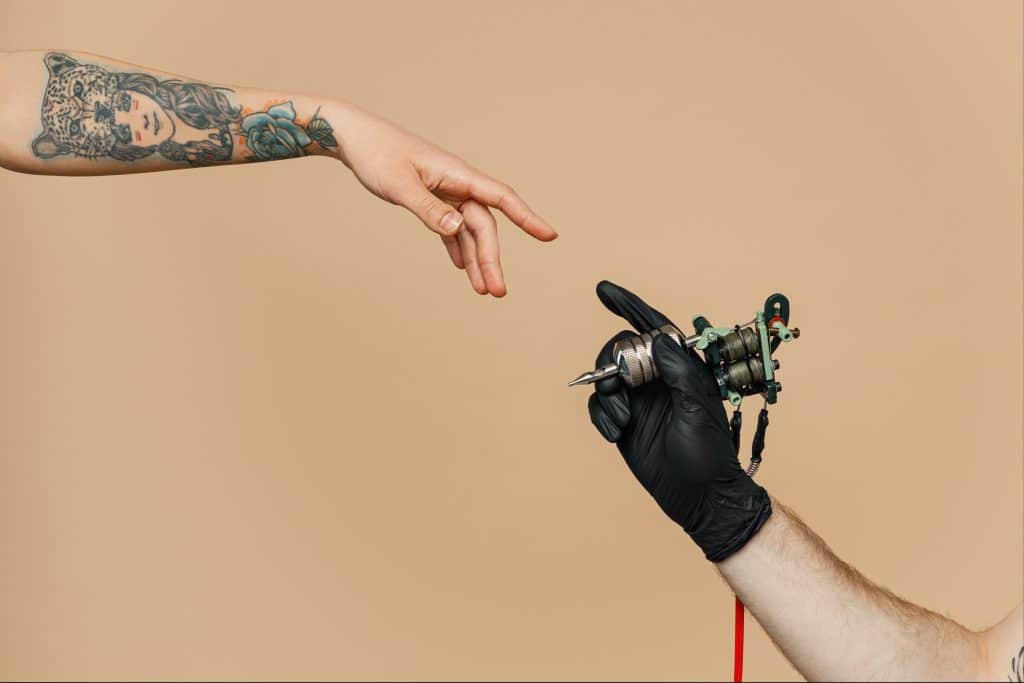
“[T]attooed bodies can be equated with walking books that should be read, analyzed, and interpreted to reveal the intricate narratives contained within.”
Francois Naude & Luzelle Naude, “(Tat)who Am I? Tattoos as an Expression of Narrative Identity.”
Tattoo regret in the 21st century
Pair that shift with the fact that the world currently has the largest human population in history, and it becomes clear that more people than ever before have access to and are getting tattoos. This naturally means, looking at the number, there will be more people than ever before who have tattoos they regret. That’s just how scaling works. However, the claims that there is an increase in the percentage of people getting tattoos who regret them is not without merit.
“Tattoo regret means that a person feels regret and is dissatisfied with at least one of their tattoos after obtaining them. Studies have shown that tattoo regret rates have increased in recent years as tattoos have become more popular and common; tattoo regret is also correlated with acquiring one’s first tattoo at a younger age.”
Altunay, et al. “Tattoos: Demographics,” 2.
The Gen-Z canvas

This is likely in large part owing to that lack of stigma I mentioned. Both in Gen-Z and Gen-Alpha, but also in the generation that raised anyone born in the last 25 years. Before Gen-Z, Millennials were the generation with the highest rate of getting tattooed, after all. This means that Gen-Z and Gen-Alpha have grown up around tattoos in a way no previous generation has. Tattoos, you tweens and teens, are something that makes you ‘cool’ or ‘mature.’ And it hurts like no one’s business.
This means it’s the perfect thing for a teen to dare their friend to do. It’s the perfect thing for a kid to show how tough they are. Or to keep up with the newest fashion trend. Tribal tattoos and birds in flight on the collarbone are great examples of this. To a lot of Gen-Z’ers, (and now Gen-Alphas too), tattoos are like a more permanent version of dying your hair or getting a piercing. Especially when they are still young enough to think they’re invincible, or not care that they’re not. Which means more teens are getting tattoos at younger and younger ages.
The thing about being a teen is that you can think just as well as any adult. But your brain hasn’t developed the resistance to peer pressure that you grow into as an adult. You’re more prone to making impulsive decisions compared to the version of you you’ll be in five or ten years. This marks a fundamental difference in part of the demographic of people getting tattoos. And thus, in part, the motivations for getting tattoos. This is one of two primary reasons for the increase in tattoo regret.
Looking back on youth
The other reason is related, but slightly different. It has to do with life experience, and self-presentation.
“Tattoo narratives never tell the story of something that happened to the wearer but[,] instead, something that is the wearer. …Thus, tattoos are living and breathing embodiments of the individual’s autobiography. Although all bodies tell a narrative, the unique articulation of the tattooed body communicates a more distinctive personal narrative.”
Naude & Naude, “(Tat)who Am I?,” 81.
That being the case, what kinds of things would you want in your pictorial autobiography? How would you feel about letting your fifteen-year-old self write your autobiography? With no knowledge of how you would spend the next seventy years of your life, no less?


I’ve met some people who are comfortable with that idea. And I’ve met many more who aren’t. The other major reason that people regret tattoos (discounting those tattoos you get drunk, or high, or in your friend’s basement, or on an impulse) is because they don’t think those permanent choices from their teens really represent who they are now.
Tattoo regret is a manifestation of a misalignment between how people see themselves and how their tattoos make them look to themselves and others. It’s essentially a kind of body dysmorphia. And it’s the reason that a big chunk of people who have tattoos they regret get them lasered. Despite the extreme pain and financial cost. Two things they might have taken for granted when they were younger.
What do they really mean when they say tattoo regret is on the rise?
Oftentimes, when people say that tattoo regret is on the rise, this is what they mean. That is to say, they generally regret a specific tattoo or tattoos they got. As opposed to the fact that they got tattooed (though that does happen too, it’s just much less common). That one set of skin is all you’ve got. If you fill it up in visible places, with things that won’t necessarily reflect you or your desires and sentiments for the rest of your life, you’re so much more likely to regret a tattoo.
“[26% of the study participants] expressed regret for at least one of their tattoos. … The mean age of first tattooing was 19.3 years for those
Altunay, et al. “Tattoos: Demographics,” 4–5. | DOI: 10.4103/ijd.ijd_879_22.
who expressed regret for at least one of their tattoos, while the mean age of first tattooing for those who did not express regret was 22.7 years. The tattoo regret rate was also higher in males than in females[,] as 66.3% of the regretful group was male. … While [54.1%] of the non‑regretful group had a university‑level degree, [only 40%] of the regretful group had a university‑level degree. … [A]mong the participants who had their tattoos performed by an amateur, 43.3% stated that they regretted at least one tattoo. However, only 19.3% of the participants who had their tattoos performed by a professional tattoo artist expressed regret. … [P]articipants who had their tattoos applied on their upper extremities and face had higher regret rates of 29.3% and 44.1%, respectively.”
Now, I’d like to say that you can avoid this by waiting till you’re older. But that’s not really a catch-all solution. You’re obviously better off getting a tattoo in your twenties than in your teens. But, would you at sixty still feel that the choices of your teen or young adult self really reflect who you are, or what you’ll want to present to the world?
Informed risk-taking
Ultimately, getting tattooed is a risk. You don’t know that the process will be smooth. Or that it’ll heal well. That it won’t look horrible in twenty years, or that you won’t hate it by then even if it doesn’t. You can’t know. And sure, plenty of people don’t regret the tattoos they chose to get. However, enough people do that you can’t just disregard the possibility. Get that tattoo for the right reasons, if you want to get tattooed. It’s in your best interest.
You have to take an informed risk if it’s something you want. I’m not opposed to taking risks when it comes to body modification myself. I don’t want to discourage you. If it’s a leap of faith you’ve resolved yourself to accept the consequences of if you fail, then I’d say take it! I certainly have, and I don’t regret it. I have more piercings than I am years old. And my lobes are stretched well past the point of no return.

Author’s endorsement
When I have the money for it, my first tattoo is going to be the tattoo I’ve wanted to get since I was seven years old. Of course, having sat with it for well over a decade, it won’t look exactly the same as what my first-grade self envisioned; I plan to go with a simpler and highly legible design, to ensure it is still readable by the time I kick the bucket. But it’ll be of the same image. Just because you want something as a kid or a teen doesn’t mean you won’t still want it as an adult. If it meant enough to you as a child, you can still get it for the child in you as an adult. There’s no harm in waiting. And if you change your mind about the tattoo? Well then, tattoo regret averted!
A little advice
That said, if you are set on getting a tattoo in your teens, here’s some advice from someone whose done their research:
You don’t get that tattoo because a celebrity you like or one of your friends has it. You don’t get impulse tattoos. Don’t get tattooed unless you’re sober. Don’t get tattooed if you hate your body, and you’re looking for a way to fix it, or hurt yourself. Start small, and you start in places that aren’t visible. Make sure that tattooist knows what they’re doing, and that you know what you’re doing.
And you make sure that whatever you put on your skin is important to you. Try to make sure it’s something you’d want in a visual autobiography of your life, reflecting an integral part of who you are or used to be. I didn’t want to go in blind, and I certainly don’t want you to. Look after yourself, and make sure those risks of yours are worth taking.