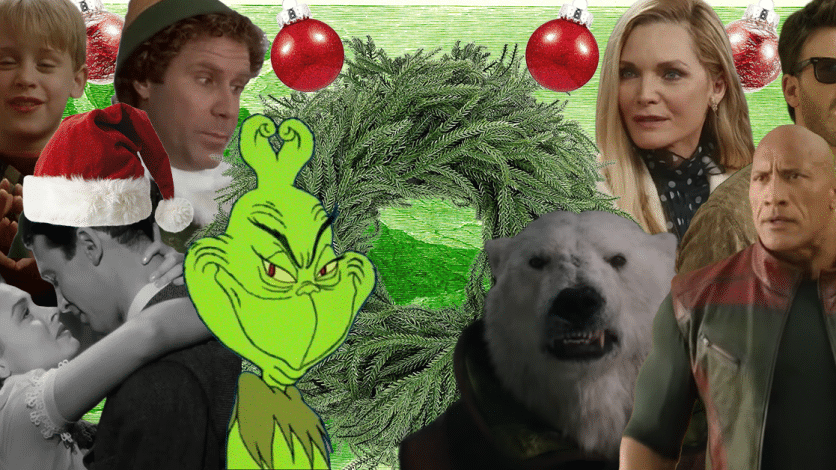
Every December, many of us fall into the same familiar routine: rewatch our favorite nostalgic Christmas movies. We revisit It’s a Wonderful Life and queue up Home Alone. Perhaps you let The Grinch play in the background while decorating the tree. These films feel inseparable from the season itself. They are not just movies but rituals, returning year after year with the same emotional weight and comfort. We get a steady stream of new holiday movies every year across Hallmark, Lifetime, and streaming platforms, but have you noticed that there are very few modern Christmas films that have earned a place in our seasonal rotation?
This raises an uncomfortable question. Why do so many Christmas movies exist today, yet so few actually matter? While holiday content has never been more abundant, it has also never felt more disposable. The magic that once turned seasonal releases into lasting traditions seems to have faded, replaced by repetition and predictability. To understand why, we have to look at earlier Christmas classics and note what modern holiday media no longer provides.
What made Christmas movies candy-cane sweet?
The most enduring of Christmas movies share more than just simple festive settings and cheerful soundtracks. They are more emotionally sincere, character-driven, and more obviously tied to the spirit of the season. Films like White Christmas or The Polar Express were not afraid to lean into vulnerability, loneliness, fear, or moral reckoning before arriving at the long-awaited warmth and resolution. Their stories felt purposeful and heartfelt, connecting to real and prominent issues—not just seasonal ones—at the time of release.
These films also trusted their audiences. They allowed moments of stillness and discomfort, and they built emotional arcs that we felt earned our repeat viewings. Characters evolved in ways that felt soft and intentional. In comparison, many recent additions to the genre feature jarring character changes to keep the story’s pace going, with no real work or thought put into the writing of these characters. We used to be rewarded for our anticipation. The holiday setting was not interchangeable; it was essential to the story. Not just a cash grab for unassuming holiday watchers. In this way, Christmas was not just a backdrop (we’re looking at you, random background Christmas trees), but the emotional motivators of the story.
Importantly, these Christmas movies existed in a media environment where scarcity mattered, where it truly was the survival of the fittest. A new holiday film felt like an event, a treat to be enjoyed at the end of the year. Audiences knew when it was airing or releasing, and that anticipation helped cement its place in collective memory.
May the Christmas special rest in heavenly peace
Looking back, one of the most significant shifts in holiday media came with the decline and loss of the iconic Christmas specials. For decades, network television molded what content families experienced and how they shared it seasonally. Specials aired nationally at specific times, more often than not only once a year. Households would gather around the screen together, sharing in this collective culture, bringing communities together. These specials fostered closeness even among folks who never would have had a connection outside these occasions. These broadcasts cultivated shared cultural moments that extended beyond the stories themselves. These were events that were shared by all those who had access to a television set.
Since the 2010s, we have witnessed how streaming services replaced this model entirely. With streaming came convenience, but also excess, with a lack of quality. Instead of a thoughtful handful of anticipated premieres, audiences were suddenly overwhelmed. With hundreds of holiday titles being pumped out at an alarming rate, without advertisements or a sense of anticipation, the ritual of waiting disappeared, and with it the sense that any one film mattered more than another.
Will you shine my sleigh tonight?
Two specials that are good examples of this are Frosty the Snowman and The Snowman. These were short, simple, and emotionally vulnerable. They did not rely on complicated storylines. Instead, they trusted the audience to feel the atmosphere, the music, and the restraint, leaving a lasting impression.

Frosty the Snowman offered warmth and gentle humor, utilizing cheerful fantasy with an underlying sense of temporality. The Snowman, by contrast, was wordless, relying on animation and music to evoke wonder and melancholy in all ages. Both specials understood something modern holiday films often forget. Christmas magic does not need excess to endure. It needs intention and freedom for emotion to have space to be felt.
The loss of the Christmas special removed a crucial necessity for the creation of tradition. Without any scarcity (or quality), holiday content has become abundant…like that of a landfill. When there is excess, there is no chance to become celebrated.
Streaming through the snow
Hallmark, Lifetime, and Netflix now dominate the Christmas movie landscape, producing holiday films with industrial swiftness that lack care and intention. While these movies scarcely advertise beyond their own streaming banners. While they promise to provide a certain amount of comfort and cheer, they often follow the exact worn-out blueprint. The formula has become so rigid that it borders on self-parody.
Perhaps a career-focused woman returns to a small town just in time for Christmas, where her values are called into question and misaligned with the holiday spirit. A misunderstanding blocks the romance, often over something inconsequential, and tension builds without any real stakes except perhaps a job. By the final act, a “super sudden” realization restores lost faith in love, tradition, and the holidays themselves. These films roll the dice with professions, towns, and meet-cute/”Hallmark-moment” scenarios, but the emotional arc never changes.
The predictability is not comforting so much as it is cheap and unavoidable. The audience is never asked to wonder what will happen; it’s only a matter of when. The predictability of these storylines has become so embedded in the genre that it is almost comedic. Turning what should be cozy storytelling into a checklist. The details may change, but the structure remains identical.
Streaming and the fast fashion holiday movie
This fast fashion approach mirrors recent trends in other industries, where speed and volume take priority over product quality and longevity. Holiday movies are no longer designed to last past the initial stream. They do not need to aim for an enduring impact on the viewers. They are designed to fill a seasonal slot, to be consumed once and quickly forgotten.
Even attempts at “representation” are often superficial. Films routinely feature interchangeable white leads accompanied by a token minority best friend. Proving that, in itself, to these companies, this is just another checkbox rather than a commitment to evolving the genre. A good example of this is the brief attention Last Christmas received in 2019. This attention was mainly attributed to its casting of an asian male lead as a love interest. Only further highlighting how rare meaningful variation still is. Yet even that film failed to secure lasting cultural relevance, fading as quickly as it arrived.
The beating of a broken drum
There was a time when Hollywood returned repeatedly to Miracle on 34th Street, remaking it across generations to reaffirm tradition. While those remakes were sometimes criticized, they were created with a clear intention. They aimed to reinterpret a familiar story for a new audience while preserving its emotional heart.
Today, even those remakes feel more memorable than many original holiday releases. Modern Christmas movies often imitate the gestures of warmth without earning them. They give off the festive look, sound cheerful, and resolve neatly, but they rarely linger. The result is a genre saturated with snow but starved of sincerity.
Under the mistletoe
Christmas movies did not lose their magic overnight; it was a slow and painful death. The magic was lost through repetition and a reluctance to trust audiences with any new material. The result is a genre rampant with content oversaturation but short on long-lasting influence. If a new holiday classic is ever to emerge, it will require more than twinkling lights and boring, predictable romance. Hopefully, something great will Jingle All the Way into theaters sometime soon!