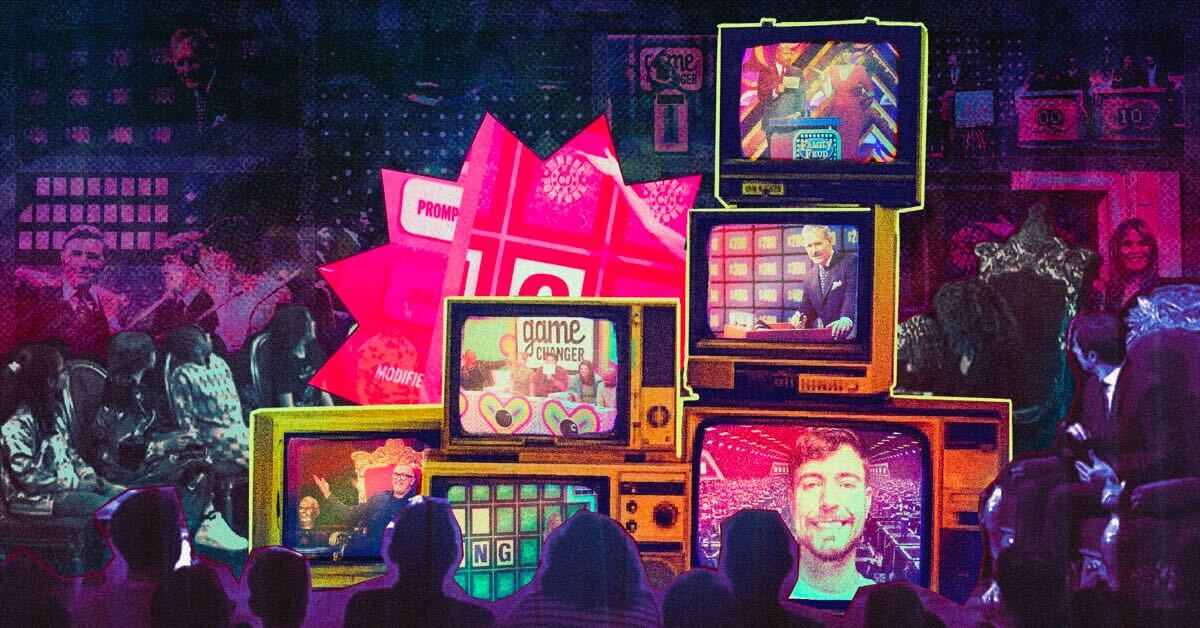
For a while, it seemed like game shows might be a thing of the past for Generation Z. Many young people have certainly seen network classics like “Wheel of Fortune” or “Family Feud,” but these shows have slowly faded out of mainstream pop culture in recent years. However, game shows are once again managing to hook in a younger audience — though they look a little different now.
Why the Old Formula Wasn’t Working
In the 2010s, game shows were getting pretty tired. Even if each one had a unique gimmick or celebrity presence, most of them functioned in exactly the same way. Normal people would compete to win money by performing tasks, some of which required physical, mental, or collaborative skills, while others were based purely on luck.
This would all happen on a flashy soundstage with a well-dressed host (and occasionally one or more very attractive woman). This setup worked for decades, but now, things are changing. The old formulas are failing to attract young audiences — audiences who already barely watch cable television.
While hallmarks like “Wheel of Fortune,” “Jeopardy!”, and “Family Feud” definitely aren’t going anywhere anytime soon, their demographic definitely skews older.
Still, Gen Z does watch game shows. They just might not exactly look like the classics. These newer programs have switched up the whole idea of what it means to be a game show — for the better, and also, maybe, for the worse.
(I’ve included links to example episodes of the shows or properties covered here, which you can view entirely for free. Judge for yourself whether or not you think these games are worth playing!)
Ingenious: “Game Changer” (on Dropout.tv)
Example episode: Season 4, Episode 1 — “Sam Says”
For those unfamiliar with Dropout.tv, it’s an original streaming service run by former members of the popular YouTube sketch-comedy channel CollegeHumor.

In 2020, CollegeHumor was acquired by CEO (and “Game Changer” host) Sam Reich, who helped transform the channel into a full-time streaming platform.
With the amount of streaming services out there today, it’s easy to be skeptical. However, Dropout is relatively cheap and hosts a wide range of comedy content. They even encourage sharing your password with friends, a practice bigger services like Netflix and Disney+ have tried to eradicate.
While Dropout has a variety of hit series like “Dimension 20,” “Make Some Noise,” “Um, Actually,” and more, “Game Changer” is the one I’d recommend watching first. It’s a concept so perfect, I actually can’t believe it hasn’t been done before: a game show where the game changes every show.
“Game Changer” rejects the very idea of being formulaic. In one episode, you might see contestants trying to “out-innuendo” each other (“Like My Coffee”), and in the next, three comedians will have to memorize random facts in order to escape a time loop (“Deja Vu”).
Many “Game Changer” contestants are CollegeHumor alumni, and several of them return for multiple episodes. Because of this, the viewer gets to know the personalities of the competitors, who are often real-life friends and colleagues. And they all have a background in comedy, so you can always guarantee you’re in for a fun ride.
Several full episodes of “Game Changer” are available for free on YouTube, so you don’t have to worry about paying for Dropout.tv before you’re fully sold on the show. I recommend starting with “Sam Says.” It’s play on Simon Says that gets increasingly complex as the episode goes on.
Hilarious: “Taskmaster” (on Channel 4 and YouTube)
Example episode: Season 2, Episode 1 — “Fear of Failure.”
Similar to “Game Changer,” many of the contestants on the UK series “Taskmaster” are professional comedians or television personalities. Each season, five of them compete to perform tasks given to them by the Taskmaster, Greg Davies, and his co-host “Little Alex Horne” (who actually created the show).
A large part of the humor in “Taskmaster” comes from the banter between Davies and Horne, as well as Davies’ attitude towards the contestants.
Even though Davies acts mean and antagonistic, the bit never goes too far. Viewers might get the sense that points are being distributed according to the whims of the Taskmaster, but never that the show’s participants are actually having a bad time. It helps that they aren’t actually trying to win a monetary prize. Instead, their ultimate reward for winning is a golden statue of Davies’ head. Because the stakes of the show aren’t very high, humorous interactions can take center stage.
Some of the most iconic “Taskmaster” contestants (like Katherine Parkinson, James Acaster, Nick Muhammed, and Fatiha El Ghorri) are the ones who didn’t perform very well in their respective seasons. Even without winning, these competitors managed to be unforgettable simply due to their personalities and comedic styles.
The actual tasks given throughout the show are ever-changing and always creative. Contestants might have to destroy a cake, get an egg as high as possible, join a zoom call dressed as Abraham Lincoln…you get the picture.
I’d recommend starting Taskmaster at the beginning of Season 2. There’s nothing wrong with Season 1, but the first episode of the second season just happens to contain some iconic and hilarious tasks that will certainly get first-time viewers hooked.
Exploitative: “Beast Games” and Other Mr. Beast Properties (on Amazon Prime and YouTube)
Example episode: $456,000 Squid Game in Real Life!
Now we get into the sketchier side of popular Gen Z gameshows — the Mr. Beast empire. Mr. Beast (Jimmy Donaldson), got his start on YouTube. In fact, he’s currently the most subscribed-to creator on the platform.
Before he got his own official gameshow, “Beast Games,” Mr. Beast created a variety of gameshow-esque content. Usually, his videos featured scenarios in which ordinary people could undergo challenges to win ridiculous amounts of money. Recent videos in this vein include: “Would You Risk Drowning For $500,000?” and “100 Identical Twins Fight For $250,000.“
His most infamous video, and the one that inspired “Beast Games,” was “$456,000 Squid Game in Real Life!” (2021) — a recreation of Netflix’s “Squid Game.” Just, you know, without the brutal murder aspect.
Though the execution of this game is far less gory than the fictional “Squid Game,” there’s still something to be said for its uneasy inception. Is it really a good idea to recreate a fictional narrative device that is, by nature, exploitative and dehumanizing?
Mr. Beast’s personal “Squid Game” misses the message of the original show entirely. Which is annoying, but not a crime.
However, soon after this, there came confirmation of the suspicions that some of Mr. Beast’s content initially provoked. Between allegations of mistreating employees, running illegal lotteries, and creating a workplace culture of misogyny, the problems with this online empire require an entirely separate article to discuss.
Jimmy Donaldson is frequently referred to as a “stunt philanthropist,” and this label is accurate. There’s no doubt that his content is entertaining and successful. But at the end of the day, it’s a stunt. The person that benefits most from Mr. Beast’s game show philanthropy is, of course, Mr. Beast himself.
What to Leave in the Past
Considering these shows, what about them works and what doesn’t, there’s one major change all game shows should consider implementing in the future: way less focus on the prizes.
Series like “Game Changer” and “Taskmaster” are so entertaining to watch because their prizes are often forgettable or trivial. The show is, at the end of the day, about the game. The contestants play it for the sake of playing it. And when they lose, it’s not the end of the world.
This isn’t to say that game shows shouldn’t have prizes at all. But an absurd jackpot isn’t the only thing that draws viewers in anymore.
The New Game Show Model
In each show discussed here, change is the constant. Naturally, “Game Changer” is the most blatant example of a show that relies on change. Still, neither “Taskmaster” nor the Mr. Beast shows are overly formulaic. “Taskmaster” has new, previously unseen tasks in every episode, and Mr. Beast is always coming up with a new stunt for his contestants to undergo. Clearly, Gen Z viewers don’t always want to know what they’re going to get when they tune in. The fresher, newer, and weirder the episode, the better.
Next, the success of comedian-led game shows is promising. Audiences now like to get to know the personalities and careers of the contestants they’re watching. Seeing everyday people push themselves to the brink just for a chance at winning money they’re desperate for just…isn’t fun anymore. Especially when so many people are desperate for money nowadays.
It’s important to note here that “Game Changer” and “Taskmaster” do not regularly eliminate contestants. There may be a winner and a loser, but no one is forced to go home.
A focus on humor instead of drama — hilarious failures instead of costly, life-ruining mistakes — creates a television environment that is healthier overall. Though “stunt philanthropy” will always be a trope of the game show genre, it’s ultimately a one-note gimmick that stifles creativity and innovation. And it’s not the way forward.