


Pixar is an animation studio that needs no introduction, producing beloved classics such as The Incredibles, Wall-E, Ratatouille, and Monsters Inc. However, I think it is safe to say that their latest films are not on the same par as those earlier works. Inevitably, the question of if Elio, Pixar’s newest offering, would continue this trend was in my mind as it hit theaters this month.
However, I soon found myself much interested in a different question: Is Pixar’s Elio autism-coded? I unexpectedly heard a lot of online discussion about this topic, and with my interest in autism in the media following my review of Netflix’s Love on the Spectrum, taking a look for myself seemed only natural. Is Elio not only a good film, but a good autistic film too?
Wait, Pixar released a new movie?
Something I noticed coming up to Elio’s release was a big lack of marketing, especially for a release from the prestigious Pixar. It seems this was not just me, as the film has had a disappointing box office run so far, which I think is for two reasons. The first is that Disney simply prioritized marketing its Lilo & Stitch remake, and the second is that Elio may have been difficult to market. Since its first look trailer in 2022, Elio faced numerous delays, changed directors, and has a staggering eight credited writers. In retrospect, it seems obvious why Disney put the straightforward Lilo & Stitch remake as its big summer release.
I did not notice any significant tells of its tumultuous production during my viewing, but this all provides important context. Pixar higher-ups recently had a press release about wanting to shift from more personal stories to ones with broad appeal, and I would imagine this had an effect on Elio’s development. With all that out of the way, how did the final product turn out?
How Elio’s autism is a case of fans projection
The debate centers around Elio’s protagonist, Elio, who I simply do not think is autism-coded. He has an overactive imagination that stems from an obsession with space, which is his most autistic trait. Many autistic kids, myself included, had an overactive imagination centered around our interests, even to it skewing our world view. Elio uses his space obsession to vent his insecurities, which I think will especially speak to autistic youths. Many autistic kids may feel isolated or too different, leading to their interest being a source of comfort and all they want to engage in. This is not a purely autistic behavior though, and I think this fact undermines most of the ‘Pixar’s Elio autism-coded’ theory.
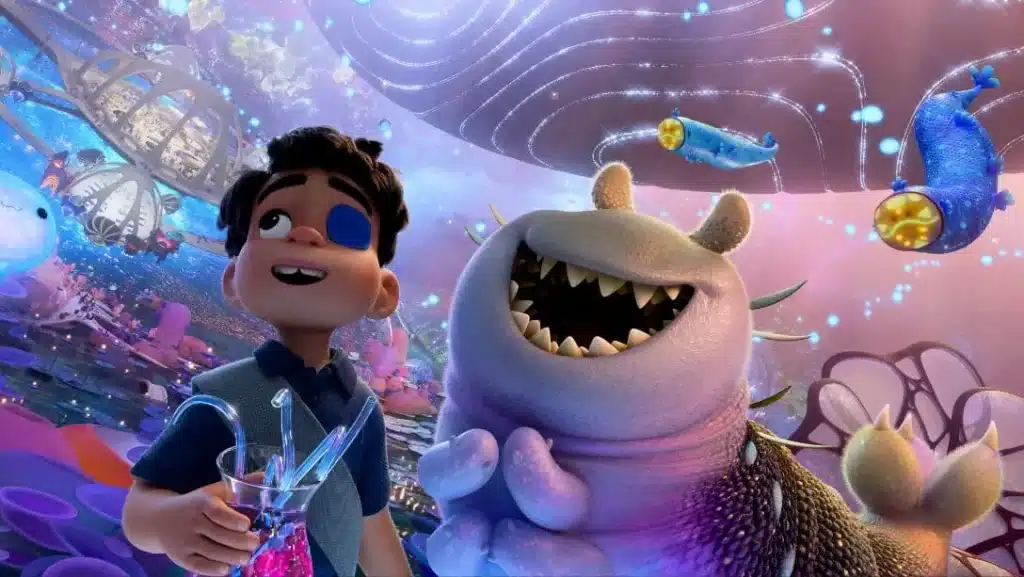
The film is full of other examples. The alien Communiverse Elio joins, full of otherworldly creatures, is evocative of the imaginary worlds many autistic kids create for themselves, but any kid can do so. Additionally, Elio’s caretaker has a book titled “How to Care for Your Spirited Child”, but ‘spirited’ could mean anything. To be a bit blunt, I think a child dealing with loneliness is about as nonspecific as it gets.
It is great that autistic viewers are identifying with Elio, but I just do not see anything concrete here. Even though this film does not have an explicitly intended autistic appeal, it is definitely better off for it. If Elio is anything to go by, it seems Pixar is indeed aiming for more broad, impersonal stories. I just fear this will lead to their later works becoming watered-down and soulless. Pixar’s shallowest films, like Cars 2 or Lightyear, are considered their worst, so I welcome Elio’s unintentional nuance.
Is Elio a good movie on its own?
I enjoyed a lot of what Elio had to offer, both as an autistic and general viewer. The animation is as good as ever, especially with the aliens, though the humans do feel a bit off. Pixar’s human designs seem to have stagnated since Soul, and I think they are a bit tired now, especially for a studio known for giving each of their films a unique look. I think a lot of the character writing was strong, with the highlight definitely being Elio’s alien companion Glordon. The kid characters felt like awkward kids while the adults were more sensible, a balance many films get wrong. The pacing is on the slower end, but this matches the film’s more atmospheric, imaginative tone.


The biggest general problem I have with Elio is, without a doubt, its surprising lack of adult appeal. Pixar is known for making all-ages films that have resonated with adults in addition to the expected kid audience, with Finding Nemo dealing with the trials of parenthood, or Monsters University with accepting the realities of life. Elio has the aforementioned appeal of childhood nostalgia, but there is nothing like these two examples. There was potential for adult themes with Elio’s caretaker aunt, but there was no attempt to capitalize on it. Adoptive parents are rare in kids media, so this really was a missed opportunity for a novel and mature perspective. My verdict is that Elio is an exceptional kids film, but in a rare case for Pixar, little more.
One final note: Pixar’s actual autistic movie
For any supporters of the ‘Pixar’s Elio autism’ theory, I do have some good news. Pixar has actually made a short film centered all around positive autism portrayal, simply called Loop. Part of the SparkShorts program of Disney+, it sees a neurotypical boy and nonverbal autistic girl learning to communicate. The word ‘autism’ is never said, but it is clear what she represents, and in all the right ways. Autism in the media need not be heavy-handed, but Loop shows how to easily autism-code a character. If you want to see an authentic portrayal, give it a watch.