On stage, it happens in a blink. A flash of movement, a sickening sound, and silence so thick it feels physical. The punch itself, the one that ends a life and fractures another, lands so quickly you could miss it if you blinked. But the reverberations of that single, senseless act echo through Punch, James Graham’s haunting new play now open at Broadway’s Samuel J. Friedman Theatre.
Adapted from Jacob Dunne’s memoir Right From Wrong, Punch is not a courtroom drama or a true-crime retelling. It’s something much rarer: a theatrical reckoning with the moral and emotional aftershocks of youth violence. Directed by Adam Penford, with stripped-back design by Anna Fleischle and sound by Alexandra Faye Braithwaite, the production asks audiences to sit inside discomfort, to watch guilt, grief, and the fragile miracle of forgiveness unfold in real time.
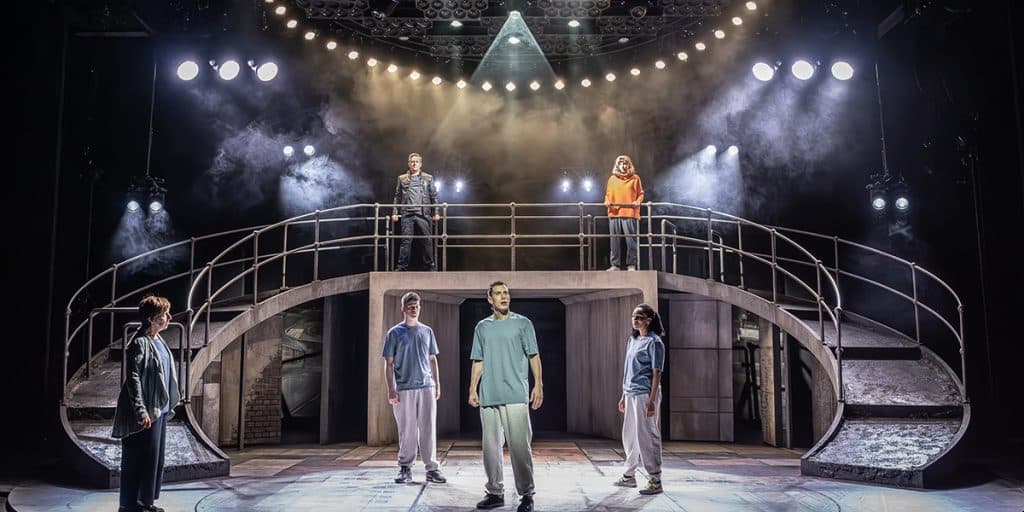
A story rooted in reality
In 2011, 19-year-old Jacob Dunne threw a single punch outside a bar in Nottingham, England. Twenty-eight-year-old James Hodgkinson fell, hit his head, and never woke up. Dunne served time for manslaughter. But what followed was the encounter between Dunne and Hodgkinson’s parents through a restorative-justice program, which became the unlikely foundation for Graham’s latest work.
Graham, best known for politically charged plays like This House and Ink, doesn’t sensationalize the crime. Instead, he dismantles it, tracing the microscopic decisions that accumulate into catastrophe. On stage, Dunne’s story becomes an anatomy of cause and consequence, where every action ricochets across families, communities, and the porous border between victim and perpetrator.
Splintered time, splintered selves
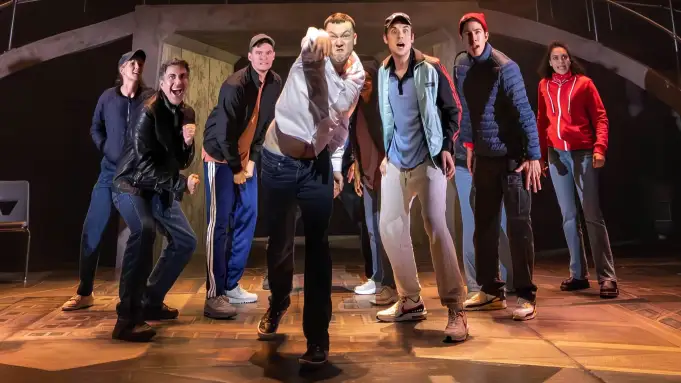
What’s remarkable about Punch is its structure. The play fractures time, darting between the night of the killing, Dunne’s incarceration, and the emotionally volatile meetings that follow his release. Will Harrison’s Jacob isn’t portrayed as a single figure but as a shifting mosaic, the cocky teenager bragging to his mates, the broken man haunted by headlines, the quiet listener learning to bear witness to someone else’s pain.
Opposite him, Victoria Clark’s Joan Hodgkinson embodies the paradox of maternal rage and grace. Her scenes are devastating, not because she forgives easily, but because she allows herself to look. To truly see the person responsible for her son’s death, and to speak to him without collapsing under the weight of what’s been lost.
Penford’s direction is surgical in its precision. The stage is nearly bare, consisting only of benches, a hanging light, and the occasional projected text that feels like a case file coming alive. That emptiness forces us to fill in the gaps, to imagine the spaces that violence leaves behind.
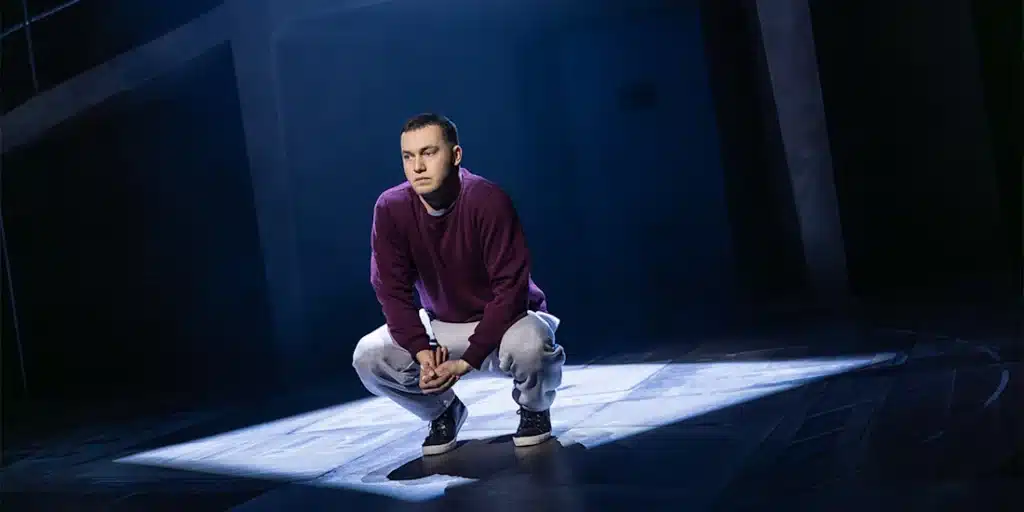
Theatrical shock and moral quiet
Where many true-crime adaptations lean into spectacle, Punch pulls in the opposite direction. Its most powerful moments are nearly silent. A body crumples in slow motion. A mother’s breath catches. A faint hum swells beneath a line of dialogue that’s too painful to finish.

Lighting designer Robbie Butler floods the stage with cold fluorescence one moment and isolates pools of warmth the next, creating a visual language that interrogates and evokes memory. Every flicker feels like a moral heartbeat. How much can we bear to see? How much should we?
That tension between empathy and judgment runs through every scene. Graham refuses to flatten his characters into “good” or “bad.” Jacob’s remorse doesn’t erase his culpability; Joan’s compassion doesn’t heal her loss. Instead, Punch builds an uneasy middle ground, where humanity exists not in absolution but in acknowledgment.
Restorative justice, not redemption porn
Perhaps the play’s most radical move is its portrayal of restorative justice. On paper, that phrase can sound bureaucratic, even utopian. On stage, it becomes guttingly intimate.
In one of the play’s most searing sequences, Jacob meets Joan and her husband face-to-face. There’s no swelling music, no emotional shorthand, just pauses, breath, and the small, unbearable labor of speaking truth aloud. “I wanted to hate you forever,” Joan admits. Jacob answers, “You probably still do.”
What Punch gets right, and what few dramatizations of real-life crime ever do, is that accountability isn’t closure. It’s a practice. A process of learning to live with what can’t be undone. Graham dramatizes this not as sentimental rehabilitation, but as a form of mutual bravery: the courage to sit across from pain and not look away.
That’s what makes Punch feel urgent in 2025, in a world that so often treats crime as content. True-crime podcasts narrate trauma into cliffhangers; social media amplifies outrage without nuance. Graham resists that flattening instinct. He builds a space where empathy isn’t indulgence, it’s rebellion.
From Nottingham to Broadway
Punch premiered at Nottingham Playhouse in 2024, then moved to London’s Young Vic before arriving on Broadway this fall through the Manhattan Theatre Club. Each transfer has refined its power without softening its edge.
Will Harrison, known for his roles in Daisy Jones & The Six, brings a brittle vulnerability to Jacob. He’s both boy and man, liar and confessor, his performance a study in contradictions. Victoria Clark, meanwhile, turns in one of the year’s most quietly devastating performances. Her Joan doesn’t sermonize; she trembles. She thinks before every word, as though language itself might betray her.
Anna Fleischle’s design situates the characters in a world that feels halfway between courtroom and confession booth. At times, the actors move like ghosts through one another’s memories, underscoring how violence collapses boundaries between the living and the dead.
A cultural mirror
The production arrives at a moment when conversations around justice reform are increasingly polarized. In the U.S., where punitive systems still eclipse rehabilitative ones, Punch feels like a whisper against the roar. It asks whether society can imagine justice that centers on repair over retribution, humanity over headlines.
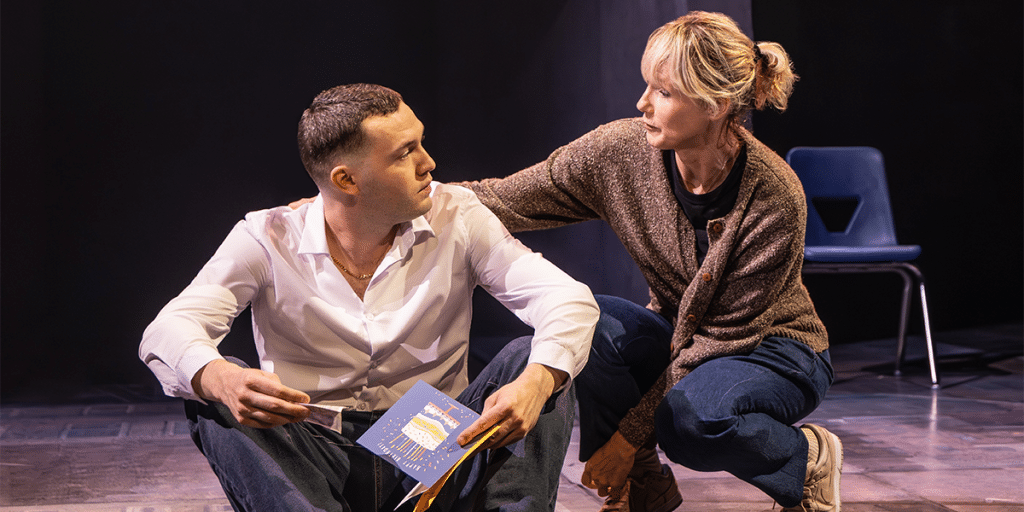
The aftermath we all inhabit
The final scene doesn’t tie things neatly. There’s no “lesson learned.” Instead, Harrison’s Jacob stands alone under stark white light, reading a letter aloud, half confession, half prayer. Behind him, the voice of the victim’s mother fills the theater. Two lives permanently intertwined, neither whole, both changed.
The audience sits in silence. No one claps right away. That’s the point. Punch is designed to leave you unsettled, to make you confront the impossibility of undoing harm, and the fragile grace of trying anyway.
Graham’s gift has always been to fuse moral inquiry with theatrical propulsion. Here, he pushes further. Punch doesn’t just tell a story; it creates a communal space for witnessing, something theater, at its best, has always done.
Why Punch Matters
In an era of instant outrage and performative empathy, Punch slows everything down. It refuses spectacle, refuses certainty, refuses to let anyone, including the audience, walk away unscathed.
The play poses the most profound questions: What does justice look like when forgiveness seems impossible? Who gets to move forward? How do you measure the distance between punishment and understanding?
By the final blackout, those questions linger like echoes in the dark.
Punch, ultimately, isn’t about violence; it’s about what remains afterward. The gaps, the reckonings, the small mercies that keep us human. It’s theater as a moral experiment and a mirror, reminding us that empathy is not weakness but the start of repair.
In the quiet aftermath, as the lights rise and people shuffle out of the theater, you realize: the real punch wasn’t on stage. It’s the one that lands in your conscience and stays there.