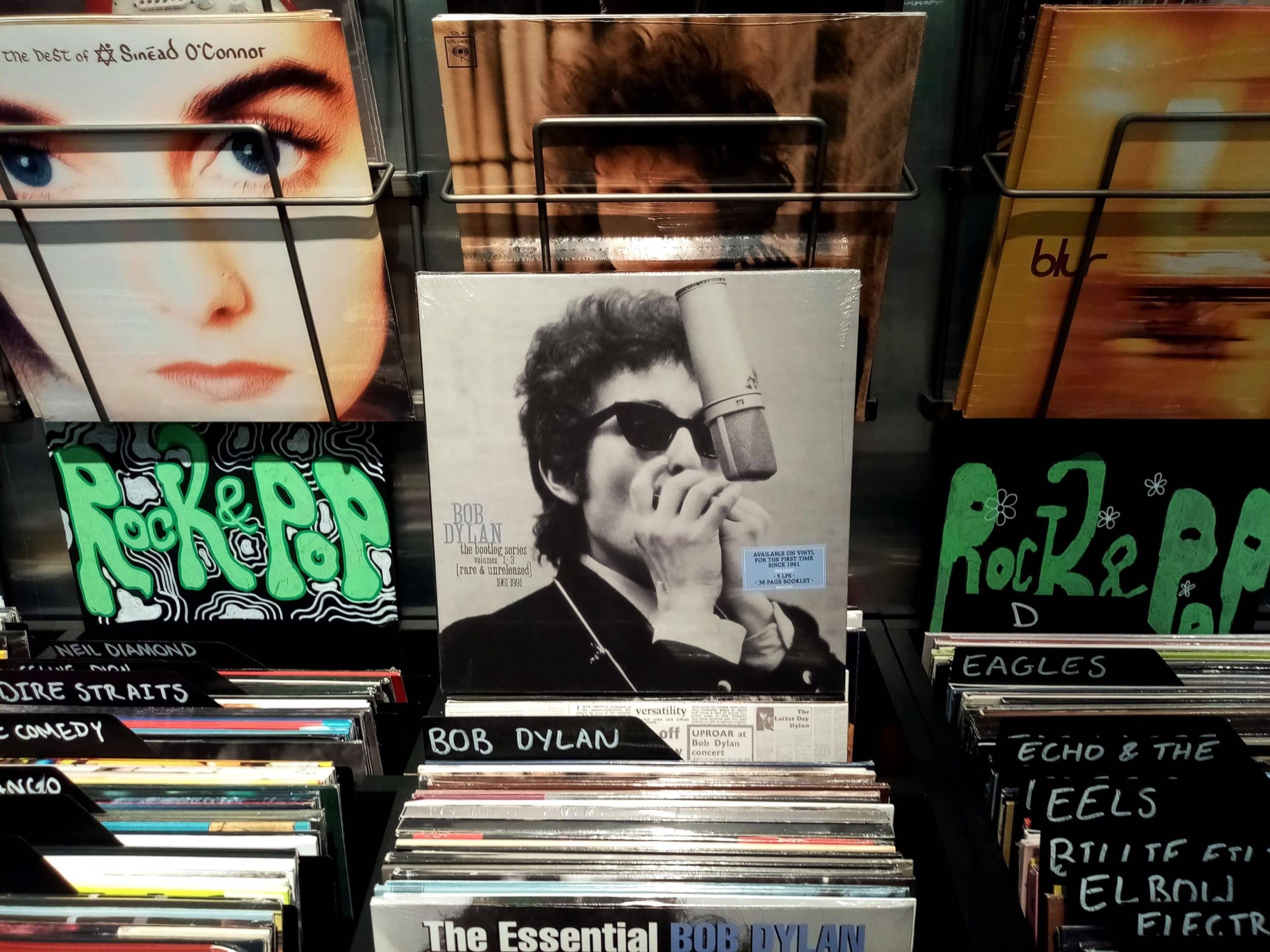
Bob Dylan is arguably the most influential musical artist of the 20th century.
We have Dylan to thank for pop music’s ascension to a serious art form. The conscious, poetic expressions of his folk songs earned him an invitation to perform at Martin Luther King Jr.’s 1963 March on Washington for Civil Rights.
Two years later, he exploded genre barriers when he plugged in his electric guitar at the 1965 Newport Folk Festival, alchemizing traditional stylings with contemporary rock and blues backing.
Dylan changed music forever. A microcosm of this is the impact he had on the Beatles. Before hearing Dylan, the Beatles were essentially the Liverpudlian Backstreet Boys.
After, they transformed into a four-man assembly line for classic, well-crafted songs such as “Yesterday” and “In My Life.”
Of course, there’s nothing wrong with being the Backstreet Boys. Fun music is great. Even Dylan isn’t above the unserious (take 1990’s “Wiggle Wiggle” as an example).
However, Dylan’s iconoclastic attitude was certainly a positive influence on music. It paved the way for new forms of artistic expression within pop.
Dylan continued to stay relevant throughout the remainder of the 20th century, winning Album of the Year over 30 years after the initial hype for 1997’s Time Out of Mind.

He’s continued his reign over culture into the 21st century and into the box office with Christmas 2024’s biopic A Complete Unknown. It earned him a place in our collective FYP as well. Since the movie’s release, Bob Dylan content on social media has been epidemic.
It’s been about half a year since and we’ve all had the time to listen exhaustively to Dylan’s discography. If you’re a little tired of his stuff but looking for similar music, I’ve got you covered.
1. Electric Ladyland – Jimi Hendrix
Electric Ladyland contains what’s considered the greatest Dylan cover of all time. Hendrix’s rendition of “All Along The Watchtower” uses wild, distorted guitar to lend the song a different flavor.
While the original is stripped down, ominous, and foreboding, the version on Electric Ladyland is loud, otherworldly, and apocalyptic.
Hendrix’s guitar playing is the highlight of Electric Ladyland. If you’re familiar with Dylan’s music, you’ll know that he always surrounded himself with exceptional lead guitar players on his electric records. Hendrix clears them all. He’s truly one of the greats.
Hendrix also shares his mastery of the blues form and penchant for surreal lyrics with Dylan. He covers blues standards, “Little Miss Strange” and “Come On (Let the Good Times Roll),” on the record.
Hendrix’s original lyrics are more psychedelic than Dylan’s, though the two make use of imagery similar in spontaneity and strangeness.
2. King Of The Delta Blues Singers – Robert Johnson
Robert Johnson’s King Of The Delta Blues Singers is the essential early blues album. Recorded in the late 30s, it didn’t see release until 1961.
In his time, Johnson’s playing was held in such high esteem that rumors began to swirl that he had sold his soul to the devil at a crossroads in exchange for wicked guitar chops.
His lyrics play into the myth. “Cross Road Blues,” “Me and the Devil Blues,” and “Hell Hound On My Trail” hint at different pieces of the tale.
Interestingly, one of the roads on which Johnson is said to have made his deal is Highway 61, the very same Highway 61 to which Dylan dedicated his 1965 album.
It’s clear to see how Johnson’s lyrics influenced Dylan. Dylan often writes about deals with the devil, most notably in his #4 hit “Like A Rolling Stone.” Johnson’s fingerprints appear on Dylan’s work on places other than Faustian deals. “Traveling Riverside Blues” shares many similarities with Dylan’s “Outlaw Blues,” for example.
Uncanny connections don’t stop here. A copy of King Of The Delta Blues Singers can be seen on the coffee table in Dylan’s Bringing It All Back Home album cover.
Johnson plays loose, improvisational slide guitar throughout the album, breaking the standard 12-bar blues form by borrowing time as he pleases. His voice and guitar take turns howling curses at the pains of life. After each line follows a melodic guitar fill as lyrical as the lyrics.
Dylan never experiments with slide guitar and doesn’t approach Johnson’s mastery of the instrument. Johnson’s stylings were clearly a great influence, though.
Dylan’s harmonica provides the melodic fillings more frequently than his guitar and Dylan, intentionally or not, is a serial time thief on his early records.
3. Born To Run – Bruce Springsteen
Bruce Springsteen is the most notable pop disciple of Bob Dylan. He credits “Like A Rolling Stone” with opening up his mind to what was possible in the genre.
Like Dylan’s lyrics, Springsteen’s feature colorful characters, working-class activism, and cries for freedom.
Born To Run is Springsteen’s breakout record and arguably his best. Its songs recount mixed feelings about his Asbury Park, New Jersey childhood.
He and his peers felt trapped by poverty and violence but they find meaning in the margins of life—as tramps and vagabonds. You’ll find Springsteen introspective but more accessible than Dylan.
Born To Run features a large backing band reminiscent of Dylan’s but with the addition of horns. It exists somewhere in the liminal space between Highway 61 Revisited and the band Chicago.
4. Mellow Gold – Beck
If The Freewheelin’ Bob Dylan is the prototypical modern folk album, Beck’s Mellow Gold is the prototypical postmodern folk album.
While Freewheelin’ dissects and scrambles elements of the classic folk genre to portray complex modern sentiments, Mellow Gold pastiches the form as a commentary on the form.
The best example of this is the song “Pay No Mind (Snoozer),” which infuses surreal Dylan-esque turns of phrase with crude imagery to discuss the commercial plight of his contemporary 90s folk singer.
Mentions of the broke, depressed folk singer persist throughout the album. Call it a theme. It’s interesting to see how the genre has changed from Dylan’s time immersed in it to Beck’s.
A 1960s folk singer might romanticize their brokeness (folk singers were never rich) while punching up at the government. A 90s folk singer like Beck dispenses with optimism about their own condition and for change. 60s folk and 90s folk are both protest music. However, one aims at injustice, the other at life itself.
It’s interesting to see how other genres that Dylan dabbles in have evolved. In the opening track, “Loser,” Beck raps over a scraping, metallic slide guitar backing reminiscent of Robert Johnson’s aforementioned delta blues.
While Dylan certainly took inspiration from Johnson’s music, Johnson’s influence manifests differently in his work than in Beck’s. Dylan gives his direct interpretation of the blues while Beck blends it with other genres’ conventions to make a head-scratchingly weird hit song.
5. The Doors – The Doors
The Doors’ Jim Morrison was the next great poet-singer to emerge after Bob Dylan. It’s interesting how many influences the two share. Both read classical poetry extensively and were obsessed with the more contemporary ‘beats.’
Additionally, The Doors contains a cover of “Alabama Song (Whisky Bar),” a composition of German writer Bertolt Brecht, whom Dylan cites as a major inspiration.
Dylan’s Highway 61 Revisited and Blonde on Blonde feature the organ prominently but the instrument is The Doors‘ main attraction. Keyboardist Ray Manzarek takes most of the solos on the album while providing the rhythmic backbone with his left-hand bass parts.
“The End” is the most interesting track. The other musicians set down a droning wall of sound that allows Morrison’s lyrics to stay the center of attention.
It culminates in a trippy retelling of the Ancient Greek myth of Oedipus followed by a wild breakdown.
If the idea of a less socially conscious, more psychedelic twin of Bob Dylan makes you say “hell yes,” you should give Jim Morrison and The Doors’ self-titled debut a listen.
6. It Takes A Nation Of Millions To Hold Us Back – Public Enemy
Public Enemy’s It Takes A Nation Of Millions To Hold Us Back is the closest spiritual successor to Bob Dylan on this list. Public Enemy takes aim at racism, authoritarianism, and cultural erosion by directly calling out those in power as well as inactive bystanders.
“Terminator X To The Edge of Panic” bashes the American government for their treatment of black people, making allusions to the Klan and the corrupt legal system. “She Watch Channel Zero?!” equates TV entertainment to TV static.
Like Dylan’s music, It Takes A Nation Of Millions To Hold Us Back also implements a variety of pop culture references.
Where Dylan has “Motorpsycho Nightmare” and “Desolation Row,” references to the 1960 film Psycho and 1965 novel Desolation Angels respectively, Public Enemy has “Rebel Without a Pause” and “Party For Your Right to Fight,” references to the 1955 film Rebel Without A Cause and 1986 Beastie Boys release (You Gotta) Fight for Your Right (To Party!).
Musically, It Takes A Nation Of Millions could not be more different from the majority of Bob Dylan’s work. However, Public Enemy group themselves in the same tradition as Dylan. Their 2007 song “The Long and Whining Road” comments on political music, making several references to Dylan’s lyrics, song titles, and album titles.
If you woke up today angry at the government, consider skipping The Times They Are A- Changin‘ this time around and try It Takes A Nation Of Millions To Hold Us Back.
7. The Band – The Band
The Band has a closer connection to Dylan than any other artist on the list. From 1966 to 1974, The Band was Bob Dylan’s band.
Originally called the Hawks, they joined Dylan on his first electric tour where derisive reviews that would only refer to them as ‘The Band’ sparked a name change. They thought it was funny.
The Band marks a significant departure from The Band’s sound during their first tour with Dylan. On the tour, they played loud, distorted electric blues. On the album, they play a muted, cleaner country rock. Think the Eagles crossed with the Grateful Dead.
The Band‘s lyrics discuss country life and the wandering outlaw. Dylan’s influence is clear. Songs like “Up On Cripple Creek” weave conversations into the music and “The Unfaithful Servant” invokes the Christian Bible as Dylan often did.
8. Tom Waits – Rain Dogs
This is undoubtedly the most esoteric pick on this list. Tom Waits’ voice is even less accessible than Dylan’s. Frankly, it’s not unlike the Cookie Monster’s from Elmo. Acquire a taste for Wait’s vocals, though, and you will find that Rain Dogs absolutely slaps.
Rain Dogs‘ jangly jug-band backing channels the spirit of Highway 61 Revisited. The lyrical content does too. Both albums discuss wandering misfits, channeling what I can only describe as a kind of primordial Americana. They both feel ancient.
Further, Waits’ recruitment of the Rolling Stones’ Keith Richards for several tracks calls to mind Dylan’s recruitment of various sellsword guitarists of some notoriety for his electric trilogy in the 60s.
This album sounds like a carnival freak show. It cranks up anything people find unsettling about Dylan’s music up to 11 and it works.
The first track, “Singapore,” is perhaps the strangest. Waits throws you into the deep end. Stick with it. It’ll grow on you.