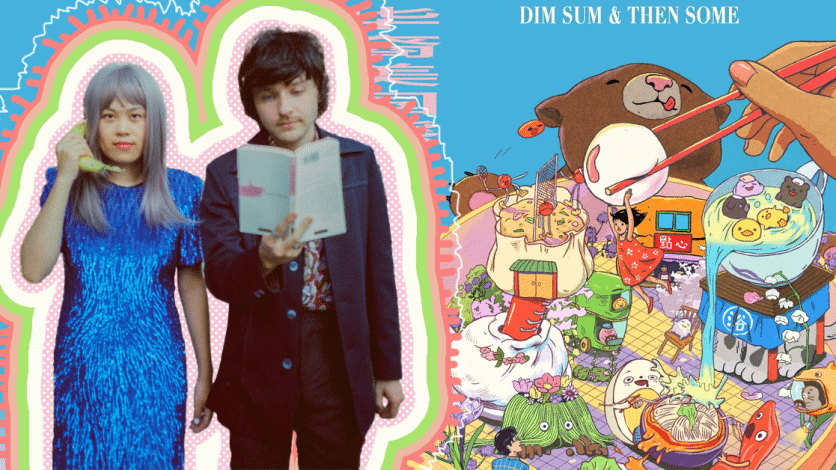
Psychedelic pop duo Chinese American Bear just released their third studio album, “Dim Sum & Then Some.” If you’ve never heard of this artist before, you’re in luck. I’m here to profile their sound and give you a track-by-track review of their new album — a must-listen for fans of unique indie pop.
Chinese American Bear is a musical partnership from Seattle, Washington, USA. Its two members, Anne Tong and Bryce Barsten, are married high school sweethearts creating music in English and Mandarin. They’ve been releasing songs together since 2020. With their third album having just arrived, they show no sign of stopping anytime soon, and their popularity has only been growing.
The band’s sound is upbeat and quirky, yet somehow it still manages to be introspective and completely original. Their music is heavily inspired by ’60s and ’70s psychedelic styles, though Tong and Barsten’s incorporation of electronic elements also adds a bit of a futuristic vibe.
Overall, Chinese American Bear’s songs are summer-y, golden-hour, rose-tinted nostalgia embodied. Vintage music, for the modern era.
Past releases
Before this May, Chinese American Bear had already released two incredibly solid albums. Their first was self-titled, released in 2022, and their second, “Wah!!!”, came out in 2024.
The song that hooked me on this band was “Take Me to Beijing (一起回北京),” off “Wah!!!”
One of their more melancholy songs, “Take Me to Beijing (一起回北京)” explores Anne Tong’s longing for her childhood years spent in Beijing. The song is heavily relatable for many Chinese American fans, speaking to cross-cultural identity and nostalgia.
However, even as someone without any ties to Beijing or Chinese culture, I still immediately found the song to be a touching, ethereal experience. The listener almost gets the impression that Beijing could be their own hometown, or a stand-in for it, — that’s how strongly the emotions come through in Tong’s lyrics and vocal performance.

And that’s just one example of their past work. As you’ll notice from both the title and the lyrics of “Take Me To Beijing (一起回北京),” Chinese American Bear fully commits to being a bilingual band. Every single one of their songs features both English and Chinese, even their cover of Taylor Swift’s “Blank Space (空白格) .”
The two languages work well together musically, and their casual integration by Tong and Barsten perfectly represents Chinese American Bear’s ethos as an authentic cross-cultural project.
“Dim Sum & Then Some”
The title of Chinese American Bear’s newest album, “Dim Sum & Then Some,” falls in line with their established aesthetic. CAB songs are often light and playful, even when exploring deep emotions. Many of them discuss simple joys, one of which often happens to be food. Chinese American Bear’s Spotify “about” page includes the description “Hungriest band in the world 🍜🍚🥟🥡” — with the emojis and all.
As with their past work, food is definitely an important theme in “Dim Sum & Then Some.” The title of the album itself makes that clear. For anyone who may never have heard of it, dim sum is a collection of different Chinese dishes served in small portions. “Dim sum” literally translates to “touch the heart.“
Listening to “Dim Sum & Then Some” feels just like eating a dim sum meal. Each track gives you a little taste of something different, yet they all compliment each other in a cohesive way.
Here’s a song-by-song breakdown:
“Intro (开场白)”
As the opening song on “Dim Sum & Then Some,” this intro is exactly that — an intro. It’s purely instrumental, with some brief laughter at the very end. That being said, instrumental album intros tend to be more or less skippable, but Chinese American Bear’s “Intro (开场白)” provides a great musical foundation for the album to follow. It’s grand and hopeful.
“All The People (所有人)”
“All The People (所有人)” is a nice little song. It’s very evocative of a nursery rhyme or fairytale poem. The repeated lyric “’round and ’round the fields they fall” especially brings to mind children’s games like “Ring Around the Rosie.” The song feels like a piece of folklore with some electric guitar woven in. The band cites the fantasy genre as an indirect influence on this song, which comes through partially, in my opinion. I never would have thought of this track as being influenced by fantasy or romantasy, but after hearing about it from Tong in an interview with Flood Magazine, I suppose I can see it.
It’s worth mentioning the music video as well, which features puppets entirely handmade by Bryce Barsten, a DIY endeavor that he said felt even more worthwhile in the age of AI.
“All The People (所有人)” isn’t my favorite song on “Dim Sum & Then Some,” but it’s certainly a fun listen.
“No No Yeah Yeah (不不好啊好啊)”
“No No Yeah Yeah (不不好啊好啊),” on the other hand is absolutely one of my favorite tracks from this album. This was the second single to be released off “Dim Sum,” and it was born of a personal challenge by Tong and Barsten to create a song only using the words “no” and “yeah.” The song does include other lyrics, but a lot of it is definitely “no” and “yeah.” However, the band’s joyfully soft indie-pop energy does a great job of keeping these two words from ever getting worn out.
“No No Yeah Yeah (不不好啊好啊)” is a great earworm song. It perfectly captures Chinese American Bear’s ability to create sugary feel-good tunes that aren’t in any way generic or derivative.
“I Wanna Go Home (我想回家)”
“I Wanna Go Home (我想回家)” is a song of nostalgic musing. With a tone both optimistic and sad, it imagines a perfect place for two lovers to go. The lyrics “Let’s go find someplace called home / I wanna go home” imply that this home might be impossible to find. Still, the singer believes in it.
“I Wanna Go Home (我想回家)” is an absolute montage of imagery and sounds. It again illustrates Chinese American Bear’s ability to evoke memory. This one feels like a more cheerful spiritual successor to “Take Me To Beijing (一起回北京).” I can’t get enough of it.
“Turn Up The Radio (把收音机开大点)”
“Turn Up The Radio (把收音机开大点)” is an expression of pure, childlike joy. Chinese American Bear knew exactly what they were doing with the music video for this song. It shows scenes of a little girl (credited as Murphy Li) dancing and playing in her sunny bedroom. She listens to music on a pink radio.
There’s not much else I can say about this song honestly. Listening to it just feels exactly like being the girl in the video. It’s another reminder of simple joys. Lyrically, it’s not complex. But it evokes the feeling of hearing a song on the radio as a kid and knowing instantly that you’re in love with it.
“Chant (南无阿弥陀佛)”
“Chant (南无阿弥陀佛)” is an interesting one. Without being able to read the characters, I immediately noticed that the Chinese title was longer than the English one. It turns out, the title is actually “Namo Amituofo.”
“Chant” is not an inaccurate translation, though it’s an oversimplified one. “Namo Amituofo” is a chant which comes from Pure Land Buddhism. This is a form of Buddhism popular in East Asia which focuses on being reborn in the land of the Amitābha/Amituofo Buddha.
According to some (very basic) research, “Namo Amituofo” essentially means, “I take refuge in Amituofo.” The chant is recited for personal peace, reflection, spiritual connection, or to bless others.
So why is this important to the song? Well, the entire song is actually just a repeated recitation of “Namo Amituofo.” As the mid-point of the album, “Chant (南无阿弥陀佛)” serves as a moment of rest and meditation.
This song won’t be a hit on its own, but it works well with the rest of “Dim Sum & Then Some.” It asks the listener to take a moment of pause in between two fast-paced and danceable songs. “Chant (南无阿弥陀佛)” proves that Chinese American Bear is doing more than just writing catchy singles. They’re creating a cohesive album experience.
“Mama (妈妈)”
“Mama 妈妈” takes an awesomely groovy foray into disco. The influence of the ’70s is immediately recognizable within the first seconds of the song. As well as the disco beat, this song also features some string accompaniment (reminiscent of Vampire Weekend’s early work) and an electronic voice filter, used tastefully.
If there’s any area in which this song suffers, it’s in the simplistic title. Though “Mama 妈妈” was one of the pre-released singles on “Dim Sum,” it took me a while to actually give it a listen. When I finally did, its musical complexity and immense re-playability really surprised me.
“Mama 妈妈” is thematically reminiscent of another Chinese American Bear song, “Feelin’ Fuzzy (毛绒绒的感觉).” Both explore the push-and-pull relationship of a fed-up mother and a child who just wants to play and have fun.
“Lovely Day (美好的一天)”
“Lovely Day (美好的一天)” is the perfect song to listen to, well, on a lovely day. It initially feels almost too sugary-sweet, repeating the words “It’s a lovely lovely lovely day.” But at the end, the music slows down and the final lyrics muse, a bit sadly, “sippin’ on candy / my tongue is blue / I don’t know what to do.”
The whole song has a bit of a sleepy, restrained feel to it as well. Its surface-level cheerful tone is undercut by hints of sadness, tiredness, or boredom. I adore the subtlety with which the band introduces these complexities, which might be hard to catch on the first listen.
“Land Of Fun (好玩的地方)”
This one feels like one of the most straightforward statements of Chinese American Bear’s nostalgia aesthetic. “Land Of Fun (好玩的地方)” contains the English lyrics “I needed to get back, back to the land of fun” and “play, boy, play, girl.” The Chinese lyrics double down on the sentiment, further expressing a wish for play.
It’s a pleasant song with a relatable message. In my opinion, it’s not the band’s best song about the simple joys of childhood. “Land Of Fun (好玩的地方)” feels like a bit of a weak point on this album, but I wouldn’t call it a skip.
“Forever Lover (永远的爱人)”
“Forever Lover (永远的爱人)” is the most contemplative song on “Dim Sum & Then Some.” Which is to say it’s still pretty upbeat, but a little melancholic as well. A song about the band members’ relationship as a married couple, “Forever Lover (永远的爱人),” like “Chant (南无阿弥陀佛),” is a welcome interlude of seriousness within a generally playful album.
It’s a clear expression of the love between Tong and Barsten, featuring some reflections on the fact that “forever is a long long time.” The music video shows scenes of the couple traveling around a city via vespa, scenes which wouldn’t feel out of place in a retro romance film.
“Forever Lover (永远的爱人)” carries the same oddly sad nostalgic feeling that “Take Me to Beijing (一起回北京)” conveys. Again, there’s a sense that this music is vintage, that in choosing an aesthetic that brings to mind the 1960s and ’70s, Chinese American Bear is always interacting with the passage of time in their art.
(It’s a good moment to point out that a lot of promotional photos for the band have this grainy, old-camera filter imposed on them. It’s as if CAB has just recently emerged from a totally different era.)
While Tong and Barsten’s love might last forever, they’re still positioning themselves as a temporary moment, something you’re already nostalgic for.
So, yeah, “Forever Lover (永远的爱人)” is one of their best.
“Chinese American Bear Anthem (华裔美国熊之歌)”
“Chinese American Bear Anthem (华裔美国熊之歌)” is the humorous outro to “Dim Sum & Then Some.” It’s a chanted repetition of the band’s name with autotuned segments in which Tong and Barsten state facts about who they are. For example “they love to eat and sleep, sleep and eat and eat and sleep” or “they like to hold hands.” It also references past Chinese American Bear songs, like “Bear Day (熊的日子)” and “Feelin’ Fuzzy (毛绒绒的感觉).”
Obviously, this one’s meant to be a sort of thesis for the band, as well as a reminder that they don’t take themselves too seriously. My only complaint would be that this anthem leaves you wanting more. It feels more like an intro than an outro.
Final Breakdown
I’d definitely recommend giving “Dim Sum & Then Some” a listen. It’s a great album for kicking off some good-time summer vibes.
“Wah!!!” (2024) still holds its place as my favorite Chinese American Bear album. Nevertheless, this one’s a close second for sure.
My absolute favorite songs from “Dim Sum & Then Some” have to be “No No Yeah Yeah (不不好啊好啊),” “I Wanna Go Home (我想回家),” and “Forever Lover (永远的爱人).”
Press play for yourself, and see if you agree with my picks. The album is now available on music streaming services, and the band has also uploaded the whole thing to YouTube, with a video of the two of them making dumplings as a visualizer. Because, of course.