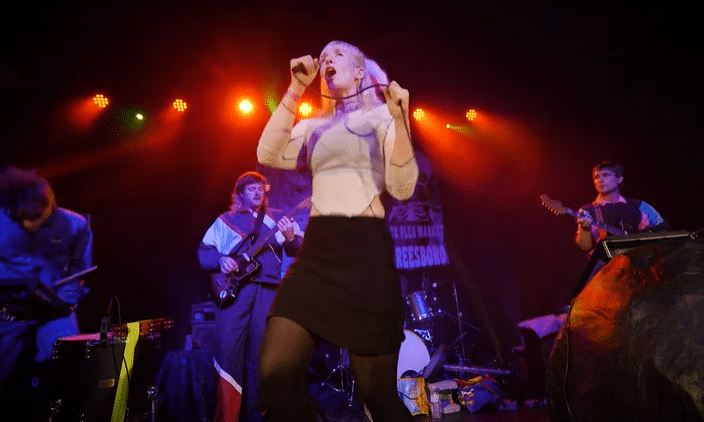
If you happen to be an avid egg punk listener, chances are that you are familiar with just how many variants of the genre exist. From beatdown hardcore and crust punk to ska punk and “pigfuck” (blame famed music critic Robert Christgau’s description of Sonic Youth for that last one), there are a seemingly endless number of rabbit holes to dive into for the punk and hardcore-inclined.
Similarly, egg punk is a semi-recently developed subgenre pioneered by members of Gen Z. The generation can tout the subgenre as one of its biggest innovations in underground music.
What is egg punk?
Unlike some other subgenres, egg punk is based around an extremely strict set of influences. One of the primary artists that egg punk draws inspiration from is the cult new wave band Devo.
Devo may be one-hit-wonders to many thanks to the MTV-defining music-video-and-song combination that is “Whip It.” But their early years saw them develop a style of jittery, electronic-oriented punk that would go on to influence the stylistic development of peers like The B-52’s and Oingo Boingo.
Just like Devo, egg punk embraced a somewhat unpredictable style of synth punk. Somewhat surreal lyrics and frequently garish visuals are of particular focus. Many early groups of the subgenre would riff on Devo’s sound, making them one of the genre’s earliest influences.
Devo may be the primary line of connection between egg punk and the original punk movements of the late 1970s and early 1980s. However, they aren’t exactly the exclusive reason for it existing.
Egg punk’s intentionally lo-fi production style and generally DIY aesthetic can be traced back to a number of sources. Early non-Devo punk was frequently recorded on a low/non-existent budget. In turn, much of it was lo-fi in a similar way that egg punk would eventually be. Beyond the initial punk sphere, one can hear the lo-fi sounds of Guided by Voices or the Cleaners from Venus in many of these bands’ sonic aesthetics.
Where does egg punk begin?
The origins of egg punk often depend on who you ask. The genre’s sound can be dated back to the mid-2010s. In this time, several bands of young punks developed the DIY sound that was frequently compared to some of the previously mentioned artists.

Three of the biggest names in this first wave of egg punk were Lumpy and the Dumpers, Uranium Club, and The Coneheads. With all of these bands coming from the midwestern United States (Missouri, Minnesota, and Indiana, respectively) and debuting around the same time in 2013 and 2014.
These groups (among others) would have sounds that embraced various other styles of punk. Nonetheless, their connection as bands with a DIY, synth-oriented take from the same region is undeniable.
The Coneheads’ 2015 comedically titled compilation L.P.1.: “14 Year Old High School PC-Fascist Hype Lords Rip Off Devo for the Sake of Extorting $$$ From Helpless Impressionable Midwestern Internet Peoplepunks L.P.” stands out as a record that especially helped put the genre on the map thanks to positive reception from publications like Pitchfork.
The origins of its name
All of these bands and a number of others have since come to be known as early egg punk groups. However, the phrase “egg punk” did not quite exist in the mid-2010s. With this burgeoning yet extremely niche movement growing larger with each passing year and remaining unnamed, it was only a matter of time until someone coined an umbrella term to describe the overarching sound of these artists.
In a series of events that could only occur in the internet age of punk, the term “egg punk” slowly developed over the course of its usage from various meme accounts. By 2018, the term had even been recognized by singer-songwriter and hitmaker John Mayer via his Instagram account. There is no definitive reasoning behind this name. However, it is generally agreed that it is meant to encapsulate the unserious nature of the genre.
Many young bands were taking hints from other more straightforward punk and hardcore bands (the term “chain punk” developed parallelly as a means to describe these more self-serious groups). As such, the abstract nature of the term “egg punk” perfectly summed up the often satirical nature of the movement.
The fall & revival of a genre
Similar to many other niche, regional punk subgenres, egg punk did not last initially. By the end of the 2010s, only a handful of the original egg punk bands were still active. Even fewer were consistently releasing full-length projects and touring. For many, this seemed like the natural end of a subgenre destined to attract a small audience.
This narrative began to turn itself around by 2022. The arguable driving force behind egg punk’s return to form was Tennessee band Snõõper. After building up hype with several EPs, the band released their first full-length album, Super Snõõper, in 2023.
While the record was far from a traditional commercial success, it was immediately acclaimed upon release. Beloved by publications like Pitchfork and Stereogum, Snõõper even received a co-sign from legendary Black Flag frontman Henry Rollins.
Much time has passed since the initial peak of Lumpy and the Dumpers and The Coneheads. Since then, the egg punk sound has expanded well beyond its birthplace of the United States of America.
International impact
In other predominantly English-speaking countries, some underground bands have begun embracing the sounds of the genre’s pioneers. In Sydney, Australia, musician Kel Mason’s music under the Gee Tee project received positive reviews from several publications. More than that, it added a dash of egg punk to Sydney’s underground music scene.
Even in countries where English is not a national language, egg punk has begun to sink its teeth into underground punk music that is willing to laugh at itself. German band Pisse has brought the sound to central Europe. Elsewhere, the Spanish group Prison Affair has delivered the egg punk gospel to the Spanish-speaking world. The sound has barely been exposed to the rest of the world at this point. However, as it spreads beyond the United States, egg punk seems here to stay.
What comes next for egg punk?
Figuring out the next steps for egg punk is impossible. While it may have been gasping for breath just a few years ago, the subgenre seems shockingly lively in 2026. Whether another death and rebirth is right around the corner or if it will continue evolving into a wholly new sound is difficult to say. As it stands, though, one thing is for certain: egg punk is one of the most major contributions that Gen Z has made to punk music thus far.
There are countless punk bands made up of young people. Still, few feel as groundbreaking as those associated with the egg punk scene. No matter how the genre grows from here, it seems that plenty of musicians all across the Gen Z age spectrum are determined to keep it alive.