Across the western world, national flags are being reinterpreted in real time. Once seen as simple emblems of pride or unity, they are increasingly used to express exclusion and hostility. In countries like the UK and the US, far-right groups are reshaping the meaning of national symbols to promote racism, xenophobia, and aggressive nationalism—distorting what these flags once stood for.
The flag’s straightforward symbolism is changing. The meaning surrounding national flags are shifting, and not everyone shares the same understanding of the flag anymore.
It raises a critical question: Who owns the meaning of a flag — and how has that meaning changed? The significant cultural shift in what flags represent has coincided with a racist agenda set by the far right. Can flags still represent inclusive ideologies in the wake of their reappropriation to fit in with racist discourse?
How flags are changing
Far-right groups in the UK, such as the English Defence League (EDL), are actively using national flags like the St. George’s Cross and the Union Jack to oppose immigration and promote racist ideologies. These groups have hijacked patriotic symbols, transforming them from representations of national unity into tools of exclusion.
Rally organizers and sympathetic local groups are actively reshaping the meaning of these flags by displaying them at events and protests. Under Tommy Robinson’s leadership, the EDL has launched the “Raise the Colours” movement, encouraging supporters to wave national flags as an act of pride and defiance. Yet this is no ordinary display of patriotism, it is a deliberate effort to use national symbols to exclude and isolate migrants.
This shift coincides with recent legislation aimed at discouraging immigration to come to the United Kingdom. Just this past week, the British government announced that it will now require prospective immigrants to pass an A-Level standard English test. This is a move that disproportionately affects non-native speakers and reinforces exclusionary practices.
Although Prime Minister Starmer has emphasized the need for greater unity across the political spectrum, his government has allowed far-right rhetoric to go unchecked. This is coupled with the fact that he still raises the flag in his parliamentary home. It raises serious questions about the UK’s commitment to inclusivity and how the current leader thinks flags are only circumstantially controversial.
These developments challenge the narrative that the United Kingdom is a welcoming and diverse society, as its leaders often claim. Flags, once symbols of national unity, now carry a darker meaning—co-opted as banners of hate.

How people use flags in discourse
In Scotland, groups with anti-immigrant and anti-Muslim sentiments hung the Saltire across main streets in Glasgow in a bid to inspire nationalistic and exclusionary sentiments. Many initially believed the displays were part of a council initiative, but they were actually the work of far right groups.
The Saltire has become something else entirely. In protests in Glasgow’s city centerm far right groups have waved saltires to the march of their anti-immigration beliefs. The Saltire has also been hung around across streets of the city.
This use of the flag promotes a clear agenda. It coincides with and continues the belief that Scotland (and the UK as a whole) are unwelcoming.
Other Scottish cities like Dundee and Aberdeen have seen the erection of saltire on street lights as well. The far right’s intent to distort the flag has spread across Scotland as a whole.

Without large-scale consequences from governments, the flags of their countries will continue to represent misinformation and hatred. And I fear this will only get worse.
The consequences of denying a flag (USA)
Across the Atlantic, American flags are just as contentious. Donald Trump said in the past year that anyone caught burning American flags would be susceptible to adequate jailtime.
This direct message is a hard pill to swallow. Even in the event that citizens of the western world disagree with their flags, they have to represent them anyway.
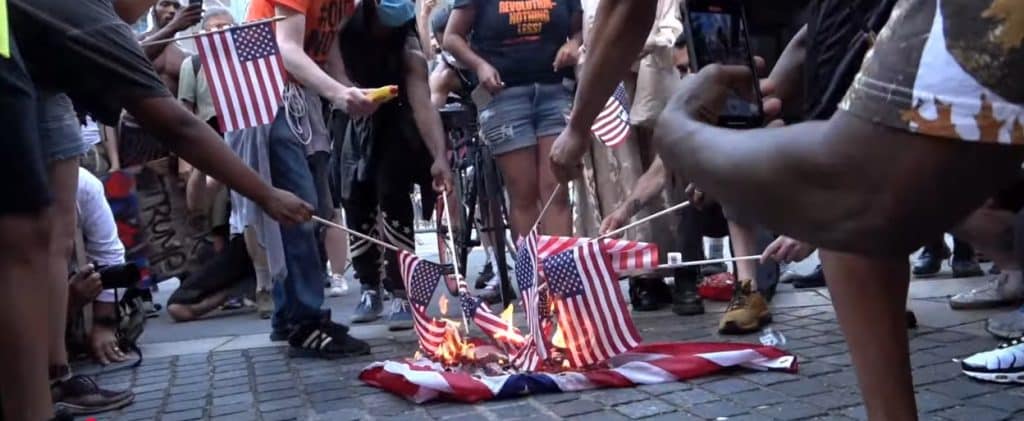
This decision vetoes a law passed in the late 1980s that allowed the destruction of flags as a political statement.
The American flag has also seen a massive reappropriation under the rule of the current president. Rather than burning the flag after the Capitol Hill riots of 2021, many Trump supporters turned the American flag upside down in support of the then-former president. This coincided with a contentious attempted indictment.
Fundamentally, it shows that a nation’s messages can be subverted in a literal way. The far right has completely distorted a national symbol.
The flag was also linked to support for Biden’s inaguration. Writer Emma Bowman for NPR stated, “At that time, the flag had emerged as an anti-Biden protest symbol synonymous with the false claim that the election had been stolen from Trump.“
When the right subverts national imagery, they shift its intent. Trump supporters have shown that they can destroy inclusivity and progress by imbuing national flags with violence.
The dangers of ignoring the signs
Flags are the fundamental symbols of a nation. In the examples above, they have undergone a clear recontextualization.
Additionally, without proper checks from lawmakers, countries can send an unclear message to the rest of the world. In the UK, the EDL uses flags to convey a message that conflicts with the views of the majority of the public. Their hateful use of a national symbol clearly represents a movement supported by only a small minority.
There is a division between the UK’s current government officials. Members of the Labour party have conflicting views of the flag’s current message. Ironically, the Union Jack is no longer unanimous, as its new message is being debated.
Patriotism is clearly not enough to override the message that the far right have avidly tried to spread. When flags are removed by local councils, they are put back on the poles they once resided on in a cyclical restoration.
If the government continue to be relaxed about the use of the national flag (especially in local communities), there can be no certainty regarding its meaning.
This places national symbols in unknown territory. The very values that elected officials want their flags to represent have changed.
The future of national symbols
Once broadly accepted as emblems of pride, belonging, and shared history, flags are now caught in the middle of a growing cultural and political conflict. Across the UK and the US, far-right groups have increasingly used flags in ways that promote exclusion rather than unity. The result is a visible redefinition of these national symbols—away from inclusivity and toward ideologies rooted in division.
This shift is unlikely to reverse on its own. Symbols like national flags change meaning depending on who is shaping the conversation around them. When they’re constantly tied to extremist views, their original purpose and meaning begin to fade and be replaced by new, more divisive interpretations.
In recent years, governments have done little to directly address this issue. In the UK, for example, far-right groups display flags in cities like Glasgow and Aberdeen, and authorities have offered minimal responses. This reluctance to act decisively—particularly at the local level—raises concerns that national symbols are vulnerable to manipulation.
Finding a clear solution has proven difficult. While governments in the past, such as Germany, decisively banned highly controversial symbols like the Nazi flag, modern flags present far more nuanced challenges.
These contemporary symbols often carry multiple meanings depending on context, intent, and audience, making legal or political intervention complex. Unlike overtly extremist imagery, they can be framed as expressions of heritage, identity, or protest, even when used to promote exclusion or hate. People interpret these symbols subjectively; to many, national flags encapsulate a range of identities.
The future of national flags depends on the resolution of these tensions. Will the loudest and most extreme voices continue to claim flags, or can society reclaim them as representations of diversity and pluralism? For now, they remain contested: not just symbols of state, but reflections of a deeper struggle over who defines national identity.