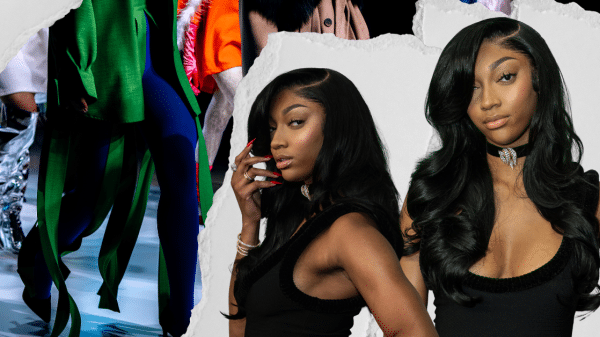
Jaden Smith may just be the ultimate nepo-baby. As the child of famous actors Will Smith and Jada Pinkett Smith, he’s no stranger to public scrutiny. In fact, he frequently appears to relish it. Well known for viral soundbites and eyebrow-raising fashion choices, Smith shocked many when, last year, he accepted a role as the luxury brand Christian Louboutin’s new menswear creative director. After debuting his first full collection, the internet has predictably been eviscerating everything he touches. Believe me, although I would love to get in on the action… I have to defend Jaden Smith on this one.
Celebrity Hires and the Case for Jaden Smith
In the past, I’ve frequently written about the dread scourge that is fashion houses hiring celebrities as creative directors. I believe that, in most cases, this boils down to desperation. Luxury houses hire these celebrities due to declining sales and weakened cultural relevance.
We frequently watch life-changing positions go to big-name stars who know next to nothing about designing high fashion. By choosing to value clout, these brands inevitably deprive nascent designers of opportunities while largely flattening the cultural landscape. So, why am I sticking up for a celebrity who was born into a family worth $420 million?
I think part of it stems from Christian Louboutin’s overall transparency about the appointment. When he announced that Smith would be taking over as menswear creative director, Louboutin made it blisteringly clear that this was ultimately a way to revitalize his menswear, a division of Louboutin which, despite making up 24% of sales, has trended steadily downward as of late. Smith was brought in as the proverbial crash cart — a disaster artist who could, hopefully, jump-start the brand’s waning influence.

Crucially, Louboutin never tried to conceal that this was Smith’s true purpose at the house. If anything, Louboutin chose Smith specifically because he has a uniquely charged kind of cultural clout. There’s never an impassive take about Jaden Smith. You either love him or hate him, and either way, he’s already got you talking. So, when Smith’s collection featured a pair of bright red, oversized bear claw shoes, it feels safe to say he understood his assignment.
Ragebait by Design
The collection, much like Smith, was sort of all over the place. There were some genuinely good pieces, more than a few mediocre ones, and some that read as straight up ragebait. For instance, one pair of loafers took toe boxes to a new level by chiseling the imprint of toes into an exaggerated Flintstones-esq silhouette. In the end, they mostly looked like concrete diving flippers, and they’re the kind of piece reviewers love to bash. But let’s give Smith a little credit. It’s easy to hate on the bear claw clogs and Louboutin-brand archery quiver. In fact, it’s almost too easy. Hating on Smith himself and hating on his designs are now interconnected, and that seems to have been the plan all along.
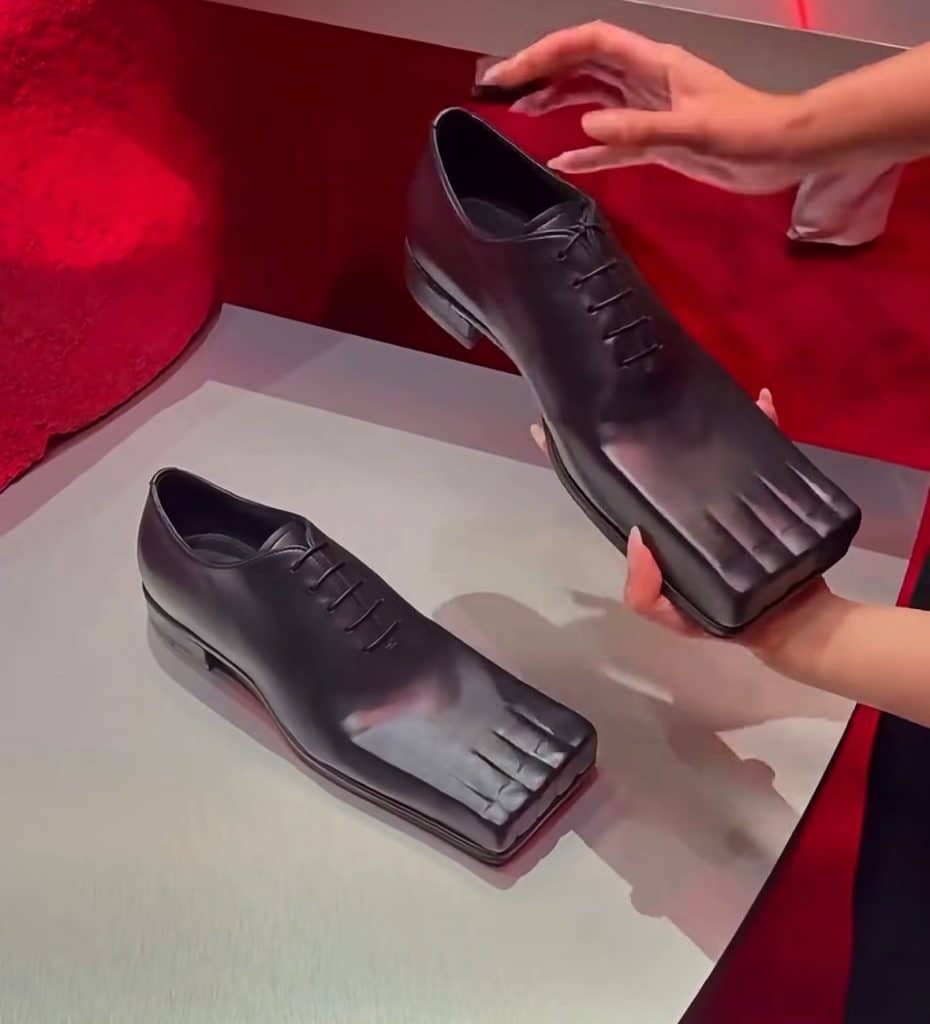
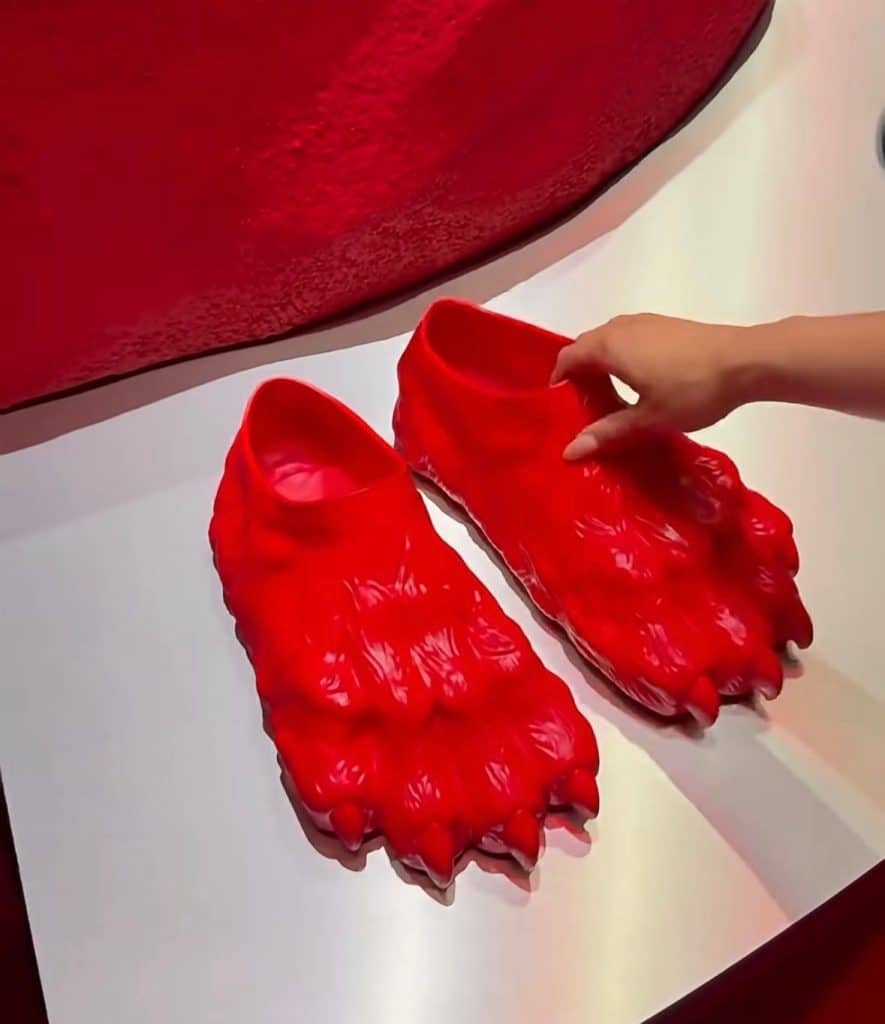
Smith, for his part, has been leaning into the hate, whether consciously or unconsciously. He appears almost cartoonishly ditzy when asked to describe his thought process behind the collection. Smith talks about certain shoes being “surrealist” and “avant”, and cites van Gogh’s Starry Night as inspiration for some of his designs. These comments are chock full of first-year-at-art-school energy, and they predictably fan the flames of criticism that seem to swirl around Smith at all times.
Jaden Smith’s Collection Highlights
Mind you, people were also quick to dismiss the strong parts of the collection. There was the sleek pair of ombre, red-to-black brogues that cleverly nodded to sunsets — a recurring motif in Smith’s other projects.

Smith also introduced a new greyscale pattern on a pair of cowboy boots and a handbag. At first glance, it just looks like a vaguely abstract design, but on closer inspection, it becomes clear that it actually depicts a monochrome crowd in motion. In keeping with Christian Louboutin’s rich Parisian history, Smith is harkening back to 19th-century photographs of the City of Lights and its people.
Even the aforementioned “Starry Night” derbies featured an intriguing toe box design, swarming with dozens of thin, protruding nails. While not everything in Smith’s newest collection was a hit, it’s worth noting that it’s also the first time I’ve heard hypebeasts talking about Louboutin in years.
When Fashion Becomes Business
As we are reminded time and again, fashion is a business first and foremost. Smith’s involvement in fashion and the resulting hate remind me of the discourse surrounding the late pop artist, Andy Warhol. In both cases, the underlying debate is less about the art itself and more about what it says about art culture. Warhol was criticized for his lack of traditional artistic skill and for relying on commercialized gimmicks to sell his work. At times, he blatantly appropriated other artists’ ideas and became widely known for a crass artistic philosophy that he summed up as: “Making money is art and working is art and good business is the best art.”
That seems to be Louboutin’s whole approach. After all, it must take a certain level of skill to become as hated as Jaden Smith. In terms of “good business”, he makes for the perfect high-value, digital-age pariah. He’s got a rich kid’s affect, with just a touch of obnoxious LA hippie. He’s got a cache of pseudo-intellectual musings that he voices whether asked or not. Even this bout as a sophomoric fashion designer reads like a crash course in modern trolling.

What really stings is that Smith’s presence at Louboutin means there may be some truth to Warhol’s philosophy, after all. Louboutin has simply accepted that this is the new way of things and adjusted accordingly. If this is how the game of fashion is being played, what’s a better measure of your art than winning the game?
People are still right to criticize Smith and Warhol, respectively. Viewing art as a business and business as an art is undoubtedly hyper-capitalistic and borders on philistine. By all means, you are welcome to hold art and fashion to a higher moral standard, but it’s worth trying to see it from a realistic perspective, too. As much as we would like to treat fashion as an untainted, purely romantic craft, Smith at Louboutin shows us that, in many ways, fashion has always been the art of spectacle.
Spectacle Is the Product
That may be Smith’s saving grace. Whether or not his shoes win you over, Smith is undeniably good at understanding concentrated aesthetics and elaborate world-building. His blending of personal and stylistic influences on his hit album, SYRE, has kept his personal brand relevant to this day. Across projects, Smith routinely constructs entire fictional universes, complete with their own characters, history, and recurrent motifs.
Smith has implemented a similar approach at Louboutin — a brand known for the iconic red lacquer applied to the soles of its shoes. True to form, Smith has gone all in, literally painting his face red for the past few months and turning his entire Instagram into a certified crimson collage. For this collection, Smith chose to transform the interior of the Palais Brongniart into a red-washed landscape, complete with an all-red Stonehenge and two giant red feet flanking the entrance in a clear reference to the Colossus of Rhodes. Whether you like it or not, it definitely leaves an impression.
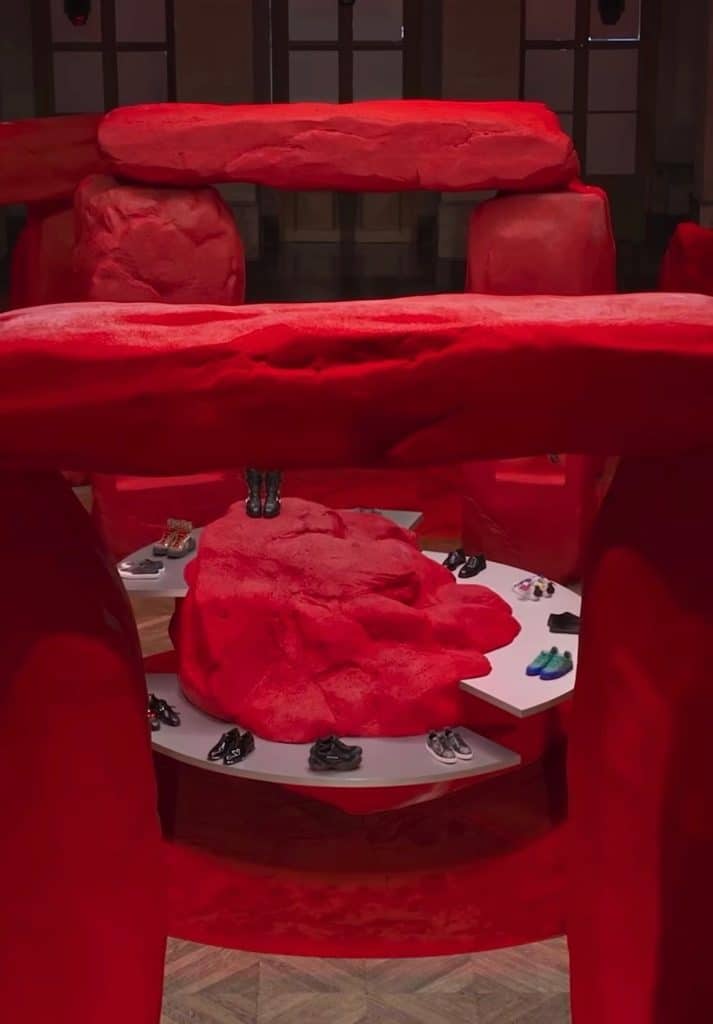
Smith claimed to have drawn influence from surrealist artists like André Breton, a fact that further distinguishes him from the average celebrity designer. For all the criticism directed at Christian Louboutin, I will say that, if the goal was just to get the media buzzing and rake in industry adulation, he could have easily gone the way of Louis Vuitton and hired a beloved celebrity like Pharrell. Choosing to bring Jaden Smith on board does present a bit of a gamble.
Playing the Long Game
What I’m saying is, Smith is definitely not a sure bet. He takes pride in being outspokenly unconventional. In the past, Smith has made waves for breaking down gender barriers in fashion: he rocked a skirt as the face of Louis Vuitton’s womenswear campaign and brought his own newly-cut dreads to the Grammys as a personal accessory.

What’s more, Smith is also young. At just 27 years old, his appointment at Louboutin signals a much-needed shift toward valuing younger voices in fashion. Even if some of the shoes were misses, it’s refreshing, as a young person, to see shapes and silhouettes that look distinctly youthful. I can honestly say that I’d love a pair of those Swiss-cheesed Plato-dots loafers. Even the bear claw shoes looked, to me, eerily similar to the big red boot that saw MSCHF sell out within minutes. These are designs that objectively make more sense to a younger audience, and it’s why most of the public outcry against Smith’s work has come from the older fashion community. They take Smith and his work at face value: a rich-boy poser with nonsensical ideas. They don’t seem to realize that Louboutin isn’t set on winning the battle — instead, the company wants to win the war.
Just the other night, at the BET Awards, host and social media star Druski made a memorable entrance suspended above the crowd in a satire of mega-church pastors. As he swung out over the audience, he shouted, “Y’all see I got these Christian Louboutins? I’m stepping in the blood of Jesus!” That same night, actor Miles Caton appeared on the runway in Louboutin boots and a matching harness. So while it might not be your suburban mom’s taste anymore, Jaden Smith’s Louboutin is clearly tapping into something that young people find exciting.