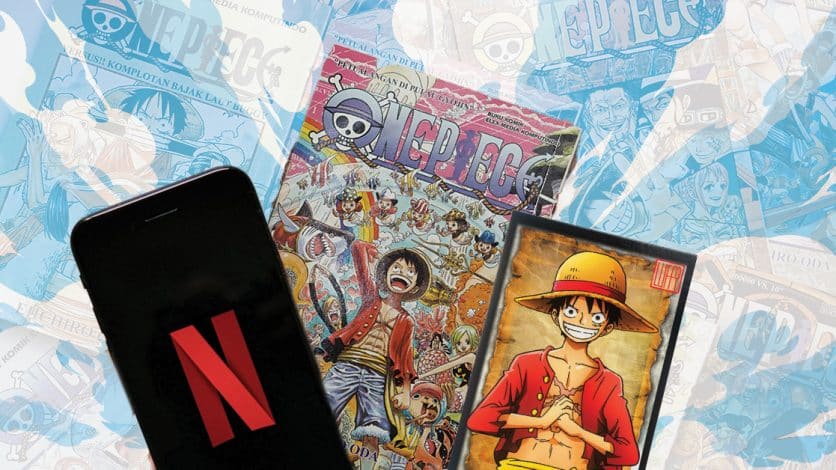
You know the hat, you know the smile, you probably even know the name: One Piece. Here’s everything you need to know and why the manga is still the best way to experience the story.
Saying One Piece is a story about pirates is like saying Avatar: The Last Airbender, is a story about a bald kid. One Piece is a masterpiece of the sort that comes up in a medium once every generation. The sort of story that makes history! The sort of story that changes lives, the sort…I’m getting ahead of myself. Let me start over.
Let’s start with the basics. One Piece is a manga, a black and white Japanese comic, published in the massively popular Weekly Shonen Jump. This is a biweekly anthology magazine that publishes serialized comics targeted toward young adult males. One Piece first sailed onto magazine pages in *checks notes, checks notes again* 1997.
To say One Piece has had a successful voyage would be an understatement. During its run, it has smashed records, spawned countless spinoffs (including a live-action series and an ice-skating show), and catapulted its creator to tenth place in the pantheon of all-time bestselling authors.
Speaking of the author, let’s meet him!
Eiichiro Oda, like most mangaka, is reclusive. He rarely leaves his face uncovered in photos or videos. But if you’re not seeing him on the street, it’s not just because he’s shy. Oda is an admitted perfectionist who works from 5 am to 2 am every day, sleeps away from his family, and only sees them once a week. Unusually for a mangaka of his stature, he does most of his illustration work himself, rather than relying on assistants.
Despite this punishing schedule, he does give the occasional interview. He also keeps a regular correspondence with fans, so we know some information about this reclusive genius. We know, for example, that he is married and has two children. We also know that he was born in the Kumamoto prefecture.
In 2016, an earthquake measuring 7.0 on the Richter scale rocked the area. In the aftermath, Oda made substantial donations toward recovery and worked on art for local projects. As a thank you, the local government erected statues of Luffy and his crew around the prefecture. Not a memorial building made out in his name, nor a mural of him somewhere, but statues of his characters. Oda is One Piece; One Piece is Oda. Now that we’ve talked about one side of the coin, let’s talk about the other.
What’s the story?
Immediately before his execution, the Pirate King Gold Roger announced he had left his treasure all in one place. In a majority-water world, treasure hunters and pirates raise their sails and take to the Grand Line, a dangerous and unpredictable stretch of water, to find it. Meanwhile, the World Government tries to stop them, maintain order, and eradicate pirates from the world.

20 years later, Luffy sets sail. His weapon? A rubber body. His greatest asset? An indomitable will. His goal? Claim the treasure at the end of the Grand Line and become king of the pirates. As he sails from island to island gathering crew, he faces increasingly dangerous and bizarre opponents, making a name for himself almost by accident. Finally, he sets out on the Grand Line. Here, he will meet allies, enemies, and tribulations greater than anything he could have ever imagined. In the background looms an increasingly sinister World Government and an ancient, half-forgotten war. And Luffy, unbeknownst to himself, seems to be the key to ending it.
Oda insists he is writing a fun story for kids. Despite this professed shallowness, One Piece deals in weighty, heady themes. The inheritability of will, the dangers of oligarchy, and freedom are some of the themes Oda tackles. Oda is also not averse to asking difficult questions. How much of the history handed down to us can we trust? What makes a government flawed? Is the creator to blame for the misappropriation of his creation? What makes a great leader? What is the cost of meaningful, lasting change? These are only some of the questions Oda asks
Why do people love it?
The fact that people love One Piece is obvious, but the answer to why is not as obvious. Why have so many people fallen in love with a pirate story written for teenage boys? The answer is the same as for any great work of literature: Its story is more than its basic premise.
Oda fills his story with likeable, complex characters who bounce off each other in engaging and unexpected ways. While this alone engages you, what keeps you hooked is how they grow through the story. Character arcs in One Piece aren’t a simple linear progression. The characters have their high points and low points. They suffer and face problems that their capable fists can’t solve.
But this isn’t just a set of character pieces; there is a compelling overarching narrative. Each Island brings a new setting, enemies, and friends. Oda somehow manages to balance moments of zany humor with scenes of shocking darkness and moments of deep philosophy. All this, while keeping the story sailing at a vigorous clip, especially in the first half. And if things slow down in the second half, it’s only because the story has grown with its audience and is more comfortable taking time to build out the world and the characters who live in it.
And all that is without even talking about the art. Oda’s style is unmistakable. Both in plot and art, Oda is a Mozart. He pairs childish humor with sophisticated thematic sensibilities, and his cartoonish style often masks his astounding technical skill. And, though Oda’s paneling can occasionally be dense, at his best, he’s nearly unparalleled in the dynamism that he coaxes out of his medium.
Welcome aboard! here are your crewmates!
One Piece’s ascent has been a shockingly slow burn, given the persistent quality of the series. Its popularity has deservedly skyrocketed in recent years. Your parents probably have seen Luffy, if not on the cover of a manga, then probably on his Macy’s Thanksgiving day parade float when it debuted in 2023.
This increase in awareness and popularity has bred a niche of lively content creators. Youtubers like Morj talk at great length about the importance and greatness of One Piece. Meanwhile, channels like Grand Line Review float theories, recap chapters, and indulge in the age-old shonen-fan pastime of speculating who can beat whom in a fight.
There are also more analytical creators, like TBSkyen and Totally Not Mark, who thoughtfully dissect the story, chapter by chapter. And once you’ve caught up, you can dive into the backlog of creators like AxelBeats! and MelonTeee, who have produced substantial analyses of the characters and themes driving One Piece.
Finally, there’s an active Reddit community. Here, you can find fans joking, theorizing, sharing fan art and cosplays, and discussing how the series has impacted their lives. But be warned: It has spoilers. Now that I’ve discussed the story, people who love it and why they love it, let’s talk about the best way to experience it–and why it’s the manga.
Why should I read it?
The two biggest points in favor of the Manga both stem from its status as the original version of the work. The first of these advantages is that when you’ve caught up, you’ve really caught up. This means you can engage with the bustling community without fear of spoilers. The manga paces itself better than the anime, which saturates its episodes with filler to keep to a 1:1 episode-to-chapter ratio.
There are other advantages as well. Reading the manga allows you to experience the vision of the author in its purest state. Oda fills his panels with easter eggs and in-jokes that the anime doesn’t always pick up on. And, when he isn’t testing the maximum number of panels he can pack onto a page, Oda is a fantastic artist.
Reading the Manga also grants you access to extra content. Oda often uses the cover pages of the manga chapters to tell side-stories that co-occur with the main narrative. The stories, told through single-panel comics, range from comedic codas or diversions to important plot developments and lore. They frequently go ignored in anime and will probably remain so in the live-action. The manga is uniquely able to contain them.
Another thing you would miss out on if you were only watching One Piece is the SBS sections. Here, Oda gives half-serious answers to fan questions and fills out the lore with trivia like birthdays and bathing schedules. On occasion, he points out easter eggs that went largely unnoticed or extra details like detailed ship schematics. Moreover, the final pages may include fun activities and coloring pages.
Where can I read it?
There are two main ways to get started reading One Piece: paper volumes and digitally. The paper volumes, which are published by VIZ, are almost certainly available at your local book or comic store. Typically, a volume will cover a couple of chapters. Being able to hold books in your hands is always nice. Plus, reading them in print brings you closer to reading them as they were intended to be read. You can buy the first three volumes in an omnibus here. However, given the sheer length of One Piece, purchasing physical volumes is not always a realistic proposition–whether you lack shelf space, funds, or both.
The second option, and the one that I use, is to pay for a monthly membership to the Shonen Jump website through VIZ, the publisher. This membership is only a couple of dollars and grants access to a huge portion of Jump’s Archive (they published a bunch of other big names, like Dragon Ball, Naruto, and JoJo’s Bizarre Adventure). Plus, the entirety of One Piece. You get it all for a fraction of the price. Sign up here.