When the real world excludes, queer fans rewrite through fan fiction.
In the crevices of the internet, a yearning for belonging arises — born from the displacement and the lack of representation in mainstream narratives.
To ease that discomfort, people immerse themselves in fictional worlds through fan fiction, inserting parts of their own identities where reality has fallen short. Nowhere is this more vital than within the queer community, where marginalization and erasure often push individuals to seek refuge in fiction.
The impulse to rewrite is ancient
Literature as an outlet for therapeutic expression is hardly a foreign concept, though fan fiction represents a comparatively new iteration of that impulse, with its popularity surging alongside the anonymity provided by the internet.
However, its emergence is far from unprecedented. In many ways, fan fiction is rooted in antiquity; classic literature frequently serves as a precursor to modern transformative works, with writers reinterpreting, expanding, or subverting existing stories long before the term “fan fiction” existed
In fact, drawing upon the inspiration and familiarity of the original world, readers have long sought to expand stories that captivated them. This impulse stretches back to Homer, whose epics inspired later Greek and Roman authors to reimagine familiar mythic narratives.
In the 19th and early 20th centuries, this impulse took more recognizable fan-fictional forms.
For instance, readers of Jane Austen’s novels didn’t have to wait for sequels—they wrote them themselves. Sybil Brinton’s 1913 Old Friends and New Fancies: An Imaginary Sequel to the Novels of Jane Austen is widely considered the first published Austen fan fiction, a playful attempt to extend characters’ lives and stories.

Similarly, Sherlock Holmes enthusiasts frequently penned their own adventures, particularly during long waits between Conan Doyle’s stories
Digital fan fiction as queer sanctuary
The rise of sprawling online archives has only deepened this sense of possibility. Platforms like Archive of Our Own and Tumblr have turned niche fandoms into vast, collaborative ecosystems where queer narratives are not exceptions but the norm
In these corners of the internet, readers trade stories the way friends once traded secrets—quietly, urgently, and with the understanding that someone on the other side will understand.
Data from AO3 supports the idea that such communities are not just welcoming on principle but overwhelmingly queer. In a survey of over 16,000 users, 81% identified as LGBTQ+, with 25% identifying as transgender and a smaller but notable 1% as intersex.
The data reveals that the platform is a space where non-normative identities are not peripheral but central and where writers and readers alike can safely explore and affirm their sexual and gender identities.
As fan fiction moved online, the internet became a kind of digital closet—private enough to offer protection, yet open enough to welcome anyone who entered.
For queer readers and writers, the space offered something they rarely found elsewhere: the freedom to try on identities, desires, and narratives without fear of exposure.
Within these anonymous corridors, fan fiction evolved into a quiet but powerful form of self-recognition. Users could rework familiar characters into versions of themselves, test new names or pronouns, and imagine relationships that reflected who they were or hoped to be
Consuming and creating fan fiction
The absence of queer stories inspires the average person to pursue their own form of authorship, articulating fictional worlds that actualize their desires and help them navigate the parts of themselves they cannot yet name.
This blend of exploration and creation is central to the experience of many queer fans, and for Vivian Muñoz, 26, it became a lifeline. As both an author and a consumer of fan fiction, Vivian discovered the genre on Wattpad at the age of 13.
Reading gave them language for identities that felt just out of reach; writing gave them the freedom to test those identities in private, on their own terms.
“Fandom spaces are what helped me understand gender fluidity and different identities. I think a lot of anime fandoms like Attack on Titan in 2014 dealt with gender identities and I was able to explore my own identity the more I read.”
For Vivian, fandoms functioned as more than entertainment; they were frameworks for self-reflection. Engaging with fanfiction allowed them to experiment with pronouns, gender presentations, and relational dynamics in ways that were affirming and exploratory.
The process of writing, particularly in fandoms such as Detroit: Become Human, became an intimate method of self-expression. Vivian describes their work as almost simulating personal sexual experiences:
“I would write explicit content in a way that almost replaced my own sexual encounters. I wrote my characters treating each other the way I wanted to be treated.”
In the shelter of screen names
Anonymity and pseudonyms play a crucial role in queer fans’ ability to investigate identity. Writing under assumed identities allows them to experiment with sexuality and gender without fear of social repercussions.
Certain fandoms, such as Hannibal, Detroit: Become Human, Kingsman, Attack on Titan, Merlin, and Good Omens, offer particularly fertile ground for this process.
The worlds typically feature characters who are nonhuman, androgynous, or otherwise malleable, giving fans the freedom to reinterpret gender, body type, and sexual orientation.
With Detroit Become Human, a game built around androids awakening to their own consciousness, it’s not hard to see how queer players found room to probe their own forms of becoming. Detroit: Become Human supplied a narrative where sentience unfolded slowly, hesitantly, in the shadows of a rigid world—an arc that mirrored the writer’s own complex negotiations with gender and sexuality
”When I wrote for the Hank and Connor pairing, I realized I was writing about body dysmorphia, found family, and queer gender identities,” Vivian said. “That fandom helped me feel comfortable changing my pronouns.”
On writing queer when the canon won’t
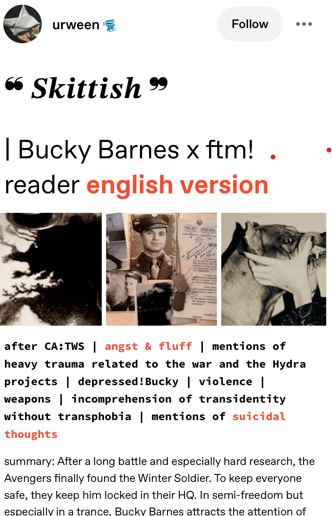
It becomes clear, then, that mainstream culture remains saturated with heteronormative narratives, both in life and in fiction.
Yet queer communities can respond through fan fiction by reshaping exclusionary stories into ones that finally make room for them
Scholar Jennifer Duggan’s research backs these claims. She notes that speculative genres, such as science fiction and fantasy, are uniquely suited for queer experimentation.
The queer community’s long-standing habit of confronting and amending omissions in dominant narratives is now gaining scholarly validation.
Researchers repeatedly note that canonical texts tend to reiterate and reinforce heteronormative identities; in contrast, fan fiction provides what Eve Sedgwick termed a “reparative reading,” or an approach that allows readers to challenge exclusionary narratives while imagining more expansive worlds.
In the end, fan fiction endures as one of the few creative ecosystems where queer people, especially young queer people, can rehearse who they are before the world insists on defining them. It is a workshop for identity, a stage for desire, and a refuge where the rules of gender and sexuality bend toward possibility rather than constraint.