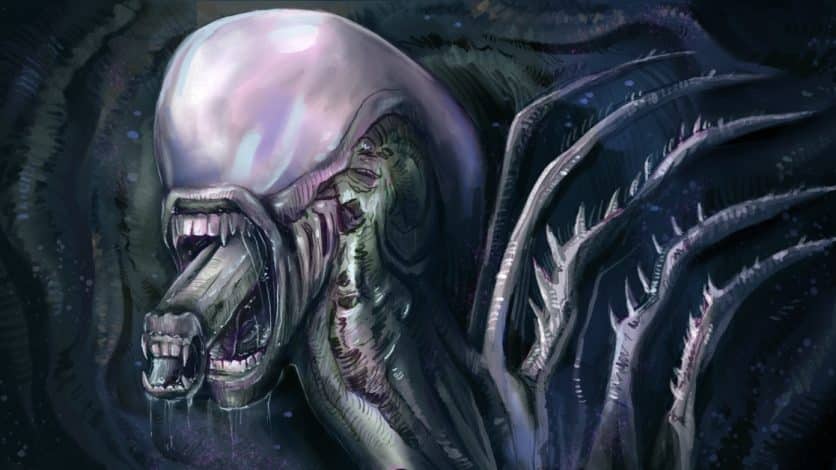
With Alien: Earth premiering on Disney+, the iconic franchise that once redefined sci-fi horror is turning its gaze to a far more introspective territory. Showrunner Noah Hawley has promised a darker, philosophically inclined entry into the Alien universe. One that doesn’t just focus on acid-blooded monsters or the thrilling chase between Xenomorphs and humans. And from the early episodes to the fresh premise, Hawley seems to have delivered what he promised.
So far, Alien: Earth explores what these aliens imply about humanity’s place in the universe. In other words, it’s a move into cosmic horror territory with a genre that questions if we humans are truly the most superior race in the cosmos.
Of course, this isn’t uncharted territory for the Alien franchise. From the 2012 entry, Prometheus, and even in Ridley Scott’s original film, the film has never truly been about killer aliens, unlike what the title suggests. It was about the terrifying possibility that humans are irrelevant in a vast, hostile universe. Alien: Earth doubles down on that idea. Taking place on a future Earth where corporate overreach and technological power rule the planet, the existence of an alien force beyond such powers makes humanity feel powerless.
But what exactly is cosmic horror, beyond the scary aliens and tentacles? And why is it more relevant than ever? Since Alien: Earth introduces such ideas to a new mainstream audience, it’s worth tracing the literary lineage behind them. From the books, authors, and philosophies, we’ll examine what kept this genre alive and mutating for generations.
What exactly is cosmic horror?
“The most merciful thing in the world, I think, is the inability of the human mind to correlate all its contents.” – H.P. Lovecraft, The Call of Cthulhu
Cosmic horror is unlike Gothic or Slasher horror. Whether it be ghosts in a haunted mansion or a killer with a knife, those things are tangible forces. We can see them, understand them, and later in the story, we even learn more about them. Instead, cosmic horror is all about slowly shattering the comfy foundations that we rely on. What happens when humanity is confronted by a cosmic force that is inevitable? What is the meaning of our religions and sciences in a cold, uncaring universe? It raises the horrifying implication that nothing matters and that we, too, are nothing. That dread and atmosphere is what lies at the center of the genre.
But most of all, the core of cosmic horror is the fear of the unknown. These stories aren’t about what the monsters are. Writers present these elements vaguely or eliminate them outright in favor of what they represent: the limits of human understanding. Characters in this story might come across a forbidden truth or even an alien god hidden in the earth’s surface. But while readers can speculate what those things are, they are plagued by a lingering uneasiness regarding the lack of definition. The forces are out there, and there is nothing that can stop them.
Naturally, this means that cosmic horror isn’t usually a popular genre on screen. How do you show something as an unimaginable thing? How do you make the monster ambiguous in a visual medium? In film or TV, monsters typically embody a design, which is something knowable. Thus, literature is the traditional home for cosmic horror. Shrouded in flowery language and suggestive words, the monster is vague, with gaps that can only be closed by the readers’ imagination.
Origins of cosmic horror
The roots of cosmic horror go back to the early 20th century and to one name that lives in infamy: H.P. Lovecraft. A deeply flawed but undeniably influential writer, Lovecraft pioneered a kind of horror that was less about vampires and ghosts (a common trend at the time). Instead, he focused on ancient gods, forbidden knowledge, and the limits of human sanity. His mythos, the infamous Cthulhu, the Necronomicon, and the Elder Things all formed the foundation of cosmic horror, where the real monster is the truth itself. In a way, Lovecraft’s works acts as a bridge from late 19th century gothic tales to the more recent trend of sci-fi horror, with one example being Ridley Scott’s original Alien film.

Lovecraft’s obsession with cosmic horror was a direct reflection of his worldview, one shaped by deep xenophobia, elitism, and a fear of the unknown. He saw the world outside of his home in Providence, Rhode Island, as an increasingly alien and threatening realm. In particular, he feared the advance of science, immigration, and social change in the early 20th century. His stories project that anxiety outward: the terrifying “other” becomes not just people from different cultures, but unknowable beings from other dimensions, whose mere existence threatens one’s sanity. In this way, his fiction channels personal and cultural fear into myth, turning prejudice and isolation into metaphysical horror.
But don’t let Lovecraft’s questionable worldview discourage you from reading. His idols, Algernon Blackwood, Arthur Machen, and William Hope Hodgson, among others, also wrote about cosmic forces for entirely separate reasons from Lovecraft’s problematic beliefs. And more importantly, authors like Thomas Ligotti brought a more inclusive, psychological, and contemporary lens to the genre. Writers like Ligotti show that cosmic horror is evolving, just like the universe it fears.
Recommendations and where to start with cosmic horror
If Alien: Earth sparks your interest in cosmic dread, the best place to start is in the pages. Read the classics: Lovecraft’s short stories such as The Call of Cthulhu, The Colour Out of Space, and At the Mountains of Madness. Most of them feature cosmic monsters, sure, but the terror of the story lies in what their existence implies: a vast, indifferent universe fundamentally beyond human comprehension.
Of course, Lovecraft’s work isn’t for everyone. His prose is clunky, and his lack of dialogue makes it hard to focus on the story. For a different voice that still captures similar ideas, check out Algernon Blackwood’s The Willows. There are no tentacle monsters or ancient gods, just two men in a forest, and hints that something is very, very wrong. The haunting atmosphere and slow-burning horror will leave you entirely breathless. It’s a level of unease that Lovecraft rarely reached at his best. Imagine Heart of Darkness written in an eldritch twist, where the evil doesn’t come from an imperialism allegory but an incomprehensible alien force. Lovecraft called it “the finest weird story he ever read,” and that’s for good reason.
From there, cosmic horror takes bold new forms through modern hands. The Southern Reach Trilogy by Jeff VanderMeer is one such example. The trilogy begins with clinical reports and dissolves into something stranger: fractured timelines, shifting identities, and ecosystems that defy explanation. VanderMeer makes ecological decay an existential terror, as even the Earth itself becomes alien. The film adaptation of the first book, Annihilation, stars major Hollywood actors like Natalie Portman. Even the most hardcore cosmic horror fans admit that the magic of the genre was preserved on the screen.
Conclusion: why cosmic horror still haunts us
In a time when the world feels increasingly unpredictable, it’s no wonder that cosmic horror is becoming mainstream. It speaks to a fear bigger than monsters: the fear that no one is in charge, and nothing makes sense. But in a twisted way, it may also speak to the comfort of knowing that confusion and turmoil amount to nothing in the grand scheme of things. Alien: Earth taps directly into that unease, but the roots run deep, and they’re dwelling in the pages.
Cosmic horror reminds us that the scariest things aren’t always the things lurking in the dark. Sometimes, it’s the knowledge we were never meant to have or the realization that the world we see is not quite what it presents itself as. As the genre continues to evolve, its stories challenge us to sit with the unknown.
For readers, that’s where the real horror and obsession begin.