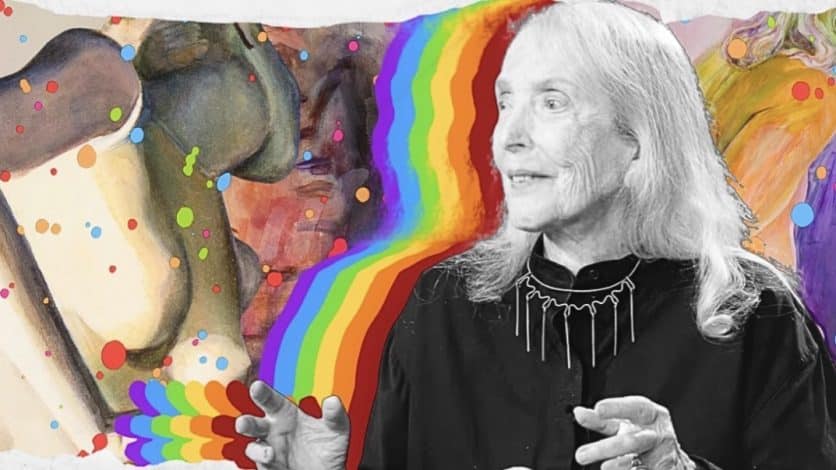
On view at The Jewish Museum in New York City until the end of May 2026, a room filled with large paintings of nude figures invites you into a sensual exploration of the form. Joan Semmel’s sixteen works, consisting of paintings, paper sketches, photography, and sculptures, are raw, vulnerable, and undeniably naked. Semmel is the artist behind In the Flesh, a collection of her best works since the 1970s. In her vast exhibition, Semmel works to fight against the taboo of women artists, women’s bodies, and the act and art of nakedness. Her nude portraits explore identity, individuality, and feminism within the art of naked embracing forms.
Naked versus nude: a notion Joan Semmel answers
Joan Semmel’s feminist artwork is based on the foundation of the difference between “nude” and “naked.” In Semmel’s eyes, to be naked is to be unclothed and see yourself as an individual. To be nude is to be seen naked by others but objectified and without seeing yourself for yourself. Naked bodies without a face implore viewers to see her art, and themselves, as simply what they are: bodies. Individuality does not require a face, and to see and know your body as it is unlocks true self-love.
Joan Semmel’s paintings feature figures embracing themselves, including the most naked and vulnerable parts, with love and gentleness. The soft lines in the figures and the curves and muscles in the paintings are all intentionally soft, invoking the idea of nakedness beyond the physical. True vulnerability and identity come from loving the imperfect; not just on the outside, but on the inside as well. So much of society’s view of women comes from ideas of traditional beauty and body standards. Semmel offers a gentle but powerful feminist protest: “Here we are, as we are…”
@artpulsenyc Join us at the provocative Joan Semmel exhibition at the Jewish Museum. The show traces Semmel’s career—from her iconic works rejecting the male gaze to her later-in-life paintings that keep aging bodies in the spotlight. The exhibit will be open until May 31. #art #nyc #nycart #joansemmel ♬ original sound – artpulse.nyc
What In the Flesh does differently than other exhibitions is that it takes away the external world. The focus is on the subjects and their naked bodies as individuals. The nakedness of the portraits transcends the state of being unclothed. As the individual, or individuals, embrace themselves and/or each other, the rest of the world falls away. It is a testament to self-love and to seeing and appreciating our bodies as they are, despite whatever flaws might be present. Joan Semmel’s work follows themes that speak to her personal experience as a woman and her own relationship with her body.
Identity and individuality, imperfection & vulnerability
Many of Semmel’s works revolve around bodies embracing–but not just with multiple subjects. Her works depicting singular individuals embracing their own naked forms serve to highlight the fluidity of identity and comfort with the self. Joan Semmel’s feminist work urges viewers to embrace themselves for qualities that go beyond the skin. In the Flesh shares the deep themes of empowerment in the female form, along with philosophical questions about identity within the self.
The art features multiple figures lying together and leaning into their vulnerability, producing a gentle haven where women find safety amongst each other. These works create a breathtaking third space where you feel as though you are one of the subjects. Despite differing physical positions, both figures are equally important, another reflection of Semmel’s feminist inspirations.
Joan Semmel’s feminist work of nude self-portraits, while entirely unclothed, is not about sex. The images are full of much deeper emotional influence and themes of self-identity and individuality. It isn’t about the act of sex happening amongst the bodies; it is about celebrating their individuality with each other. Identity of the individual comes not from faces or sex but from vulnerability. This encapsulates the theme of sexual agency in Semmel’s works.
As God made it: how growing up Jewish influenced Joan’s art
Joan Semmel’s upbringing in a New York Secular Jewish (one of the more progressive Jewish sects) home likely influenced her artwork. In Judaism, there is a belief in sanctity in the human form, exactly the way God created it. Joan Semmel’s work of showing bodies in their raw, naked forms is likely inspired by these teachings. While pornography is frowned upon for religious Jews, Semmel is neither Orthodox nor Hasidic (two of the most traditional Jewish sects); nor is she a painter of pornography. Her work is about appreciating the body’s perfection. This is a beautiful testament to Semmel’s Jewish upbringing and how it inspired her best works of art.

As a Secular Jew, Joan Semmel’s view on sexuality is more open-minded than that of popular Christian narratives. Secular Jews forego many of the older taboos associated with bodies and sex. For Secular Jews, bodily consent, autonomy, and even pleasure are regarded as normal. These teachings certainly influenced Joan Semmel to view naked bodies as non-taboo and beautiful. In her eyes, bodies aren’t meant to be hidden; they deserve to be uplifted. This is a core part of the Jewish faith: honoring the God-given body.
Joan Semmel’s teachings focus on sanctity in the human form. Rather than stain or shame the naked form, she creates a sacred space to worship it. Her faith normalized the acceptance of autonomy, consent, and pleasure, which she used to show people in their nakedest–and some might say holiest–forms. Her Jewish identity doesn’t contradict her artistry; it nourishes it.
The body: extension of the self, a separate individual
Semmel’s feminist images of holding yourself versus holding another in gentleness and vulnerability portray the core idea of the body as a separate but related individual to the self. Thus, faces aren’t necessary in In the Flesh. This idea directly correlates to her return to NY in 1970, where she found her community of feminist artists and curated exhibitions that defied the dominant male gaze in women’s nude art at the time.
Maintaining a healthy relationship to your body entails the recognition that it is your partner for your life. Our bodies are our first, last, and most loyal partners. You have to treat your body as an individual with needs–one that is deserving of love and respect. The history of female nude art largely became dominated by male artists who depicted women’s bodies as objects. Feminists like Semmel see bodies as individuals, subverting the narrative that came before. Joan Semmel’s work aim to reclaim the autonomy of our bodies, both in real life and in art.
@artforum In 2013, “Joan Semmel: A Lucid Eye,” the artist’s first solo museum exhibition, opened at the Bronx Museum of the Arts. To mark that occasion, Artforum joined Semmel in her SoHo studio for a conversation about her life and work. Revisit the interview conducted by Lauren O’Neill-Butler through the link in bio. In the February issue, Ida Panicelli reviews “Joan Semmel: Against the Wall” at New York’s Alexander Gray Associates, a recent show that featured new works in which the nonagenarian artist “acknowledges her own finitude, depicting herself in spaces that appear confined and simultaneously infinite.” “Joan Semmel has never displayed any embarrassment about portraying her own body, confronting without compromise all the subtle modifications wrought by age,” Panicelli writes. “Rejecting the classical and idealized concept of the female body, the artist shows us her flesh, genitals, and abundant breasts—she is not interested in the face but in skin, minus any frills—and returns us to our shared humanity.” #JoanSemmel #ArtforumVideo #Painting #Artist #Art #GetCultured #NewYork #Exhibtion #Artforum #portraits ♬ original sound – Artforum
Joan Semmel’s commitment to concealing the faces of her subjects doesn’t objectify them like male artists once did. Her art means to free bodies from objectification. Bodies, particularly women’s bodies, have been historically and culturally deemed taboo. Joan’s work has carved out space for women artists to assert their voices and share their art.
In the Flesh: retrospective of art, feminism, & nudity…
Joan Semmel’s work is as historic and powerful as that of a trailblazing veteran of feminist art. In the Flesh is a provocative and intimate display of womanly nudity, individuality in bodies, and vulnerability in nakedness. It asks you to become comfortable with taboo and to see things as they are rather than as told to you. It is a breathtaking display of Semmel’s best work. Many of the pieces are from her earlier decades, while others are as recent as 2019.
Joan Semmel’s work is groundbreaking, captivating, and truly an experience for anyone who is interested in feminist Jewish art or in themes of identity in nude art–or someone who simply wants to broaden their horizons. The exhibition features some of Semmel’s favorite works from other Jewish artists as well. In the Flesh is an artistic and cultural experience; the works will fill you with wonder and questions. Political art and art that incites social commentary are good for everyone, and thankfully, there’s a lot of great conversational art out there now.
Feminist art is thriving today, with myriad women reinvigorated to fight for gender equality. Joan Semmel’s work reminds us that women still have more to say–that there is far more discussion, dissection, and understanding to be had. Her art will stay with you, not unlike a powerful message in a bottle. The legacy Joan is setting is one of continued perseverance, learning, and exploration.