The internet’s appeal often arrives in the pixelated frames of squares and rectangles. As users scroll through feeds, timelines, and group chats, they encounter an endless stream of memes—small, seemingly disposable images that function as one of its primary forms of communication. Their immediacy allows a single image to convey frustration, embarrassment, excitement, or disbelief more efficiently than words.
Memes are a dime a dozen, preserving fleeting feelings within the comment sections of TikTok, Instagram, and the countless crevices of the internet. They punctuate everyday digital life; yet behind many of the internet’s most recognizable reaction images are moments of genuine grief, humiliation, fear, and vulnerability. Through constant circulation, these images become untethered from their origins, transformed into cultural shorthand whose meanings often bear little resemblance to the circumstances that produced them.
The internet’s native language
Memes seem to have spawned with instantaneous ease, emerging from scraps and somehow proliferating. But the concept actually predates social media. Long before reaction images populated comment sections and group chats, Richard Dawkins coined the term “meme” in The Selfish Gene (1976) to explain how cultural ideas spread through behaviors and symbols that replicate like genes across societies. The internet later created the ideal environment to accelerate this process.
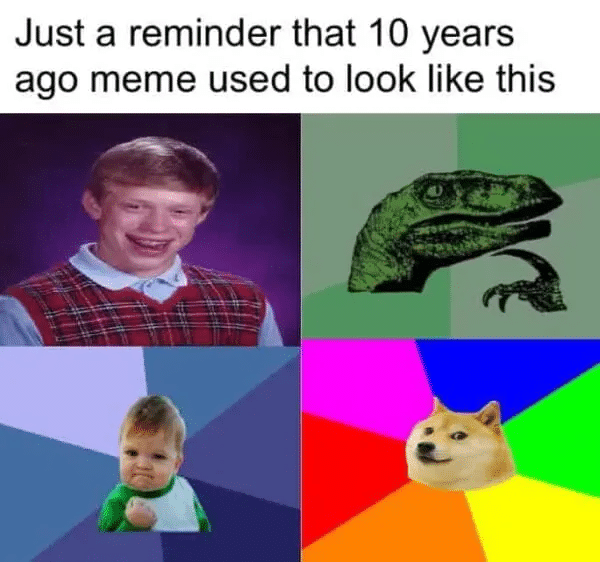
Early viral phenomena such as the Dancing Baby, LOLcats, and the endlessly remixed “Bad Luck Brian” demonstrated how users could transform ordinary images into shared cultural artifacts. As platforms evolved, meme culture evolved with them. Users created Advice Animals, Rage Comics, and later reaction images that shaped the visual language many members of Gen Z grew up with.
From cultural gene to viral meme
In the expanding digital space, images are clipped from their original contexts and repurposed for virality. In this attention economy, emotion becomes a commodity—pulled apart, packaged, and exchanged in fragments cut off from their surrounding stories.
In Memes in Digital Culture, Limor Shifman draws on research by Jonah Berger and Katherine Milkman to explain why certain forms of online content achieve extraordinary circulation. Their findings suggest that people are more likely to share material that evokes high-arousal emotions such as awe, anger, or anxiety. Memes capitalize on this logic by condensing emotional experiences into instantly recognizable visual forms.

Further, Shifman argues that internet memes function as a form of vernacular creativity, with everyday users increasingly shaping online culture instead of traditional media institutions. Drawing on the work of Jean Burgess, Shifman suggests that memes function as a shared cultural language through which communities construct identity, establish social boundaries, and communicate collective experiences. Memes do more than entertain; users continually negotiate their meanings through circulation, repetition, and remixing.
Fluency often comes at the expense of context. The same processes that transform images into cultural virality also strip them of the circumstances from which they emerged. As memes circulate, individuals become templates, experiences become reactions, and moments of vulnerability become reusable forms of expression.

Talking in memes
Gen Z’s preference for talking in pictures stems from the commercialization of emotion and the accessibility, immediacy, and visual appeal of expression. Feelings that required lengthy explanations can now be conveyed through a single image, no longer diluted by words.
Among the internet’s most recognizable reaction images, women appear with notable frequency. Online communities routinely detach moments of grief, frustration, embarrassment, and despair from their original contexts and circulate them as emotional shorthand.
Media scholar Zizi Papacharissi describes this phenomenon as “affective publics,” networked communities that form around the online circulation of shared emotions. Within these spaces, users value images for their ability to communicate feeling quickly and collectively, often over the circumstances from which they originally emerged.
For a generation raised in continuous connectivity, this visual language serves as an efficient emotional signaling system. Recognition replaces explanation, and understanding emerges through immediate identification rather than sustained engagement. Memes are essentially compressed emotional archives, allowing users to signal complex states of mind through a single image.
Susan Sontag, in Regarding the Pain of Others, argues that repeated viewing can distance audiences from lived reality, turning experience into spectatorship. This tension has affected Gen Z’s adjustment to adulthood amid economic instability, climate anxiety, political uncertainty, and declining social mobility. Across blogs, essays, and online diaries, there are countless accounts of the dissatisfaction young people feel with the world they inhabit. A recurring theme is the paradox of being told that they are “the future” while feeling increasingly unable to create that future. Instead of inheriting opportunity, Gen Z has come of age during overlapping crises that make the future feel less like a promise and more like a burden.
The faces of feeling
Celebrity culture and reality television make this dynamic particularly visible by converting women’s emotional expressions into widely circulated affective templates.
For instance, Taylor Armstrong’s emotional breakdown on The Real Housewives of Beverly Hills, during which her experience of abuse was publicly revealed, was widely repurposed as reaction content for overwhelm or distress.

Similarly, images of Britney Spears from periods of intense media scrutiny in the late 2000s—showing her crying, visibly distressed, or surrounded by paparazzi—have trended as a visual proxy for emotional instability.
A photograph of a woman crying at the National September 11 Memorial & Museum, originally taken during the twelfth anniversary commemorations of the September 11 attacks, has gained similar traction online as a reaction image for frustration, disappointment, or minor distress, divorced from its original context of public mourning.
In meme culture, these images are reposted with cavalier captions to signal everyday frustration, awkwardness, or exaggerated reactions to minor inconveniences such as school stress, social embarrassment, or routine overwhelm.
The ownership of feeling
Online communities extract women’s emotions from their sources and retool them into repeatable units of affect, making them more palatable and easier to consume within digital culture.
Across these examples, circulation diminishes emotional specificity in favor of recognizable intensity while exposing a gendered structure in digital culture. Meme culture repeatedly generalizes women’s emotional expressions, turning feminized feeling into consumable cultural material.
As Sara Ahmed observes, female unhappiness occupies a peculiar cultural position: It attracts attention precisely because it disrupts the affective norms that women are expected to embody. The figure of the unhappy woman lingers within the social imagination as both a source of fascination and a problem to be managed–a dynamic likewise reflected in meme culture.
Underlying this circulation is a curious appetite for the spectacle of female feeling. Emotional expression is reduced to an object of consumption, while the lived reality that gave rise to it fades into irrelevance.
The afterlife of female emotion
The prevalence of these images reveals more than meme mechanics; it exposes how emotion acquires cultural value. The newfound virality of women’s emotionality signifies a collective attraction to visible feeling that can be absorbed without empathy, context, or response.
“Meme-ified” emotions are infinitely transferable, capable of expressing countless experiences while belonging fully to none of them. A paradox remains: The more widely these emotions circulate, the further they drift from the lives that produced them.
The meme preserves the appearance of feeling while eroding its specificity. In doing so, it becomes more than a vehicle for humor or relatability; instead, it becomes a coping mechanism through which a generation can process experiences that often feel too large, complex, or overwhelming to confront directly.