


With genocide on the rise, climate change worsening exponentially, democracies collapsing, and half the world either at war or on the verge of it, it’s hard to feel like the world isn’t ending. But somehow you still need to find a way to live. How do you go on when it feels like everything is ending?
If you haven’t been sleeping under a rock, you know the world is pretty crazy right now. Although I wouldn’t blame you if listening to it all makes you want to crawl under one. It’s hard not to feel overwhelmed by the constant onslaught of information.
Every time I scroll my FYP, it’s: “funny meme, advertisement, a hospital was bombed, TikTok dance, ICE kidnapped another person off the street, cat video, another ad, reality TV drama, if you scroll you’re killing someone, the US committed another war crime, yet another ad.” It’s incredibly disorienting and downright demoralizing.
Because after all that, you’re just supposed to, what? Go to work? Apply to grad school? Play video games and worry about hanging out with your friends?
How are you supposed to go on when it all seems so pointless and fake? How do you live in a world gone crazy? There may not be a single answer, but there are things you can do to make it easier.
1. Remember you aren’t alone
One of the benefits of being connected to people all the time is that it’s much easier to see that you aren’t alone. It’s not you that’s crazy, it’s the world. In fact—
“Globally, news avoidance is at a record high, according to an annual survey by the Reuters Institute for the Study of Journalism published in June. This year, 40% of respondents, surveyed across nearly 50 countries, said they sometimes or often avoid the news, up from 29% in 2017 and the joint highest figure recorded.”
The Guardian
Frankly, it would be more odd if you were completely unaffected by everything going on in the world. It is normal and healthy to be overwhelmed by this magnitude of bad news.
While knowing you’re not alone doesn’t necessarily fix anything, it does help ease the pain. Community is one of the pillars of what makes us human. So when we come together over our shared issues, even if only to commiserate, it can make a big impact.

One 2022 study on how shared reality affects stressor reactivity found that “…social validation during co-experienced stressors reduces reactivity. Specifically, the psychological experience of shared reality calms some people down” (National Library of Medicine).
If you’re feeling scared, powerless, or overwhelmed, then talk about it. Chances are, it won’t only help you, but also others who feel the same.
2. Focus on your locus of control
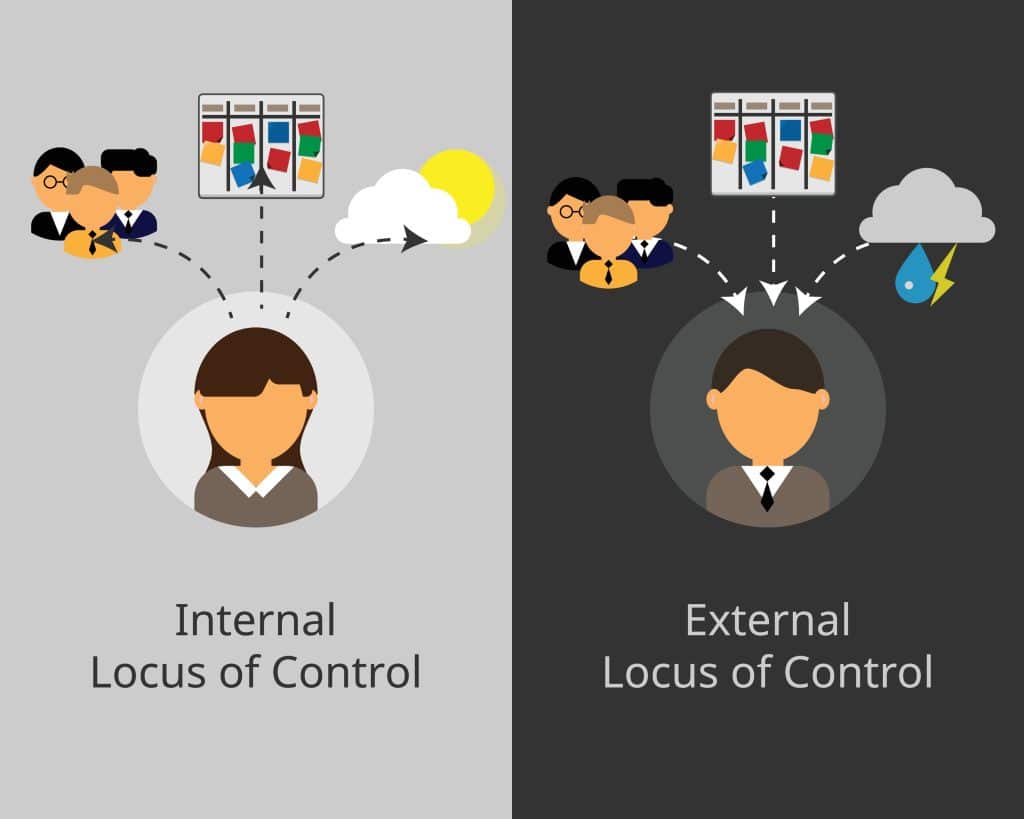
One of the most important ideas I’ve ever learned in psychology is the concept of a locus of control. In short, “A locus of control refers to the degree to which an individual feels a sense of agency in regard to his or her life” (Psychology Today). An internal locus of control refers to a belief that things happening are primarily due to the individual’s actions, abilities, and mistakes. While the external locus of control shifts that responsibility onto external factors such as the environment/circumstances, luck, and the actions of others.
Neither mode of thinking is entirely appropriate for all situations. What’s important is the ability to discern which situations—and, oftentimes, which specific elements of situations—can be attributed to the self or others.
Unless you’re the one pulling the trigger, you cannot take on the responsibility—and guilt—for the death and devastation plaguing the world. But that doesn’t give you permission to be a silent bystander, either.
Instead of getting caught in a constant loop of guilt every time you hear the news, be proactive. Sit down one day and actually ask yourself—what amount of charity and activism would be enough to make you feel okay? Then ask, how much of that could you reasonably accomplish without severely impacting your health and well-being?
That could mean setting aside a certain percentage of your income for donations. Or it could mean dedicating a specific amount of time to protesting or calling your representatives. For most people, it can be as simple as helping your immediate community, your neighborhood. Whatever it is, it’ll make you feel better than doing nothing.
3. Set boundaries
Once you’ve determined how much work you can do, it’s important to set firm boundaries for yourself.
If your FYP looks anything like mine, you’ve probably seen the videos of violent atrocities, and the victims begging you not to scroll unless you want them to die. There is this rhetoric frequently used in leftist spaces, that because these victims cannot “take a break” from the devastation, we should not either. But I find something myopic about this perspective. What does it accomplish?
There are people starving and freezing to death on the streets right now. Does that mean you should do the same? Who benefits from this mental self-flagellation other than the guilt-ridden, masochistic ego of the individual? Studies show that constant exposure to tragedies and graphic imagery is associated with a mental toll and increased stress. Considering this and the lack of a clear goal, to me, it just reads as voyeuristic and vicarious self-harm.

You never want to completely block out the noise, but consider intention and context. Are you watching to learn something important, or because you can’t look away? Are you specifically trying to make a difference, or are you trying to unwind before bed? Is it helpful to force yourself to look at footage of children being bombed while you sh*t, or is it disrespectful? Is viewing the horrors spurring you to action, or causing you to sit in it?
Sometimes the political activism content is good, sometimes you need dumb memes. Other times, you’re shopping. At the end of the day, it’s about time and place. Being able to quickly discern between the noise and the stuff you want to see as you scroll is a hard skill, but a necessary one in this day and age.
4. Give yourself permission to fail
None of this is easy.
In all likelihood, you will fail to do this consistently. But you should not let this discourage you. All work worth doing is worth struggling for.
And fighting against your brain is definitely a struggle. Studies show that humans are hardwired to seek out negativity. This could be due to evolutionary reasons, as “negative information alerts to potential dangers.” But just because something helps us survive doesn’t mean it helps us thrive. Over-vigilance can lead to greater impairment and increased sensitivity to stressful events.
Navigating that isn’t a matter of perfection; it’s a matter of your willingness to try again. So you get sucked into doomscrolling until 2 am. Take how shitty you feel the next day as proof of why you need those boundaries. So you didn’t listen to the news for the week. The world didn’t blow up because you specifically weren’t watching. Just take the break for what it was, and resolve to do better if you can.
5. Remind yourself why you continue
If you’re feeling overwhelmed, remember it’s not a coincidence. The world didn’t suddenly become more evil overnight. This is a deliberate political strategy that is being leveraged to make you feel powerless and keep you from taking action.
The technique is called “flooding the zone,” and Trump’s administration has explicitly touted it as one of its key tactics to overwhelm media opposition. If everyone’s distracted by Trump insulting Rob Reiner after his death, renaming the Kennedy Center, or posting AI photos/videos, then it makes it a lot easier for them to do things like removing slavery from history, withdrawing from the World Health Organization, committing war crimes, creating concentration camps, and removing protections for U.S. citizens.
Not to say any of the former things aren’t terrible, but they should help you understand something vital. Your time, energy, and attention have the power to make change. They would not be trying so hard to take them away, if they did not. When you feel too overwhelmed, you need to focus, not relent. Keeping your sanity in a world gone crazy isn’t only survival, it’s power.
Conclusion
Amidst all of this madness, I often find myself thinking of a quote from one of my favorite authors, Louise Erdrich:
“This is how the world ends, I think, everything crazy yet people doing normal things”
Future Home of the Living God
To proceed as normal is to accept the current condition of the world as normal. So, I misled you a bit in writing the title of this article.
I’m not going to tell you not to crash out about the end of the world. If there’s anything worth crashing out about, it’s this. But instead, I would like to propose this: crash out with intention, and take care of yourself in the meantime.
Self-destructing and wallowing in misery does nothing to change the current circumstances. And ignoring the problem isn’t much better. You have to find the way through the middle—the path that preserves yourself enough to help make the necessary change.
I’ll leave you with this quote from Mitski: “I used to rebel by destroying myself, but realized that’s awfully convenient to the world. For some of us, our best revolt is self-preservation.”













Stephanie Marlin
January 30, 2026 at 1:48 pm
Well done, Venus. I needed to read this today.