Sound, visuals, styling, and beauty all work together to signal who an artist is in a given moment. They also convey a certain message. For Sabrina Carpenter, glam has become one of her sharpest storytelling tools. In the crowded landscape of contemporary pop, where music, image, and social media presence collide, Sabrina has sculpted a glamorous brand that is one of the most cohesive aesthetic narratives in modern pop, using the power of fashion, makeup, and recurring visual motifs.
Through her glam team, Sabrina has crafted a visual language that communicates girliness, humor, vulnerability, and self-possession. She relays these messages before she ever sings a note. This aesthetic identity has become central to her artistic evolution. It is one of the key reasons her recent rise feels both organic and enduring. Her aesthetic is fundamental to how fans experience her artistry. Across her recent albums, her beauty choices helped define each era, guiding her transition from former teen star to fully realized pop force. Let’s do a full glam decode on pop sensation Sabrina Carpenter.
Looking sweet, thinking sharp
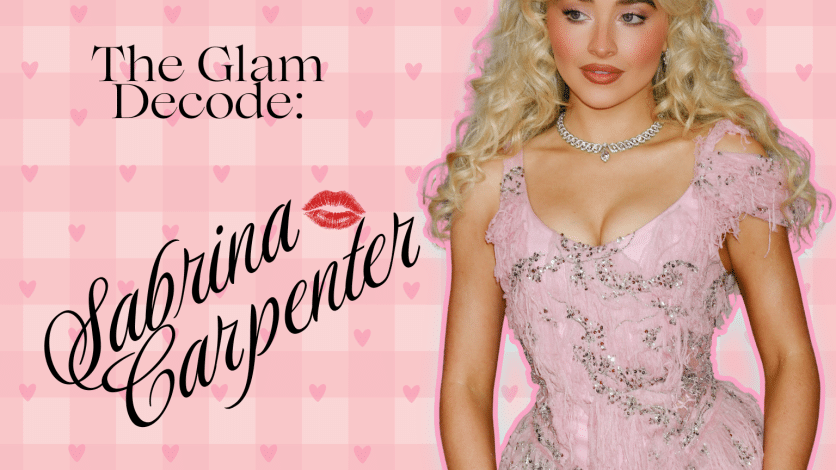
In her early career, Sabrina’s visual identity leaned toward gentleness and relatability. Her hair was lighter and looser, often worn long with minimal structure or curl, while her makeup favored natural skin, subtle lashes, and muted lips. At the core of Sabrina’s branding is a careful balance between nostalgia and modernity. She frequently draws from mid-twentieth-century glamor, like old Hollywood starlets, pin-up imagery, and the polished femininity of the 1950s and 1960s. She achieves this while filtering these references through a pop lens that translates smoothly to the audiences of today. This is evident in her silhouettes, which often emphasize the waist, highlight the legs, and favor playful mini lengths, just like they did back in the day.
Additionally, this is evident in her fondness for pastel colors, rhinestones, gingham, and soft, romantic textures. Rather than recreating vintage style literally, Sabrina modernizes it. She allows these callbacks to feel flirtatious and knowing, rather than costume-like. The result is an aesthetic that feels timeless but never antiquated. It suggests glamor without rigidity and femininity without fragility.
Emails I can’t send: visual confessionals
The Emails I Can’t Send era marked the first major shift in Sabrina’s visual language. Here, softness remained, but it became intentional. Her makeup grew more expressive: blush appeared more prominently, lips became rosier, and her eyes became a tad more defined but not yet the iconic look we know today. Her hair began to slowly take on the now identifiable shape, with volume and face-framing becoming central to the look. Fashion followed suit, introducing corsetry, delicate lingerie-inspired elements, and fabrics that suggested intimacy rather than innocence.
Visually, this era functioned like a diary written in satin. The clothes felt private even when worn publicly, mirroring the album’s confessional tone. This is where Sabrina began to use girlhood as a narrative to own proudly, rather than a decoration of societal roles. Her looks did not just flatter her body; they told the story of emotional exposure, romantic disappointment, and self-examination. This era undoubtedly set up the transition into full glam pop royalty.
Feather-light impact
With Short n’ Sweet, Sabrina’s visual branding crystallized. Her hair has become one of the most identifiable elements of her brand, functioning almost as a logo in itself. Her signature curtain bangs and voluminous blonde waves evoke classic bombshell imagery. Yet they are styled with enough softness and movement to feel youthful and accessible. This hairstyle situates Sabrina within a lineage of iconic blonde performers associated with charisma, sensuality, and allure, like the late icon, Marilyn Monroe. However, it maintains a sense of individuality that mirrors her lyrical voice and sets her apart as opposed to blending in. The hair is rarely severe or overly slick. Instead, it moves, frames the face gently, and enhances her expressive features, inspiring fans to achieve the same look.
Beauty as Iconography:
One of the most sophisticated aspects of Sabrina’s branding is her use of recurring beauty motifs as visual shorthand. The lipstick kiss mark has become one of her most well-known symbols. Traditionally associated with flirtation and infatuation, the kiss mark in Sabrina’s world functions as both invitation and authorship. It is playful but declarative, suggesting presence, desire, and intention. This motif transforms beauty into branding, turning makeup into a signature mark rather than just facial enhancement.

Similarly, hearts appear repeatedly across her visuals, from accessories to garments to graphic elements. Hearts are often dismissed as juvenile symbols, but Sabrina reclaims them as emotional punctuation. In her aesthetic, hearts are not naïve; they are ironic and emotionally loaded. They signal vulnerability. These motifs work because they repeat. Repetition is what turns styling into iconography. By consistently returning to these symbols, Sabrina trains her audience to associate them with her presence, her beauty, and the Polly Pocket-like world she’s built for them to join.
Woman’s best friend
Her makeup further deepens the beauty narrative she has so carefully constructed. Sabrina’s beauty looks consistently emphasize flushed pink and red cheeks, luminous, almost porcelain skin, and eyes that often draw from 1960s mod makeup traditions. There are echoes of Jean Shrimpton’s wide-eyed softness, Twiggy’s graphic clarity, and the painted doll faces of mid-century beauty advertising, all filtered through a modern, skin-forward lens. The placement of blush is particularly intentional: high on the cheeks, sometimes diffused toward the temples, it creates an impression of innocence, as though her inner feelings have become part of the makeup. Her face reads expressive before she ever sings, reinforcing the honesty that defines much of her music.
This blush-heavy approach communicates vulnerability. In a pop landscape that often favors sculpted severity and high-impact glam, Sabrina’s makeup resists dominance in favor of intimacy. Even when paired with bold lips or dramatic lashes, her beauty never overtakes her features. Instead, it amplifies them, ensuring that her expressions remain central to the performance. This restraint mirrors her voice, which often balances wit and pop brightness with genuine emotional candor. By choosing softness over spectacle, she signals a quiet confidence in both her image and her artistry. Her makeup does not mask her voice; it gives it a face.
Fashion chem
Fashion is where Sabrina Carpenter’s branding becomes most overtly narrative, but what distinguishes her approach is how deliberately fashion is deployed across every era and every song. Styled primarily by Jared Ellner, whose eye for playful precision has helped crystallize her modern image, her wardrobe operates less like a collection of outfits and more like a visual script.
For performances and visuals tied to songs like “Espresso,” she leans into breezy, sun-washed silhouettes like micro hemlines, pastel tailoring, and corsetry softened by fluid fabrics that evoke the ease of European summer fantasies and mid-century leisure imagery. This style is reminiscent of Slim Aarons’ photography and 1960s romantic comedies. These looks feel flirtatious but controlled, echoing the song’s effortless confidence and lightly ironic bravado.
Sabrina draws heavily from the coquettish sensuality of Brigitte Bardot, the playful glamour of Marilyn Monroe, and the off-duty ease of Jane Birkin, yet she never slips into imitation. She actively reinterprets these references through the modern fashion houses she wears most often, using labels such as Prada, Miu Miu, Versace, Dolce & Gabbana, and Gucci to sharpen classic glamour with contemporary proportion and polish. In moments where the music turns inward, her wardrobe responds accordingly. Fabrics become demure, lines more intimate, and silhouettes more dreamy, favoring drape over structure and delicacy over spectacle. Lace, chiffon, and lingerie-inspired details suggest vulnerability without fragility, reinforcing the emotional nuance of the songs they accompany.
This precision creates a rare alignment between sound and sight. Her fashion interprets her music. By allowing clothing to echo lyrical tone and intent, she invites her audience to experience her work on multiple sensory levels at once. The result is a visual language that reinforces mood, sharpens meaning, and transforms fashion into a narrative tool rather than a seasonal indulgence.
These boots are made for dancing
Perhaps no single fashion item is more closely associated with Sabrina’s modern image than her towering, Bratz-inspired platform boots. These boots are not merely trendy; they are conceptually rich. Drawing from early-2000s pop fashion, the dramatic proportions recall dolls, pop princesses, and hyper-stylized girlhood. By wearing them, Sabrina aligns herself with a lineage of playful excess while reclaiming it through adult agency, and of course, they give our miniature queen a little extra height.
The boots create contrast. Paired with delicate dresses or dainty fabrics, they ground her look, preventing it from drifting too far into fragility or childlike imagery. Adding a couple of inches to her small stature, they communicate confidence and presence. Onstage, they amplify her physicality, making her appear larger than life without sacrificing the vintage looks. Symbolically, they reflect her broader glam philosophy: sweet and short.
In the context of pop culture, these boots also function as nostalgia reframed. Bratz dolls were once criticized for their exaggerated aesthetic by parents and adults; today, that same exaggeration reads as empowerment, and fans are proudly strutting in them to her tours.
Glam as branding
What makes Sabrina Carpenter’s beauty evolution especially effective is its clarity. Each era had a visual thesis. Nothing felt accidental. Importantly, her style does not exist in isolation from contemporary culture. She taps into current conversations around hyper-femininity, coquette imagery, and reclaiming softness as something to be enjoyed, particularly among young women. However, what sets her apart is her ability to approach these trends with irony and self-awareness.
Her visual branding often carries a subtle wink, a sense that she understands the performative nature of girlhood. Moreover, she chooses to engage with it on her own terms. This is echoed in her lyrics, which frequently balance romantic longing with sharp humor and emotional clarity. She presents being a girl not as something passive or ornamental. Instead, she views it as playful, strategic, and powerful.
In pop culture, beauty often becomes the fastest way an audience understands an artist before hearing a single lyric. Sabrina used that reality to her advantage. By leaning into classic femininity at a time when irony and minimalism dominate pop aesthetics, she stood out. Her commitment to beauty as branding made her instantly notable. This feature is a crucial factor in an industry driven by imagery as much as sound.
Sabrina decoded
This cohesion between aesthetic and music is what ultimately distinguishes Sabrina Carpenter from many of her contemporaries. Rather than reinventing her image with every trend cycle, she has refined a consistent look that evolves without losing its core. In a broader moment where Gen-Z pop stars are defined by public heartbreak, emotional transparency, and diaristic songwriting, as cultural commentary has increasingly noted, Sabrina’s clarity stands out. Her audience can recognize her instantly, not just because of her face, but because of the world she inhabits visually. This consistency builds trust and emotional attachment, allowing fans to feel immersed in her artistry. It enables them to engage with her work rather than simply consuming isolated songs or looks.
Sabrina Carpenter’s ascent is a reminder that beauty can be used in many different ways to communicate many different messages. Glam shapes perception, anchors eras, and gives audiences a visual entry point into the music. In her case, beauty didn’t just reflect her success; it helped create it. Pop stardom today demands commitment. Artists who understand how sound, visuals, and beauty work together are the ones who break through. Sabrina’s glam evolution shows how intention is what makes an era stick.
Her decode reveals something larger about pop culture: when beauty is used thoughtfully, it becomes a legacy identity.