Edgar Wright’s 2025 remake of The Running Man is a two-hour-long dystopian spectacle showcasing the institution of violence in a corrupt world. And, it mirrors some elements of our society a little closer than we’d like to admit. Action-packed and gripping at its core, the thriller is an entertaining watch.
The Running Man has captivating chase sequences and a stellar cast. Leading man Glen Powell scales walls, falls through elevators, and jumps off of exploding bridges as he outruns skilled killers tasked with taking him out. Joining him in this action-packed remake are Josh Brolin, Colman Domingo, Emilia Jones, and Michael Cera.
Trailer
Taken from Stephen King’s nightmarish 1982 novel of the same name, The Running Man follows a reimagined authoritarian America controlled by a giant corporation. In a totalitarian world driven by bloodlust, contestants may qualify to compete in one of the Network’s deadly game shows to turn their luck around. Of course, it’s all a violent ploy to entertain the masses and distract from how rigged the system truly is.
It’s quite reminiscent of George Orwell’s dystopian classic 1984: the idea of a singular, all-powerful organization controlling the flow of information to keep the underclass pinned beneath them. Unlike the 1987 Arnold Schwarzenegger-starring version, which takes place in 2019, Wright’s rendition unfolds in 2025. It’s hard not to see the shocking parallels to our very own reality.
Glen Powell is working man Ben Richards, a man who has just been blacklisted by the government. Angry and relentless to protect his family, Richards joins The Running Man, a game show where contestants must outrun hunters who have been hired to kill them. It is notorious for being the Network’s most ruthless show. What unfolds next is two hours of action-packed, violent sequences as Richards scales down buildings, dodges explosives, and sprints for his life with the entire world hunting him down.
If it’s action you’re looking for, The Running Man won’t disappoint

The Running Man is exciting, fast-moving, and all-around entertaining. That’s not to say the film is without its flaws. The pacing is slow at times, and humor undermines the intensity in certain moments. Still, it kept me on the edge of my seat right up until the very end. Each adrenaline-fueled sequence raises the stakes as Richards relies on grit and determination to outsmart the hunters on his tail. All the while, we’re rooting for him on the other side of the screen.
What the film does well is show how the Network packages everything nicely into a glittering spectacle of violence. One medium is Colman Domingo’s Bobby “Bobby T.” Thompson. TV personality Bobby T. is the arrogantly popular host of The Running Man. And he plays the part of an unfazed high-class citizen well, smiling big for the camera as the crowd wildly cheers for bloodshed in an almost gladiatorial display.
Between the sadistic crowd, the violent nature of the game, and the arrogance of the “high and mighty,” I couldn’t help but make parallels to The Hunger Games. The scenes of the studio were giving the same deceptive energy as the Capitol, naturally making Bobby T. this world’s Caesar Flickerman. Both follow a dystopian world where an elite upper class use distraction tactics (in the form of violent games) to keep control in their hands. Meanwhile, the poor are left struggling. Even down to Bobby T.’s elaborate showman outfits, the similarities are uncanny.

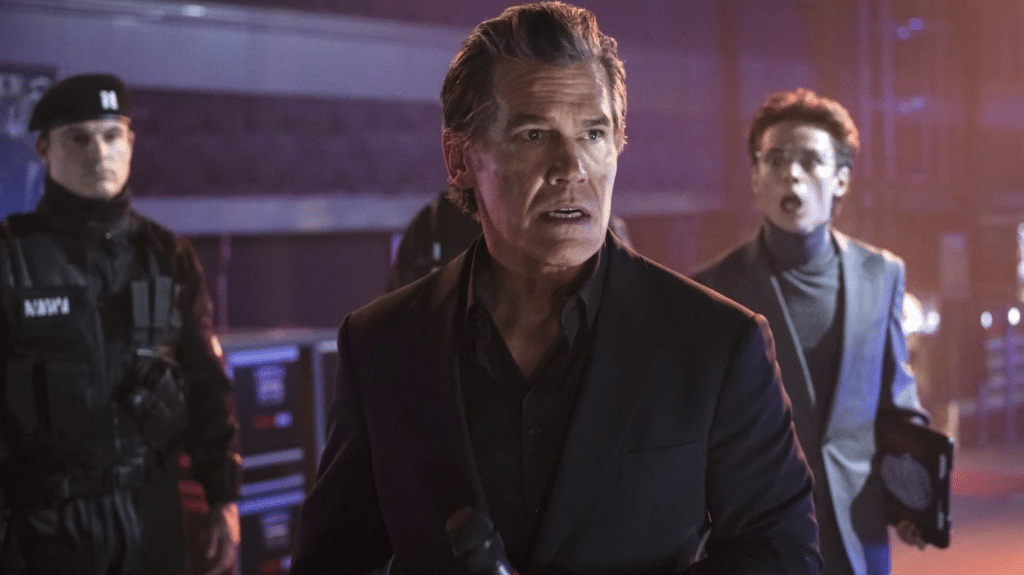
Josh Brolin plays cold-hearted producer Dan Killian, and he smashes it. The conniving, power-hungry producer uses Richards’ family to manipulate him into participating in The Running Man. Playing the villain has grown to be Brolin’s bread and butter. After his protagonist role in Weapons, he’s back to his roots as the ruthless spearhead of the Network. Another delight is seeing Michael Cera grace the screen as a violence-crazed, slightly unhinged rebel who holds his own grudge against the government.
How does Wright’s adaptation hold up to Glaser’s?

While I haven’t actually seen Paul Michael Glaser’s 1987 version, I did make sure to do my research before heading into the theater. From what I gather, the two have some clear differentiations. The newer version follows the source material much closer than that of its predecessor, so much so that it bears the golden stamp of approval from King himself.
In 1987’s The Running Man, Arnold Schwarzenegger plays Ben Richards. That’s right, the Terminator, himself, baby. Only in this case, Richards is framed by the government, and only prisoners can play the deadly game. Actually, a lot of the parameters of the game are switched up in this rendition, even Richards’ motivation. Powell’s Richards is competing for his family, while Schwarzenegger is competing for his freedom. Still, the basic premise remains the same: outrun hunters, win money, get a new start, yada yada.
The primary similarity in both is the overarching themes of class struggle and media manipulation in a corrupt society. A select group of elite ruling class citizens holds all power in the form of media manipulation to keep the lower class in their place. Like Richards, those stuck in the slums are poverty-stricken, sick, and dying. Worse still, the system is stacked against them as the wealthy profit from their suffering.
With the latter adaptation falling at the precipice of the current day, it draws comparisons to the viewpoints of our very own society. A gaping wealth gap, poverty, distrust of the media, the idea of the elite controlling the masses. Similar fears have never rung more true than in today’s age. Though the weight of that reality gets a bit lost amid the onslaught of explosions and jokes.
Hunt! Him! Down!
It’s been a few weeks since I’ve seen The Running Man, and that catchy theme song is still stuck in my head. Stephen King has truly been on a roll this year in terms of on-screen adaptations, and this film certainly adds to that momentum. If you King fans have been keeping up with Welcome to Derry, much like I have, you will be geeked to know that Derry, Maine, was namedropped about halfway through the film.
Looking back, the movie itself is kind of ironic. A bloodthirsty, dystopian society watching a violent show about people murdering each other—we rule it sadistic. Yet in that same vein, here we are, watching this violent movie about people… murdering each other. A huge distinction is that in our case, none of it is real.

While I don’t necessarily foresee The Running Man being a huge Oscar-winner, it was a thrilling watch. Could it have tightened up some of its sequences, especially the exhausting car chase toward the end? Sure. But my eyes stayed glued nonetheless. How do you think the 2025 version holds up compared to 1987?