

When the temperature drops, something happens — and it’s not just the weather.
Every winter, relationships fizzle, situation-ships implode, and even the strongest couples feel the chill.
And in this emotionally brutal stretch between November and February, one ritual becomes universal: turning to heartbreak music like it’s a survival guide.
There’s something about cold nights, early sunsets, and the soft glow of a bedroom lamp that makes a sad album feel like a warm blanket. Winter forces stillness. You’re indoors more, alone more, thinking more — and heartbreak has room to echo.
Streams of breakup songs spike every year when the clocks roll back. That’s when people return to the albums that really feel like winter: the ones that let you cry, heal, spiral, reflect, and eventually reset.
The science
It’s not just cultural — it’s biological.
Studies show that colder months bring reduced sunlight, which lowers serotonin and boosts melatonin, making people more irritable, sensitive, nostalgic, and prone to rumination.
Psychologists say winter heightens emotional recall — meaning memories of love, loss, and loneliness feel sharper. Even cortisol levels tend to fluctuate in the cold, increasing stress responses and making small relationship cracks feel like fractures.

Winter forces stillness. You’re indoors more, alone more, thinking more — and heartbreak has room to echo.
These five albums are more than projects — they’re emotional climates. Together, they form the soundtrack we return to when the world is coldest, and our hearts are too.
GIVEÕN: BELOVED
Giveon has always made music for people who aren’t just heartbroken — they’re stuck, lingering in the gray space between letting go and holding on.
BELOVED, his first album in 3 years, is his most intimate and autobiographical project yet, turning that emotional limbo into an entire world.
Rooted in a modern take on classic ‘70s soul, BELOVED feels like a cold night in December when you finally allow the truth to settle. Giveon writes with the precision of someone replaying every moment of a breakup; not to torture himself, but to understand who he became inside it.
Songs throughout the album examine the messy aftermath — the regret, the longing, the temptation to return to what hurt you because it still feels familiar.
The album’s central question is simple: Who am I without the person I loved? Giveon confronts the identity crisis that comes after a breakup, the strange sense of being too shaped by someone who’s no longer there.
Tracks like “Limbo” capture that emotional paralysis, while “Avalanche” acknowledges the inevitability of a relationship that always felt destined to collapse.
But BELOVED isn’t just about devastation — it’s about evolution.
The album ends with glimmers of hope, as if Giveon is slowly thawing after a long emotional winter. “I Can Tell” and “Good, Bad, and Ugly” show him choosing growth instead of denial, making the case for love that’s honest and sustainable, even if imperfect. And then there’s “Rather Be,” one of the rawest confessions on the album:
“I’d rather be a fool than believe in someone new / I’d rather be with you
Than the other half of someone who’s not even half of you.”
It’s toxic, vulnerable, and painfully true — the kind of confession most people only whisper to themselves at 2 AM.
BELOVED feels like the emotional equivalent of watching your breath fog up a window: quiet, heavy, and full of meaning.
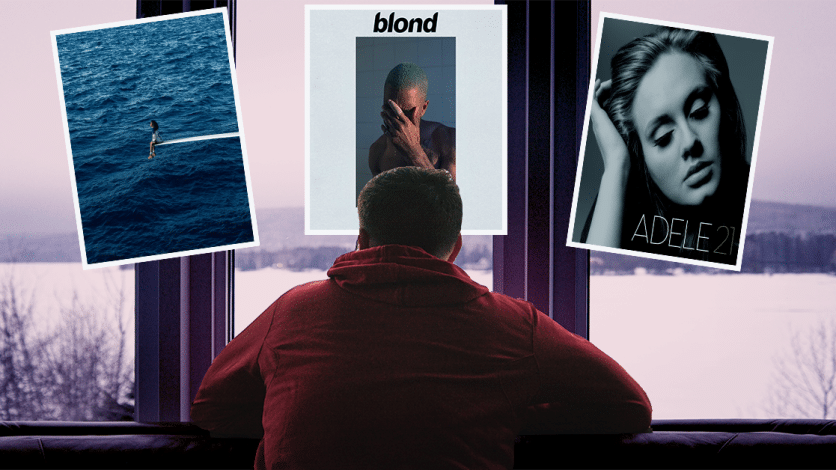
SZA: SOS
SZA’s blockbuster second album doesn’t just document heartbreak; it documents the identity crisis that heartbreak triggers.
From its title alone, SOS announces itself as a distress signal.
It’s the emotional flare someone sends up when they’re hurt, confused, lonely, hopeful, angry, and craving connection all at once.
Across twenty-three sprawling tracks, SZA lets those contradictions coexist, creating a portrait of heartbreak that’s messy, nonlinear, and deeply human — the exact emotional terrain people sink into once the holiday glow fades and the winter stillness hits.
SOS captures every stage simultaneously. One minute she’s raging, the next she’s grieving, and the next she’s slipping into nostalgia like it’s a warm coat she can’t stop putting back on.
The genre-blending — R&B, pop-punk, hip-hop, even folk — mirrors the emotional whiplash of trying to rebuild yourself after someone dismantles your sense of worth.
A recurring theme is SZA’s attempt to redefine herself outside of romance. She questions her desirability, her confidence, her place in someone’s life — and, ultimately, her place in her own.
That tension crystallizes on “Notice Me,” one of the most heartbreaking confessions on the album:
“I don’t wanna be your girlfriend, I’m just tryna be your person.
I don’t wanna be your girl, cool with being just your person.”
It’s a lyric that hits especially hard for anyone who’s never been “the girlfriend,” who’s learned to shrink their desires because wanting more has only ever led to disappointment.
There’s a heartbreaking practicality in it — the kind of emotional negotiation people make when they want to feel close to someone but don’t believe they’re worthy of the title.
Visually, SOS deepens its emotional world. The album cover — an homage to a 1997 photo of Princess Diana sitting alone on a yacht — captures the loneliness of being adored yet misunderstood.
Mariah, The Scientist: Hearts Sold Separately
Hearts Sold Separately is a battlefield soundtrack — soft, wounded, and brutally honest. Mariah the Scientist builds the album around one central idea: there is a war on love, and she’s tired of being a soldier.
Across the album, Mariah positions herself — and women like her — as “toy soldiers”, disposable in the eyes of the men they’ve loved. It’s a metaphor that feels especially sharp in the cold months, when loneliness cuts deeper and every memory feels like a bruise that never fully healed.
What makes Hearts Sold Separately hit even harder in the cold is how Mariah blends nostalgia with longing — especially in the combined track “All I Want + In Pursuit.” The opening lines feel like flipping through old photos you swore you deleted:
“I think about all the times when you stayed up watching the sun,
I think about all the nights, the sleep-deprived moments when we were young…
Don’t you ever leave me, don’t you ever go too far…
It’s that kind of confession — soft, trembling, and painfully honest — that turns the album into something more than a breakup project. Mariah isn’t just recounting a failed relationship; she’s grieving a version of herself who loved recklessly, fully, without armor.
You don’t just miss the person — you miss the era when love still felt possible.
The late-night talks. The sleep-deprived laughter. The feeling that you were building something real together.
And when she pleads, “Don’t you ever leave me… I wanna be where you are,” it hits like the kind of truth you only admit to yourself on a freezing night, wrapped in a blanket, scrolling through old messages you shouldn’t reread.
Frank Ocean: Blond (Blonde)
Frank Ocean’s masterpiece doesn’t just explore heartbreak — it dissolves into it, drifts through it, analyzes it under moonlight, pulls it apart strand by strand like someone replaying conversations they can’t move past.
Blonde is the quiet ache you feel when you’re lying in the dark staring at the ceiling, the way grief gets louder when the world gets colder.
His stories are fragmented on purpose — because that’s how heartbreak really feels: out of order, slippery, confusing, nostalgic, painful, beautiful. You don’t remember it linearly. You remember it like Frank does — in flashes.
Tracks like “Ivy” collapse the space between past and present as Frank sings about a love that felt like forever until it ended before either of them was ready.
It’s a song about being young, soft, and unguarded — and looking back at that version of yourself with both fondness and embarrassment. In winter, when the world forces stillness, that kind of reflection feels almost too real.
And then there’s “Pink + White,” with Beyonce as backing vocals, which holds grief inside beauty — a warm memory narrated like a lullaby.
“You showed me love.
Glory from above.
Regard my dear, It’s all downhill from here.”
Frank sings with the gentleness of someone trying to preserve something sacred while acknowledging it’s already gone. It’s the emotional equivalent of watching snow fall and realizing you’re mourning a summer that isn’t coming back.
But Blonde isn’t just about love lost. It’s about the identity crisis that follows — the parts of you that feel rearranged when someone leaves, the way you wrestle with vulnerability, and self-worth when heartbreak strips you down to who you really are.
Summer Walker: Finally Over It
Released in November, just as breakup season peaks, the album feels like a quiet declaration of freedom.
Finally Over It is divided into two emotional hemispheres — “For Worse” and “For Better.” Together, they mirror the exact process of healing in winter: the old wounds that sting when the air gets cold, and the slow, steady warmth that comes from choosing yourself.
The first half, “For Worse,” is a gentle reckoning. Summer looks back at past relationships without the venom, without the rage, without the rehashing of old drama that defined her earlier eras.
She admits the moments she loved too hard, stayed too long, and ignored the signs. She calls herself out with honesty but not self-hate — like someone rereading old journal entries under a blanket and finally feeling at peace with who she used to be.
Then there’s the shift — the thaw.
“For Better” opens like a window letting in fresh winter air.
This is where Summer chooses herself. Fully. Publicly. Proudly.
That’s the thesis of the entire project: healing doesn’t have to be pretty, linear, or understandable to anyone but you.
The imagery around the album became part of its emotional weight. Fans throwing their emotional baggage into a dump truck wasn’t just a promo moment — it was symbolic.
Musically, the album still carries her intimate, diary-like sound, but with a cleaner, more grounded perspective. It’s the final chapter of her “Over It” trilogy — a goodbye to the version of herself who kept loving people who weren’t ready.