

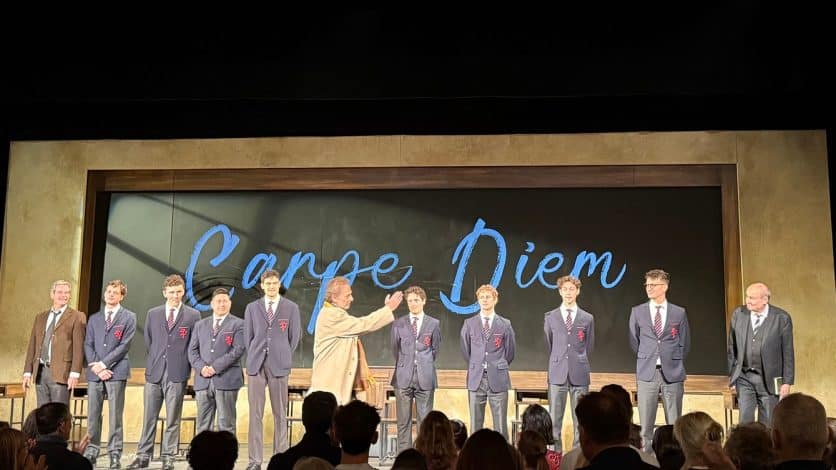
Thirty-six years after the release of the acclaimed film Dead Poets Society, the story still resonates with so many people. Olivier Solivérès decided to adapt it into a play and, eleven years later, he finally released his dream. Dead Poets Society (in French, Le Cercle des Poètes Disparus) is currently performing in Paris at the Théâtre Libre.
Before delving into the play that is attracting so many people, let’s first find out more about the plot of the story.
What happens in Dead Poets Society?
It is 1959 at the Welton Academy, and the school is celebrating the hundredth anniversary of its foundation. Based on four principles — tradition, honor, discipline and excellence — the preparatory school takes pride in what has been built over the years.
When an eccentric new English teacher, Mr. Keating, arrives at Welton, everything starts to change. During his lessons, conformity flies right out of the window. He teaches his students to dare, to step out of their comfort zone, and to embrace the chaotic and unexpected parts of life. For instance, he reads them Shakespeare in a specific voice, imitating the various traits of each character. In this way, Keating shows his students that learning should be fun and not tedious.
The main students are Neil, Todd, Steven, Charlie and Knox. Thanks to a book Neil finds, they learn about the Dead Poets Society, which was active when Keating was a student. From that moment onward, they meet up just like the Dead Poets Society used to — at night in a cave in the adjacent woods. During these sessions, the characters read poetry out loud. They start to recite Henry David Thoreau, noting how he wanted to “live deep and suck out all the marrow of life”.
In the end, Neil plays in A Midsummer Night’s Dream, even though his dad had forbidden him. Knox asks a girl out, even though she already has a boyfriend. Charlie publishes an article signed by the Dead Poets Society in the school journal. They all step out of their comfort zone in different ways.
Main Themes
The strongest theme in the film is the power of literature. Yet it also dissects conformity, personal growth, friendship, and love. Above everything else, the topic of carpe diem is foundational to Mr. Keating’s teaching method. By encouraging his students to seize the day, he motivates them to pursue their passions, which can be dangerous in such a strict school.
The four pillars of the school are directly reflected in the students’ lives. Discipline is the most dominant, as the school expects students to follow the rules and never speak up about what they really think. On this matter, Keating urges the students: “Think for yourselves” (as you can watch below). This is a major turning point.

The students, the teachers, and the parents worship America. Social classes play a similarly important role, as the different characters come from opposite backgrounds. This shapes how the parents behave toward their children. For instance, Neil’s family can afford to have their child at the academy, but they lack substantial means. Because of this, the father in particular has set a path for Neil to follow: He must become a doctor to ensure financial stability.
Education is another crucial theme. The story criticizes the limits of the education system, especially with regards to the humanities. The teacher before Keating and the teacher after him are highly conventional. In fact, they both follow the textbook without carving space for genuine thoughts from the students.
The play remains faithful to the original script, as the themes and most of the dialogue are exactly the same. Let’s find out more about how the film was turned into a play.
From the 1989 film to the stage
Starring Robin Williams as the new English teacher, Ethan Hawke and Robert Sean Leonard as the students, and so many other great actors, the film was and still is a hit. One of its most famous quotes (which you can find below) has endured through the years.
Since this film inspired the director to take up writing and a path he didn’t know he could follow, he chose to give it another opportunity to shine. In France, it is rare that a film inspires a play, though this is fairly typical in the UK and the USA. But eleven years after the director first conceived of the play, it has become a reality.
According to sound engineer Claudio Bellinghieri, “it is a really big play.” From the stage setting to the costumes, the play is of a great technical quality. Bellinghieri recalled that after one performance, the audience gave a standing ovation. I happened to have witnessed this firsthand. It showed how, even after all of these performances, the audience’s investment has endured.
The play at the Théâtre Libre
With over twenty performances, the play still attracts hundreds of people, as I observed on a lovely Saturday afternoon. From children to teenagers to elderly people, the audience was deeply diverse, conveying the play’s universal appeal.
When I walked in to take my seat, the character Neil (as interpreted by Basile Sommermeyer) was already entertaining the audience (which you can see below). Children were invited to walk on stage and dance while the actor sang and played the guitar. This unique welcome encapsulated the creativity of the entire play.
Another defining feature of the play was the actors’ remarkable skill. Stéphane Freiss as Mr. Keating and Ethan Oliel as Neil Perry (as well as the other cast members) transformed the play into a masterpiece, and they were met with critical and public acclaim.
I was thoroughly engrossed throughout the play, alternately laughing and crying. Even if it is emotionally intense at times, there’s plenty of comedy to entertain the audience. We need performances like this to remind ourselves what is important in life. You can watch the trailer below.
Why is it still relevant and important?
I have to be honest; I originally intended to collect quotes from the audience about what they thought of the play. But in the end, I couldn’t because of how emotionally affected I myself was by it. I had never seen a play that spoke to me like this one. It has been a few days since I saw it, but it hasn’t left my mind.
The biggest takeaway for me was the bravery required to stand up in a world that often encourages us to just tag along. The play also epitomizes how the humanities and literature in particular can be completely life-changing. If we only read more and watched more plays, we would learn so much about life and about ourselves.
Dead Poets Society isn’t just a film or a play about a bunch of students rebelling against the system. It compels us to pick up a book and read. It motivates us to pursue our passions, because if we don’t, what are we living for? Like Keating says:
“We read and write poetry because we are members of the human race and the human race is filled with passion.”
If you haven’t watched the film or the play, this is your sign — but beware, you will be embarking on a rollercoaster of emotions. It will make you laugh, it will make you cry, and, most importantly, it will make you think. Maybe it’s worth giving that book on your shelf a try. Or that career change. Or that passion you’ve never followed. Something might just kindle a fire in you, so what are you waiting for? Go for it.