Every creation needs a creator, and Rocky Horror had actor, writer, and musician Richard O’Brien.
Born in 1942, in Cheltenham, England, the pop culture touchstones of O’Brien’s youth included: Hammer horror films, science fiction B movies, and comic books. While laboring as a coiffeur at a barbershop fortuitously located in front of a cinema, O’Brien spent his free time after work attending late-night screenings. It was during these nocturnal exhibitions that the seeds for Rocky Horror crept into the creator’s garden of imagination.
In June 1973, O’Brien’s vision for an original piece of art that blended the visual aesthetics of horror, sci-fi, and comic books. With a narrative that challenges societal norms unapologetically and delves deep into the murky waters of social taboos, The Rocky Horror Picture Show presented itself as a musical stage production at the Royal Court Theatre (Upstairs) in London. O’Brien romanticized ruminations of his youth, first deconstructing them and then repurposing them for his own intentions. Much like Mary Shelley’s gothic novel protagonist Dr. Frankenstein, O’Brien created something vibrant, alive, and possessing a dangerous, sharp edge.
“Antici…pation” – The plot

The plot of Rocky Horror, in theory, shouldn’t work, as it is a literary collage of mismatched story ideas. The story unfolds with a recently engaged, young couple, Brad Majors and Janet Weiss, who embark on a road trip to visit the mutual acquaintance who brought them together. En route to visit the acquaintance, their vehicle suffers a flat tire. Now stranded in the rain, the couple searches in vain for a telephone to call for roadside assistance.
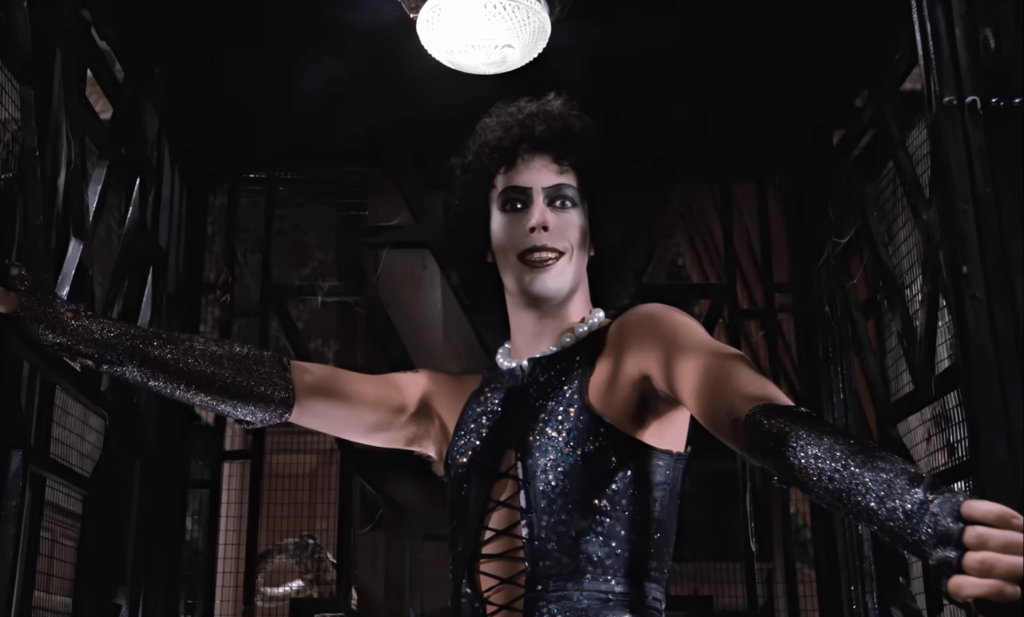
Instead of finding a good Samaritan, they wind up at a castle inhabited by a cast of characters straight out of a Federico Fellini film. Dr. Frank-N-Furter, an extraterrestrial mad scientist from the planet Transexual in the galaxy of Transylvania and a cross-dresser, hungrily welcomes Brad and Janet into the castle—much like a bloodthirsty Dracula inviting weary travelers to sleep. Complications ensue when Frank-N-Furter—who has been working in his covert lab hidden in the dark depths of the castle’s mortar—reveals the results of his labor: a perfect male specimen, a Greek chiseled god, come to life, named Rocky. Frank-N-Furter proceeds to then sexually seduce both Brad and Janet, prompting them to reexamine their romantic relationship, vows, and sexual identities.
RHPS was a hit, despite—or perhaps because of—its unorthodox plot and themes. Rocky Horror dared to celebrate sexual fluidity, cross-dressing, and the right to desire without shame in an era when these subjects were still taboo onstage. Within months, the show had outgrown its tiny venue, moving to larger theaters across London, before leaping its way across the pond. Playing to packed houses in Los Angeles and New York, the production ultimately enjoyed thousands of performances.
“Caught in a Celluloid Jam” – RHPS comes to the big screen
Two years after O’Brien reinvigorated the theatre, a young movie director was poised to transform Hollywood. In June 1975, Universal unleashed Jaws. Auteur Steven Spielberg brought Peter Benchley’s novel to nightmarish life with masterful storytelling, flawless direction, and a terrifying mechanical shark that made its presence known with an ominous two-note theme. Earning $100 million at the box office during its original theatrical run, Jaws dethroned The Godfather—the highest-grossing movie at the time—becoming a bona fide blockbuster and creating the gold standard by which all other summer movies would be measured.
Glimmer, sparkle, and shine were what Hollywood experienced in 1975. The financial success of Jaws brought an afterglow unlike any other to Tinseltown. Creative elements would now have more control over their projects, and the willingness of studios and distributors to gamble and take more risks with controversial material helmed by unestablished talent began to emerge like a shark’s dorsal fin sticking out of the water. For a fleeting and glorious moment, both the artists and power brokers of Hollywood enjoyed a symbiotic relationship; the timing was now perfect for a feature film that liberates the silver screen from one-dimensional characters stranded in standard plotlines and injects family-friendly Technicolor with a more vibrant representation of the marginalized. The Rocky Horror Picture Show fit the bill flawlessly with its theatrical release on September 26 of that year.

“It’s All Over! Your Mission is a Failure!” – Box office bomb
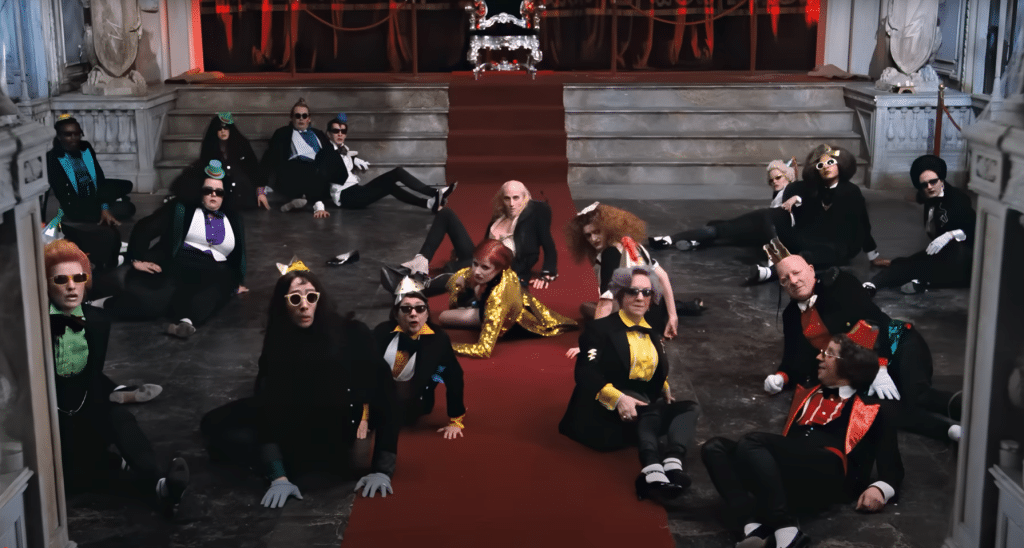
Backing The Rocky Horror Picture Show was a risky proposal for the film’s distributor, 20th Century Fox. Onscreen, O’Brien’s musical odyssey took on a life of its own, much like Frankenstein’s monster. Camp and kitsch collided into a colorful, kaleidoscopic cinematic confection. Challenging conventionalities of social norms while exploring non-traditional gender roles and sexual identities, The Rocky Horror Picture Show served up a healthy dose of outré and controversy upon its initial theatrical release.
Rocky Horror received mixed reviews, shock treatment, and lukewarm ticket sales when it strutted onto screens in platform heels and fishnet stockings. Posters for RHPS promoted it with the tagline of “A Different Set Of Jaws,” trying to surf the same commercial box office wave that Spielberg’s shark created that summer.
“Late Night, Double Feature” – Cult classic born from midnight screenings
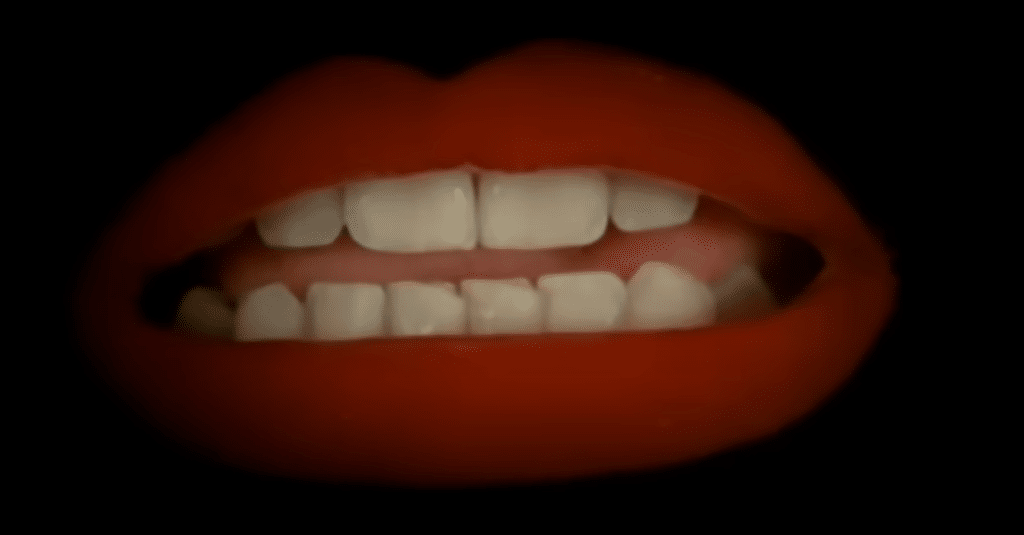
For a moment, it looked like O’Brien’s literary and musical monster might die on the operating table. Yet, like any good horror monster, Rocky Horror refused to stay dead and buried. Its box office obituary was premature. RHPS would, as all cult films do, find its audience through midnight screenings years after its original run, generating word-of-mouth buzz and a ravenous, cult-like following that continues to do the “Time Warp” again and again…
At these screenings, audience participation became a ritualistic, almost theatrical experience. Fans arrive dressed as their favorite characters—corsets, fishnets, lab coats, and glitter all part of the tradition—and interact with the film through established elements “call-backs.” A call-back is when viewers shout a line or a witty response to a character’s dialogue on screen. For example, when Brad and Janet appear helpless or confused, the audience might yell teasing insults or mimic their reactions. Props become an extension of this engagement.
“Great Scott!” – From toilet paper to toast: the props of Rocky Horror
Below are the props audiences traditionally use, each one tied to a specific moment in the film:
- Rice: At the wedding scene for Ralph Hapschatt and Betty Munroe, as they exit the church, audience members throw rice along with the on-screen guests.
- Newspapers: During the storm scene, when Brad and Janet are caught in the rain, Janet covers her head with The Plain Dealer. Audience members hold newspapers over themselves at that moment.
- Water pistols: To simulate the rain that Brad and Janet walk through, audience members squirt water pistols (hence, the newspapers).
- Candles / Flashlights / Cellphone lights: During “Over at the Frankenstein Place,” specifically the “there’s a light” verse, audience lights brighten the theater. Note: open flames are often restricted depending on the venue.
- Rubber Gloves: Frank-N-Furter snaps his gloves three times during the creation speech; Magenta later removes them. The audience snaps gloves in sync at those moments.
- Noisemakers: At the end of the creation speech, the Transylvanians respond with applause and noisemakers. The audience copies this.
- Confetti: After the “Charles Atlas Song” reprise, audience members throw confetti.
- Toilet Paper: When Dr. Scott enters the lab and Brad shouts “Great Scott!”, the audience tosses rolls of toilet paper into the air. Fans use Scotts brand, if available.
- Toast: At dinner, when Frank proposes a toast, people throw toast (unbuttered) into the air.
- Party Hat: During the dinner scene, when Frank puts on a party hat, audience members do the same.
- Playing Cards: During “I’m Going Home,” on the line “Cards for sorrow, cards for pain,” the audience throws cards.
“I Can Make You a Man” – The breakout careers of Rocky Horror alumni
Rocky Horror launched many careers. Richard O’Brien, its author, was celebrated as a new voice in the legitimate theatre. It was the first role for actor Tim Curry, who played Dr. Frank-N-Furter. Curry went on to act on stage and film, landing roles in mainstream films like Clue and Home Alone 2: Lost in New York. Curry parlayed the credits on his acting resume into a recording career. He had a hit with “I Do the Rock,” winning many critical accolades, including being nominated for a Tony and Grammy.
Susan Sarandon left Janet Weiss in Denton, the fictitious city and setting for Rocky Horror, graduating to more dramatic material—Atlantic City, Thelma & Louise, and Dead Man Walking. Barry Bostwick, like his co-star Sarandon, ditched his character Brad Majors in Denton, expanding his credits to include theatre performances, television series, and feature films. Meatloaf, who channeled his inner greaser as Eddie, became a household name in 1977 with the release of the album Bat Out of Hell, selling over 43 million copies worldwide.
“Give Yourself Over to Absolute Pleasure” – Reclaiming identity and freedom
Using a 21st-century lens to view Rocky Horror does not put into context its contributions to the LGBTQIA+ community. At the time of its theatrical release, many cities in the United States had laws against cross-dressing in public. For legal purposes, legislation broadly defined cross-dressing as dressing in the attire of the opposite sex or gender. It may be unfathomable to think that, as of 2011, an individual perceived as male wearing attire traditionally designed and intended for a female could be arrested in New York for impersonating a woman. The motivation of such law—which originally came into existence in 1848 in Columbus, Ohio—was the result of people’s fear of gays, lesbians, transgenders, and anyone else not conforming to an identity that didn’t align with the gender assigned at birth. Such legislation existed to marginalize the LGBTQIA+ community before the term LGBTQIA+ even existed.
“Don’t Dream It, Be It” – How Rocky Horror challenged societal norms
Rocky Horror may be viewed as many things: cult film, awesome soundtrack, vehicle for breakout stars. What is often overlooked, however, is the sheer risk it took to challenge the societal norms that anti-cross-dressing laws tried to enforce. Part of Rocky Horror’s appeal is attending a screening dressed as characters from the film, which may require cross-dressing. Participating in such an activity was illegal in at least 40 cities during Rocky Horror’s original theatrical run. Richard O’Brien planted the seeds of subversiveness with transgender aliens, gender-bending characters, and ambiguous sexual identities.
Sometimes art is the last bastion of self-expression, and the only hope remaining to challenge how society as a group views its members. O’Brien did this with great songs, interesting characters, and in a way that attracts new fans every year, especially during Halloween when the film is most popular. The legacy of Rocky Horror can best be encapsulated by the lyrical content of one of its songs: “Don’t Dream It, Be It.”