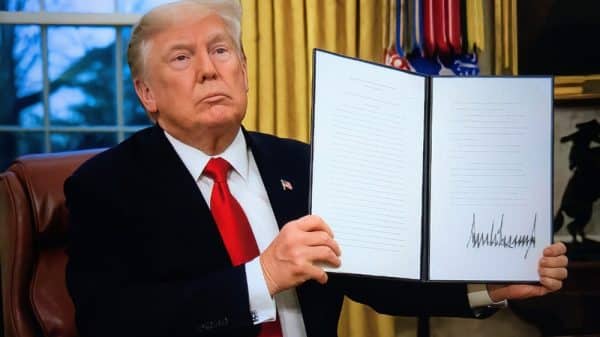
Under Trump administration directives, Immigration and Customs Enforcement (ICE) has ramped up its operations nationwide to meet increased deportation targets. This has brought a historic expansion for the agency, on an unprecedented scale and accelerated timeline.
With recent Congressional approval of $75 billion in new funding—nearly ten times the agency’s previous annual budget—ICE has begun an ambitious recruitment and hiring campaign.
While ICE hirees receive bonuses as high as $50,000, chaos has broken out in communities across the country where masked agents have pursued arrests.
Video footage has been captured of detentions following immigration hearings and raids at day labor pickup sites like Home Depot. Reporting describes concerning conditions in detention facilities, such as the controversial Alligator Alcatraz, where immigration enforcement holds alleged undocumented individuals.
Kilmar Ábrego Garcia, an immigrant at the center of Trump’s mass-deportation agenda, is now facing the administration’s second deportation attempt. First illegally deported to El Salvador’s mega-prison CECOT in March, Ábrego Garcia continues to fight to prevent deportation to Uganda.
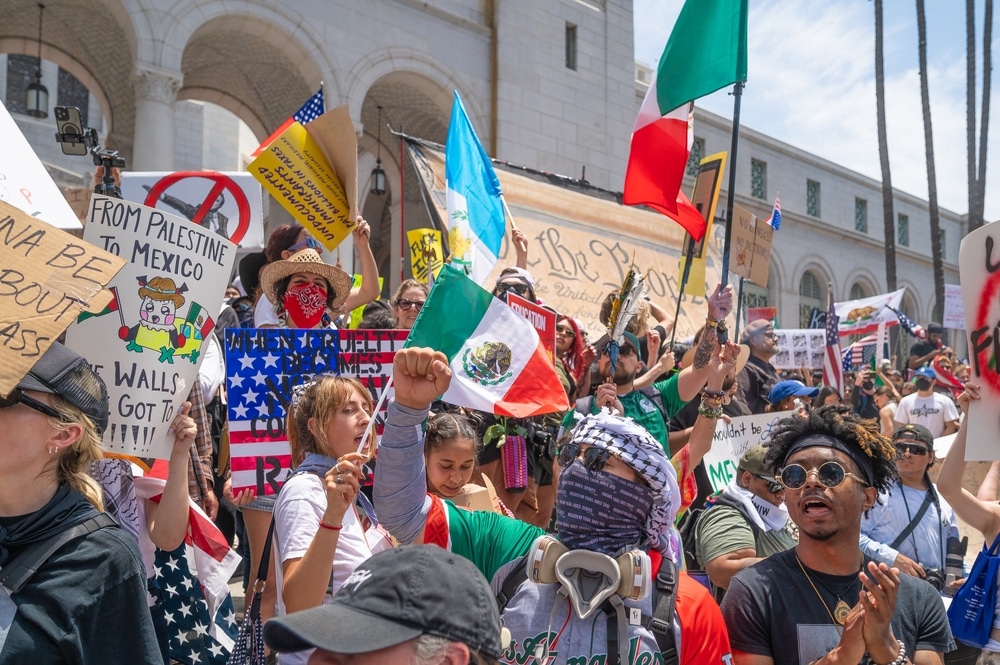
All of this has increased fear among the undocumented, their families, and their broader communities about the aggressive tactics of Trump’s mass-deportation mission.
As public criticism mounts, we must reflect on how we arrived here and reckon with what that reveals about Trump’s immigration agenda.
The power of Trump’s immigration narrative
During the 2024 election cycle, many—including me—were caught off guard by President Trump’s remark about Haitian immigrants allegedly “eating the dogs… eating the cats… eating the pets.”

The baselessness of this comment aside, it was only a taste of the much broader narrative of “migrant crime” that Trump wielded on the campaign trail.
Evidently, this narrative captivated Trump’s conservative audience and played well with a sizable portion of the American public. The Trump administration still spreads this narrative today, especially through social media content and memes shared on Twitter/X.
As powerful as the rhetoric of “migrant crime” has proven to be, given the successful passage of the Laken Riley Act, evidence of its reality is lacking. Of the people held in ICE detention, more than 70 percent have no criminal record as of August 24, 2025.
Several relevant studies conclude that there may actually be a link between immigration and decreases in violent and property crime. Even so, President Trump has accused migrants of “poisoning the blood” of the country.
A sudden change in tone
All of this makes Trump’s brief departure from the “migrant crime” narrative particularly notable, and strange. Just weeks ago, Trump claimed that undocumented workers are “naturally” suited to harsh field labor, calling them “very special people” and adding that “you can’t replace them very easily.”
But, this isn’t the first time Trump has mentioned the agriculture industry since the start of his aggressive deportation agenda.
Back in June, there was a short-lived respite from ICE arrests at farms, hotels, and restaurants. The pause came after Trump said that his administration can’t “take all [farm workers] and send them back because they don’t have maybe what they’re supposed to” in the face of worker shortages.
Recent raids on immigrant-staffed workplaces have made some workers afraid to show up to their jobs. The US Department of Agriculture estimates that approximately 40 percent of farm workers lack work authorization, explaining why some crops are rotting in the fields.
Even if Trump’s change of course wasn’t lasting, it still seems significant amidst the overwhelmingly anti-immigrant narrative he spreads. In the place of his past rhetoric about migrants ‘stealing’ Black and Hispanic jobs—whatever that meant—Trump has suggested carving out safeguards in the form of a “temporary pass” for farm and hotel workers.
The break between white supremacy and capitalism
There is a critical contradiction in the dueling messaging that both demonizes and essentializes immigrants. I argue that it perfectly encapsulates the division between two separate, though occasionally overlapping, visions of white nationalism and capitalism.
In recent years, the Republican Party has been associated with both white supremacist and capitalist ideology, with emphasis on deregulation. Unlike other issues the Republicans champion, such as crime or the economy, immigration inherently causes a divergence between these two visions.
White nationalism and unfettered capitalism both address the same issue of undocumented labor in opposite ways.
The white nationalist narrative
White nationalism, which vilifies immigrants, wields the language of criminality and contagion. Of ‘stealing’ jobs and ‘poisoning’ the nation.
This is especially true with the right wing’s conception of the immigrant population as Latino criminals, drug dealers, and rapists. This calls back to Trump’s infamous quote: “When Mexico sends its people, they’re not sending their best.”
The racial element of Trump’s mass deportation effort has only become more apparent with the mistaken detention of US citizens.
Many allege that ICE is racially profiling in its efforts to pursue undocumented immigrants. An upcoming Supreme Court case could increasingly empower immigration agents to legally stop and question Latinos.
Key Trump administration supporters, including Laura Loomer and Tucker Carlson, have cited an unsubstantiated figure of over 60 million undocumented immigrants in the US. (For comparison, Pew Research Center cites an unauthorized immigrant population of approximately 14 million.) Curiously, whether coincidentally or not, the faulty statistic matches the Hispanic/Latino population estimated by the US Census Bureau.
The capitalist contradiction
Capitalism, in contrast, celebrates immigrants. Not for their humanity, but for their productive ability and profitability.
Though pro-deportation voices claim that immigrants are ‘stealing’ jobs from US-born workers, employers of those immigrants understand it differently. The hiring of migrant workers is not an accident, but a consequence of American capitalism’s reliance on exploitable, disposable labor.
Due to their precarious socioeconomic position, undocumented workers face coercion into accepting low wages and poor working conditions. If they do decide to speak up and report their employer, they risk retaliation, job loss, arrest, or even deportation.
Reports on the conditions of—often immigrant, undocumented—workers in the agricultural industry demonstrate the extent of employer non-compliance with labor law. The neglect of crucial safety measures poses a danger to workers’ health. This is especially concerning given the financial and documentation barriers to receiving healthcare, especially in the US.
Trump seems to be navigating an effort to appease supporters who either spurn or rely on immigrant labor. As a result, Trump’s immigration rhetoric straddles the line between conflicting ideas about what the US should look like.
While one side argues that immigrants shouldn’t live and participate in the US at all, the other argues that immigrants are uniquely suitable to withstand socioeconomic precarity and profit-generating harsh labor.
Not the first time
In fact, this kind of debate is already a sore spot for leaders in the Republican Party and MAGA movement.
Earlier this year, a Twitter/X debate about H-1B visas involving many right-wing figures created friction between these two Republican Party factions.
Some like Elon Musk and Vivek Ramaswamy advocated for the employment-based visa program. They cited a shortage of skilled American workers with comparable ability in fields like tech. Others like Steve Bannon argued that the visa displaces American workers from quality jobs and wages, even harming the country’s national identity.
Trump ultimately concurred with the likes of Elon Musk on the H-1B visa earlier this year. However, the issue may now be reemerging within the Trump administration, which is again criticizing the program and pursuing an overhaul.
We have to wait to see if the H-1B visa is another victim to the Trump administration agenda, but key questions still remain: What is the future of a movement composed of these diverging ideals? Might there be an inevitable right-wing split ahead, as Trump’s second term progresses and starker fault lines form?
A rhyming history
The warring narratives and attitudes found in Trump’s immigration rhetoric are nothing new in the US. They actually have a much longer history than many public figures are currently acknowledging, and it expands beyond Latino workers.
Looking back
Earlier cases of the US using voluntary migrant labor to curb worker shortages involved Irish and Chinese immigrants. They were employed in the construction of public infrastructure. Namely, the Transcontinental Railroad. Even as these immigrants faced discrimination and economic hardships themselves, they became the targets of scapegoating for others’ strife.
In the case of Chinese workers, economic and social tensions led to the passage of legislation. The 1882 Chinese Exclusion Act suspended the immigration of Chinese laborers for a decade and denied citizenship to those already in the US.
Arguably, racial and cultural differences have been—and continue to be—used to divide immigrant and US-born laborers. By positioning the ‘other’ as the enemy, capitalists can turn workers against each other, preventing them from questioning the larger economic system and those who stand to benefit from it.
Possibilities remain
But, all hope is not lost. Another crucial historical moment that remains relevant today follows the Bracero Program. Addressing wartime labor shortages in the US, the 1942 Bracero Agreement allowed temporary agricultural workers from Mexico to enter the country.
The Bracero Program ended in 1964, shutting off the government-sanctioned stream of disposable labor into the US. Shortly after, the United Farm Workers (UFW) formed as a labor union for farm workers in the US. The UFW took multi-year, lasting actions to get concessions from the growers who employed their members.

Limiting the ability of growers to access disposable labor enabled the farm workers to resist. They strategically withheld their labor through strikes, organized consumer boycotts, and fought against exploitation. By taking collective action, they made themselves indisposable, forcing growers to raise their wages and improve their working conditions.
In today’s age of diminished union membership and organizing in the US, perhaps it’s unsurprising that immigrants continue to face wage theft, hazardous working environments, and fears of employer retaliation and deportation.
What comes next in Trump’s immigration campaign?
If there’s any word that I’d use to describe my expectations for the current administration, it’s uncertain. Trump has already escalated to new levels on all fronts, from mass deportation and National Guard deployments to apparently-illegal tariffs.
The question of how white nationalism and capitalism will, or will fail to, collaborate is an open one. But it’s important to remember that—no matter which side wins—it is still the immigrants, their families, and their communities that pay the ultimate price.