
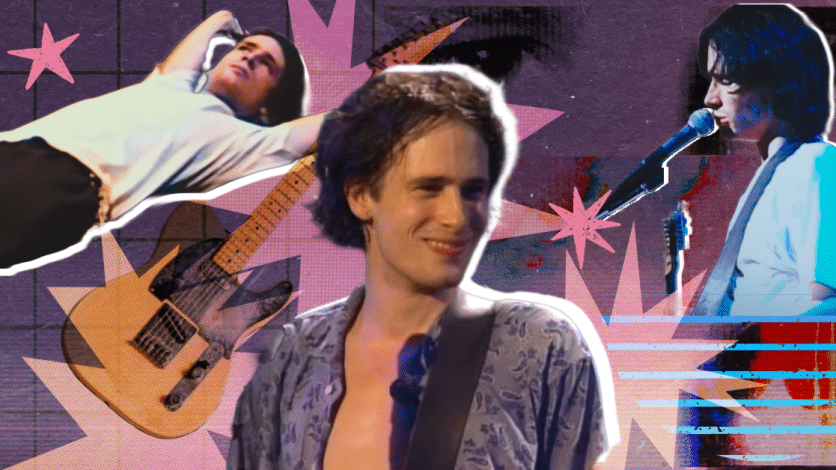
No musical artist burned as brightly or as briefly as Jeff Buckley; in August’s documentary film, It’s Never Over, Jeff Buckley tells his story to a new generation.
His debut album, Grace, is a monolith. No record before or since has captured the immeasurable levels of yearning that we know and love from Jeff.
He is the greatest male vocalist of all time. His guitar playing is inventive, impossible to reproduce. His lyrics are gut-wrenching and poetic.
And his debut album is his only album.
Buckley’s untimely (and drug-unrelated, contrary to popular belief) drowning at age 30 cut short his career just months before his second album was due to be released. Incomplete demos compiled on 1998’s Sketches For My Sweetheart The Drunk point toward another instant classic with a brighter sound than the nocturnal Grace.
The movie also arrived on top of a wave of Jeff Buckley-related content on the internet.
Whether you’re a longtime fan of Buckley’s music or a viewer of IG reels of agony and despair, you’ll love these six albums that inspired Jeff Buckley’s work, were inspired by it, or ran parallel to it.
The Bends, Radiohead
The Bends is the most sonically similar album to Grace in existence.

RYM fans and Fantano-heads might know Radiohead for their electronically driven, spacey sound from later releases like Ok, Computer and In Rainbows. As such, it’s easy to forget that they took inspiration from many of the same influences as Buckley—and from Buckley.
The Bends features similar instrumentation and vocal style to Grace. The guitar-playing is sometimes lateral and open, vis-à-vis Grace’s “Lover, You Should’ve Come Over” and sometimes approximates the raw grunginess of “So Real” and “Eternal Life”.
Yorke’s vocals are strikingly similar to Buckley’s, though he’s not capable of the same kind of improvisational scat-singing that Buckley borrowed from another artist we’ll talk about later.
In particular, “Fake Plastic Trees” sounds like it’d fit right in on Grace.
Its alternating acoustic and electric sections are reminiscent of Grace‘s fluidity, and Yorke’s falsetto soars closer to Buckley’s than on any other track on The Bends.
It’s said that Radiohead recorded the song immediately after attending Buckley’s concert.
You are guaranteed to enjoy The Bends if you enjoy Buckley’s music.
Led Zeppelin, Led Zeppelin
Led Zeppelin was Jeff Buckley’s favorite band, and it shows.
Each song on Led Zeppelin’s 1969 debut is an eclectic jam featuring outlandish instrumentation, varying tempo and dynamics, and wailing vocal performances from Robert Plant.
Guitarist Jimmy Page’s performances are loose and improvisational, sometimes screaming into the front of the song and sometimes scooting into the back to let Plant, bassist John Paul Jones, or drummer John Bonham deliver a punchy solo.
Plant’s influence on Buckley’s voice is clear. “Babe I’m Gonna Leave You” demonstrates the sweetness that Buckley harnesses on his own songs like “Mojo Pin” and “Corpus Christi Carol.” Plant belts raucous notes, improvises, and shows off a remarkable range on every track except the instrumental “Black Mountain Side.”
Brad Pitt famously said that Buckley is Plant and Page fused together, and I think that’s a bit inaccurate. Buckley is absolutely the better vocalist, but Page is five times the guitarist.
Though Buckley concocts inventive chords and writes a few memorable intros on Grace, Page is one of the greats. His improvisational genius is miles beyond anything Buckley attempts in his discography.
That said, fans of Buckley will certainly enjoy anything by Led Zeppelin. Zeppelin’s unique song structures and fantastic vocal performances scratch the same itches as Grace.
Honestly, I could’ve picked just about any Led Zeppelin album for this list. At least 5 are classics. However, this debut record in particular draws from folk and blues influences that Zeppelin shares with Buckley, making it an excellent jumping-off point for Buckley listeners.
Blonde on Blonde, Bob Dylan
Listen to Blonde on Blonde, and you’ll see why Buckley chose to cover so many of Bob Dylan’s songs…and you’ll experience near-Grace levels of yearning.
The Cohen tune “Hallelujah” is Jeff’s best-known cover, but it’s not his best. Buckley’s version of Blonde On Blonde‘s “Just Like A Woman” is one of the greatest recordings of all time.
Buckley, playing solo, uses an open tuning on his guitar to provide a sweet, static, and swelling backdrop for his angelic vocals. Dylan’s lyrics enhance the already perfect sound of Jeff’s performance.
The original version is quite different. Dylan’s guitar playing is thin and plucky, his voice hoarse and pained, and his harmonica solos howling and melodic. However, the backing band, particularly the organ, lends the track some of the same thickness as Buckley’s cover.
Lyrically speaking, this is the greatest album of all time. Blonde on Blonde includes straightforward love songs, such as “Just Like a Woman” and “One of Us Must Know,” playful songs of desire like “Absolutely Sweet Marie” and “Leopard-Skin Pill-Box Hat,” and cryptic masterpieces like “Visions of Johanna” and “Stuck Inside of Mobile With the Memphis Blues Again.”
Holy yearning. Blonde on Blonde gives Grace a run for its money for the most desire-laden record in history. Similarities end here, though. Buckley and Dylan share a penchant for romantically fraught and poetic lyrics, but their respective sounds are vastly different.
Blonde On Blonde and Grace both feature thick, wall-of-sound production, but the former favors a floaty, country-inspired musical backing while the latter fuses 70s glam with contemporary grunge heaviness.
Then there’s the voices. Buckley has an exceedingly pretty voice, and Dylan is, well, Dylan.
None of this is to say that his voice doesn’t work in its context. I think it complements the songs well.
Though listeners who enjoy Buckley primarily for his voice will probably be left a little disappointed, Blonde on Blonde‘s molten yearning and supernaturally good songwriting make it an enjoyable listen for anyone.
It is one of the greatest albums ever made.
I Put A Spell On You, Nina Simone
Buckley was clearly a student of Simone’s. Her mastery of the voice as an instrument is unmatched.
One of the most enlightening moments from the documentary was learning that Jeff Buckley was a big fan of Simone. Something clicked into place immediately; it made too much sense.
Outside of Robert Plant, I hadn’t heard another man sing anything like Buckley. That’s because his greatest influence wasn’t a man. It was Simone.
The fluttering, breathy highs, the growling lows, and the rhythmic scatting are all present on I Put A Spell On You. In fact, they’re featured. The album treats Simone’s voice like another lead instrument. When she’s not harmonizing with the rich jazz chords, Simone trades bars with (and, in my opinion, outshines) the fantastic session players.
She could absolutely wail on Led Zeppelin.
I Put A Spell On You‘s musicality is vastly different than any other record on this list and from Grace. While Buckley stumbles into jazz chords frequently by leaving strings open, using them with intent infrequently, they are foundational to I Put A Spell On You.
The Bends dispenses with such theoretical frivolities completely, Led Zeppelin presents similar stylings and broadcasts them to you through a hurricane on fire, and Blonde On Blonde has exactly one chord of I Put A Spell On You crunchiness (bonus points if you can find it).
The next two picks aren’t so similar either. Simone’s album is a unique detour on this journey.
Buckley’s unique sound stems from his mixing of elements from disparate musical traditions. He airbrushes Simone’s jazz singing onto an ancient, solid rock-and-folk-inspired backing to achieve artistic singularity.
Oh, and I Put A Spell On You also yearns.
Either/Or, Elliott Smith
While Buckley exploded the monolithic ’90s grunge rock scene with a soft touch, Elliott Smith dirtied up the singer/songwriter genre with similar vulnerability on Either/Or.
Either/Or sounds like a dirty room. Maybe that’s the dust-tan album cover with the marked-up mirror talking, but I like to think there’s a level of truth to that statement.
Smith is honest about the world his mind inhabits on Either/Or. It’s dirty and lonely and always nighttime. He tells you what he sees, and he does a lot of thinking without presenting a lot of solutions.
Grace yearns for a certain, definite (and female) cure. The yearning in Either/Or is mostly implicit. The subjects of Smith’s songs are tortured, lonely, self-critical, and wandering. They yearn for peace, but can’t identify what’ll bring it.
Smith’s vocal performances reflect this uncertainty. While Buckley belts out his pleas for connection, Smith whispers his secrets.
The production is similarly muted. Only three tracks feature drums or electric instruments. The way his voice floats over his sonorous, warm guitar, however, is exceedingly Grace-like.
If Buckley’s honesty and vulnerability are what draw you to him, you’ll love Elliott Smith and Either/Or.
The Velvet Underground & Nico, The Velvet Underground
The Velvet Underground & Nico paved the way for Buckley’s mold-breaking, oddball sound nearly 30 years before Grace‘s release.
The Velvet Underground is a weird band. At the time of The Velvet Underground & Nico‘s release, their lineup consisted of shock therapy victim, vocalist-guitarist, and lead songwriter Lou Reed, standing-up drummer Maureen “Moe” Tucker, guitarist Sterling Morrison, Welsh avant-garde viola-and-bass-player John Cale, and gothic German model and singer, Nico.
The band members were weird, but the music is arguably weirder. Some tracks feature a guitar with each string tuned to the same note, others a scratchy viola drone, and many lyrics discuss taboo subjects like hard drugs and sexuality.
On “Sunday Morning,” Reed sounds more feminine than his female counterpart, Nico, ever does on the record. This is very Buckley-esque.
It might be more accurate to say that Jeff Buckley’s singing is Reed-esque. Before The Velvet Underground & Nico, male singers sang in male voices. Even the pitchiest of them all (looking at you, Frankie Valli) would maintain a classically masculine quality to their voices.
Without Reed’s groundbreaking gender-bending performance, audiences might’ve been put off by Buckley’s feminine, Nina Simone-inspired vocal performances.
Some compositions on the album should remind listeners of Grace tracks. “All Tomorrow’s Parties'” open, meandering rhythm guitar sounds a bit like Buckley’s playing.
The alternating horror-movie, minor verses and spacious, uplifting choruses of “Venus in Furs” and the energetic slinky-ing of “Heroin” show that Lou Reed loves to play with time as much as Buckley.
And a fun fact: Buckley’s cover of Leonard Cohen’s “Hallelujah” is based on John Cale’s 1991 version of the song.
The strangeness of Buckley’s music and his put-on femininity both originate from the 1967 release of The Velvet Underground & Nico.
There’s also a certain rawness that the Velvets and Buckley share, best exemplified in this record in the prostrate, helpless mantra of “I just don’t know” in “Heroin.” The same can be said of The Velvet Underground & Nico as can be said of Either/Or; the yearning is indefinite and aimless, though indelibly present.
The Velvet Underground is even more off-kilter than Buckley, but if that’s your thing, you’ll love this album.