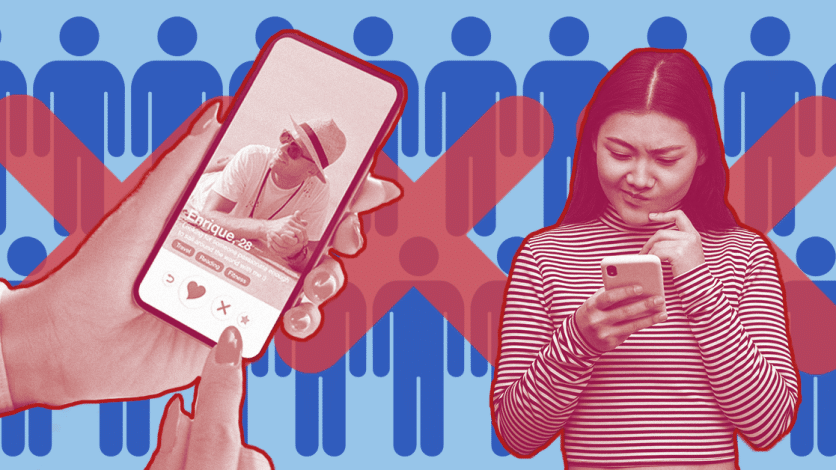
Do women need to lower their dating standards, or have men’s entitlement and mediocrity caused them to fall short of the bare minimum?
Lately, a certain mindset and animosity towards women has been on the rise in the dating world. Swarms of young men lament about how women have become borderline untouchable because of their impossibly high standards.
Common support for this argument includes the notions that women will only date a man who’s over a certain height, making a certain amount of money, or maintaining a certain body type.
This wide-sweeping claim applies to some, but rings true for far fewer than the men behind it seem to think. Nonetheless, women’s supposed focus on these surface-level traits has led many men to complain that women are shallow, ask for too much, or must lower their all-too-high expectations.
What even are ‘high standards’?
High standards are being revisited, redefined, and subsequently re-stigmatized in the public eye. A woman who claims ownership of her high standards is, more often than not, presumed conceited and self-absorbed. Why is this?
I’ve noticed that the men that abhor the idea of women’s high standards uphold at least one of two beliefs: first, a woman’s high standards are based in her desire for worldly possessions, wealth, or the vain fulfillment of her physical type. Second—and the two aren’t mutually exclusive—these men are threatened by the notion of a woman who knows what she wants (or has standards, at all).
Consequently, high standards have been virtually caricaturized, and this modern definition has opened another avenue by which women can be censured.
In reality, not so often does the female gaze fall on material assets, vanity, or status.

To clarify, I collected Google Form responses from other young women at my university and in my social spheres (mid-teens to early 20s) about the most important qualities they seek in a relationship; note that percentages are approximate.
What do women actually want?

Out of roughly 90 responses, the top three desirable traits participants sought in a partner were humor (60%), kindness (50%), and a tie for third between intelligence and loyalty (40%).
I also asked about the aforementioned traits men present to push the notion that women have absurdly high standards: height, body type/being in shape, and salary/financial dependence.
Of these, 70% of participants stated height was not an important factor when choosing a partner, over half had lenient or no preferences about their partner’s body type, and 75% did not place great importance on a partner’s salary. Additionally, 85% did not expect complete financial dependence on their partner, but instead desired self-reliance and/or mutual spending on expenses in a relationship.
Below are some of the responses received.
On height
Height, or my partner being tall, isn’t really important. I’m short and the idea of me (who’s 5’3”) with someone six feet just doesn’t sit right with me. I love short kings.
Emily, 19
I am a tall girl so I understand how you can’t really control height. Height is not something I look for, but it helps me be more attracted to the person.
Brynn, 17
On body type
Body type is absolutely not important to me. I’ve never had the conventionally attractive body as someone who is mid-size/curvy, so looking for men who fit a certain standard was never a priority for me.
Mari, 21
Similar to the height, I don’t really care about physical traits because that doesn’t define you. And I’d rather find a man that has a beautiful soul over a beautiful body.
Isabella, 19
On salary
As someone with a job, salary is important! But it doesn’t just mean the ability to spend money on your partner, but more so displays drive, work ethic, and self-discipline. Providing for oneself is independence!
Isis, 19
I don’t seek financial dependence, but the ability to be financially equal with each other. I think for me the ideal situation would be that we trade off on paying for things.
Lily, 22
I know I’ll be able to support myself with my future career and have no intent depending on a man for money. As long as they’re not broke with no job it’s not a concern for me.
Camila, 18
Most participants conveyed open-mindedness about their partner’s material assets and body type, even if they had a preference for certain traits. Some entirely refuted the idea of women’s pickiness by, for instance, seeking financial self-sufficiency over the assumed reliance on a partner.
Male loneliness or incompetence?
So if a significant number of women don’t fall under this one-dimensional definition of high standards, why has the male loneliness epidemic persisted, and why do high standards continue to be stigmatized?
Some of the main perpetrators of the disfavor towards women’s high standards are the same men who are part of the male loneliness epidemic, denoting a recent rise in social isolation and relationship struggles among young men. With the increase in men’s challenges in the dating world has come a potent bitterness towards the women they feel are unattainable.
Having high standards isn’t a bad thing
However, evidenced by my Google Form, a lot of women’s bare minimum is, well, the bare minimum. Kindness, intelligence, loyalty, and paying for dates on occasion? Are these truly unrealistic expectations?
If the male loneliness epidemic was, at its core, about male social detachment, we’d be seeing greater efforts from men to foster friendships, family relations, or community at their jobs or schools. Instead, there is an overwhelming disdain being voiced towards women, the apparent scapegoat of male dejection.
This is because men are experiencing a shift in which they no longer have undisputed access to women and their bodies.
The “male loneliness epidemic” does not relate to men lacking opportunities to build community, but instead lacking the fundamental skills and traits to attract women without the ulterior motives of sex or getting a girlfriend.
So the bare minimum seems to be asking a lot when countless female dating experiences involve settling, accepting inadequate treatment or communication, and prioritizing their partner’s desires. Today, more women are being emboldened to not only stand by their bare minimums, but heighten their expectations.
High standards are continually frowned upon because men are hyper-focused on being wanted by women instead of considering what women want.
It’s time to stop celebrating the bare minimum and start asking for more.
Women are bored with men’s mediocrity
Women who have high dating standards often have high standards for themselves. Therefore, their “pickiness” can reflect the intelligence, communication skills, and emotional regulation they inwardly foster.
Sometimes when you are insecure, you let so much poor treatment slide. Guys will treat you as an option… and you’ll just accept it. High self-esteem is the best protectant you can have to shield yourself from someone who treats you poorly, and sometimes high self-esteem is reflected as high standards.
Don’t lower your standards because you like someone, or because you struggle with self-esteem, or because you’re eager to get in a relationship. Don’t lower your standards because you think you’re not worth it.
Don’t lower your standards… but be realistic
High standards can come from knowing your worth, but being overly critical can influence how you perceive and treat others. This shortcoming can be seen in many women who participated in the “ick” trend on social media.
The trend began as a way for people to point out red flags in their partner’s behavior. But “icks” were, to a degree, reduced to a male partner doing something clumsy, silly, or emasculating—something that doesn’t adhere to the hypermasculine, stoic persona a lot of men still feel pressured to conform to.
The trend became an outlet for some to pass judgment over inconsequential, one-off moments, like their boyfriends sitting with their legs crossed. This redefining of the trend, and of how some gauge their attraction to others, has cultivated a juvenile, superficial mindset that discourages healthy communication and harmless quirks.
Dating with intention and sensibility
Ultimately, it’s important to remember that your partner doesn’t have to check every box on your build-a-boyfriend checklist. There’s value in understanding that your partner may not fulfill every area of your life—that you can seek fulfillment through other relationships—while maintaining a bare minimum.
Likewise, if men apply this mindset to the male loneliness epidemic, we may see hostility and solitude be replaced with improved communication, expanded social networks, and a refined perspective when approaching romance.
While women with unrealistically high standards do exist, “expecting more than they can give” as one participant from my Google Form phrased it, many with high standards are merely redefining what one should be able to ask for in a relationship.