“I’m proud to help support President Trump and Secretary Noem in their mission to fix our illegal immigration problem once and for all. Alligator Alcatraz and other Florida facilities will do just that.”
That’s what Florida Attorney General James Uthmeier posted on X on June 23. Uthmeier’s declaration came as a reply to the Department of Homeland Security’s announcement that it was working on “cost-effective and innovative ways” to carry out the “American people’s mandate for mass deportations.”
Uthmeier has since launched Alligator Alcatraz merchandise; the Alligator Alcatraz Camo Slim Beverage Cooler, for instance, features a circular emblem of a fierce looking alligator and snake.
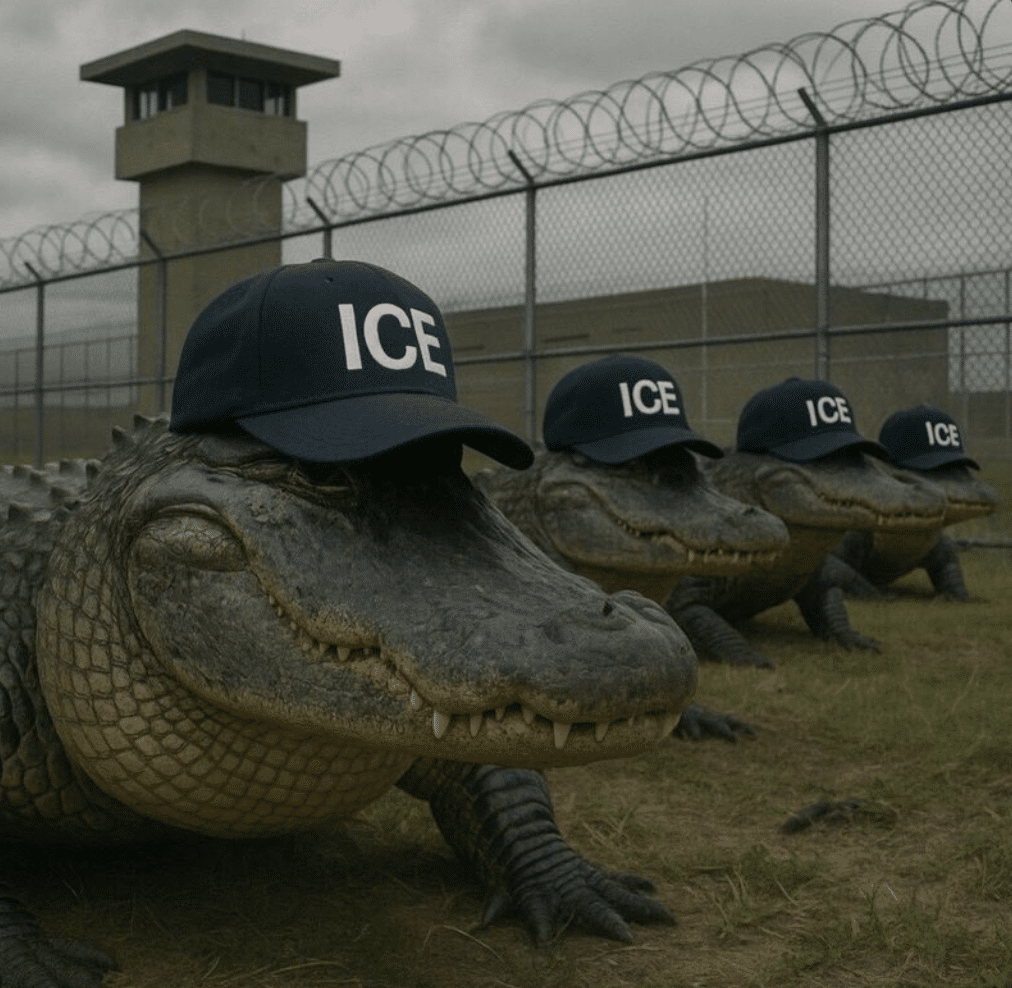
Composed of heavy-duty tents on a converted air strip, Alligator Alcatraz is the Trump Administration’s newest state-run immigration detention center. Located deep in the Everglades, the facility is surrounded by wetlands teeming with Florida-native reptiles, hence Gov. Ron DeSantis’ administration’s name for the project.
As it garners national attention — both praise and criticism – Alligator Alcatraz has much to prove. Secretary of the Department of Homeland Security Kristi Noem wrote on X that the detention camp is putting Americans first. The facility symbolizes Trump’s conviction to carry out mass deportations, but what role will it play in the process of detaining and deporting? Crucially, who are the detainees being held there, and under what conditions?
A hasty construction
The detention camp’s construction was treated with extreme urgency, and followed by a trail of backlash.
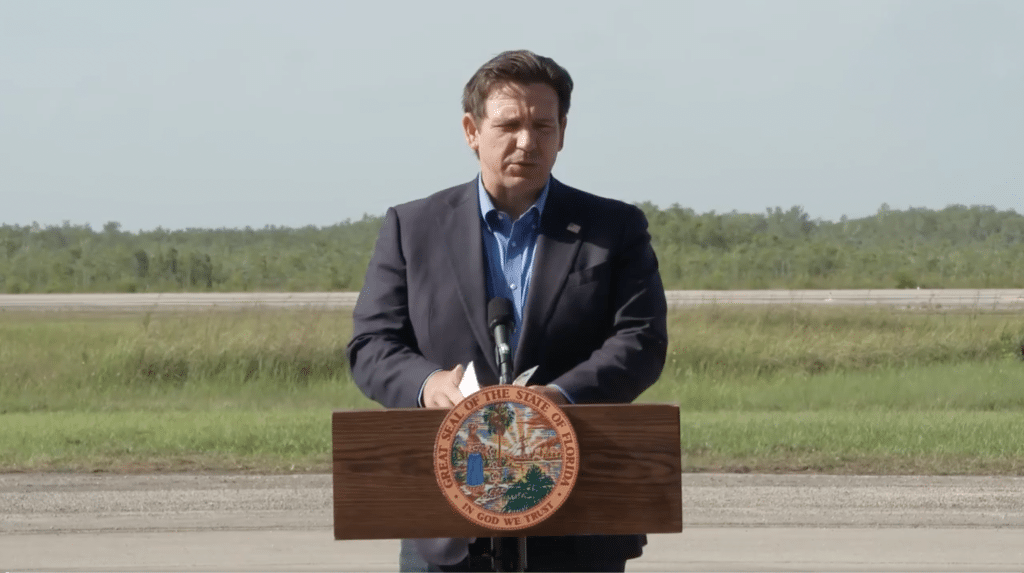
The airstrip beneath the project is owned by Miami-Dade County. According to e-mails obtained by the Associated Press, DeSantis’ administration used a 2023 executive order to begin building in early June. The order allowed Florida to seize county-owned land, bypassing “any statute, rule or order” in order to mitigate an immigration “emergency.”
Two environmental action groups, the Center for Biological Diversity and the Friends of the Everglades, have since filed a federal lawsuit contesting Alcatraz’s accelerated construction. Eve Samples, executive director of the Friends of the Everglades organization, stated in a press release that the center is built on wetlands surrounded by the Big Cypress National Preserve, and will threaten the endangered species living there.

The lawsuit was filed against the U.S. Department of Homeland Security, U.S. Immigration and Custom Enforcement, the Florida Division of Emergency Management, and Miami Dade County. Filed on June 27, it seeks an injunction to halt construction prior to the completion of an environmental impact study.
Florida insists that the facility has been built with the intention of being temporary. Spokesperson Bryan Griffin stated in an email to CBS News that the state looks forward to opposing the lawsuit in court.
“Governor Ron DeSantis has insisted that Florida will be a force multiplier for federal immigration enforcement, and this facility is a necessary staging operation for mass deportations located at a pre-existing airport that will have no impact on the surrounding environment,” Griffin said.
The DeSantis Administration remains steadfast that the urgency of the immigration emergency mandated an accelerated construction timeline. The state’s response to the suit cited “imperiling critical immigration enforcement and endangering detainees in current facilities” as necessary grounds for overlooking environmental damage.
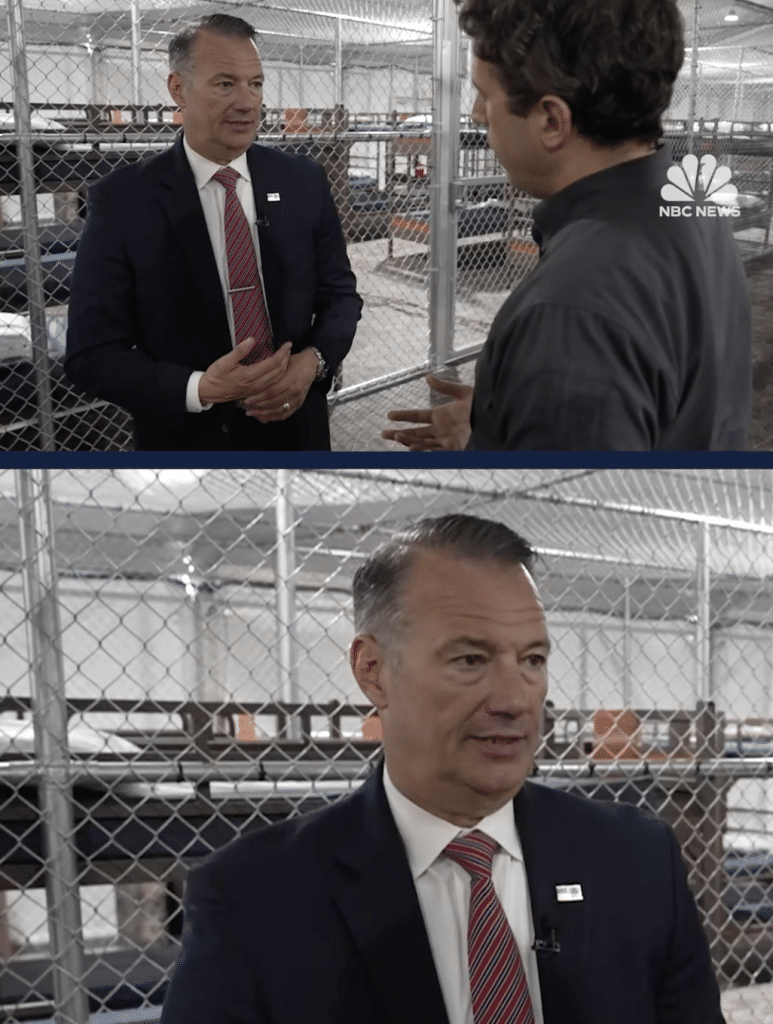
Indeed, acting ICE Director Todd Lyons reflected this same sentiment in an on-site interview with NBC News reporter Gabe Gutierrez.
“We want to ensure that we move people back in a safe and humane manner, and we would much rather do it quickly,” Lyons said. “Not only for the people detained, like I said, but for cost savings for the American government.”
Alligator Alcatraz will cost the state of Florida about $450 million a year to run. Although, Florida may request partial reimbursement from the Federal Emergency Management Agency (FEMA), according to Tricia McLaughlin, a spokeswoman for the Department of Homeland Security.
Lyons promises that ICE will continue to operate in accordance with Trump’s ethos, targeting only the “worst of the worst.” Secretary of Homeland Security Kristi Noem parroted this same promise in a post on X, adding that immigration detention means putting American citizens first.
The detainees: who are they?
The detention center will house “immigrants picked up by the local authorities on behalf of the federal government,” as stated by The New York Times. Under normal circumstances, immigrants are detained by ICE officials in private or local prisons in exchange for money.
According to a list obtained by the Miami Herald of over 700 migrants held or scheduled to be detained at Alligator Alcatraz, more than 250 are listed as having immigration violations — but no criminal record. About one-third have some kind of criminal conviction, while hundreds have pending charges.
Allegations of maltreatment
One detainee, Fernando Eduardo Artese, was arrested in Jupiter, Florida, having overstayed his 90-day allowance under the visa waiver program. After missing a traffic court date, he was taken to a U.S. Customs and Border Protection facility and handed to ICE custody. From there, he was transferred to Alligator Alcatraz.
“This is a concentration camp. They treat us like criminals, it’s a pursuit of humiliation,” Artese said in a phone interview with the Tampa Bay Times.
Further accusations of the center’s harsh conditions have piled up in the weeks following Alligator Alcatraz’s beginning operations in early July. Attorney Philip Arroyo told Newsweek that his client was denied medical care after falling ill. Kimbery Gibson, mother of a close friend of detainee Braydon Cash-Brown, stated that he was given a cup of water upon arrival before being held for hours with no further food or drink. Cash-Brown described over 15 people per room, with migrants sleeping on the floor.
Leamsy Isquierdo, referred to as “La Figura” by CBS News, was charged with aggravated assault with a deadly weapon and battery before being detained at Alcatraz.
“They only brought a meal once a day and it had maggots. They never take off the lights for 24 hours. The mosquitoes are as big as elephants,” La Figura said in a phone call with CBS.
A Colombian detainee claimed his Bible was confiscated by the detention camp’s staff. Also in a phone call with CBS, the detainee recalled being told that there “is no right to religion” within the facility’s walls.
A bipartisan split: confirmation vs. denial
Two days after President Trump, Gov. Ron DeSantis and other state Republican officials held a tour of Alligator Alcatraz, five Democratic lawmakers were barred from touring due to ambiguous “safety concerns.” Democratic Senators Carlos G. Smith and Shevrin Jones, together with three state representatives, filed a lawsuit in contention with their denial of entry.
The lawsuit alleges that the lawmakers’ July 3rd exclusion from the facility violates Florida statutes and the state’s constitution. The Florida Division of Emergency Management (FDEM) invited members of Congress and state legislators to the facility for a 90-minute tour the following Saturday.
Representative Debbie Wasserman Schultz, a Florida Democrat, said that detainees were being held in “really disturbing, vile conditions.” She called for the facility’s closing, saying, “They’re abusing human beings here.”
Stephanie Hartman, spokesperson for the FDEM, stated that “the reporting on the conditions in the facility is completely false.” Federal Homeland Security Secretary Kristy Noem maintains that Alligator Alcatraz is running smoothly, and hopes to build similar facilities in the future.
The bigger picture
Whether the allegations are proven true or false, a lack of transparency from the FDEM, ICE, and the Trump and DeSantis administrations indicates a more insidious problem.
Alligator Alcatraz turned away Democratic lawmakers attempting to tour without notice. Lyons and Noem insist the facility houses the “worst of the worst,” yet many detainees hold no criminal record. The Trump administration, perhaps justifiably, may feel it has a mandate to crack down on illegal immigration. But it does not have a mandate to do so in secrecy.