

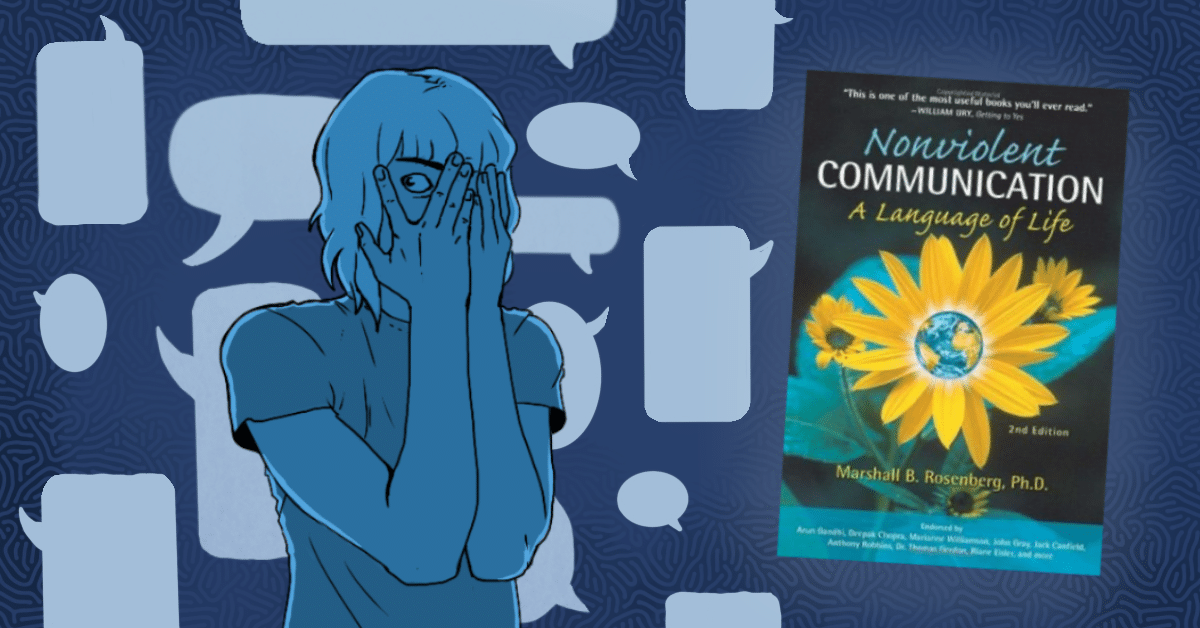
I read a book that completely changed my perspective on communication in friendships: Nonviolent Communication by Marshall Rosenberg. As a friend with an avoidant attachment style, it made me realize that other people’s words and actions are never the cause of our emotions.
Recently, I opened Instagram and noticed that one of my closest friends had blocked me. There was no warning. No argument. He had simply disappeared. “Why did my friend suddenly block me?” I exclaimed. I scoured Reddit, TikTok, and various blogs in search of a reasonable explanation.
But most friendships don’t end without a reason. In my case, we never argued. Maybe that’s the problem. I now recognize that some of the things I didn’t say drove people away from me.
Let’s talk about it.
Why we say hurtful things
“You don’t care about me at all.”
“You’re so selfish.”
“You’re so boring. No wonder your friends don’t want to talk to you.”
“You stay at home all day. You’re wasting your education.”

We may have heard of comments like these before from friends, or we have said them to ourselves. When faced with situations that trigger an emotional response, most people react in one of four ways:
- We blame others.
- We blame ourselves.
- We try to understand the other person’s needs.
- We recognize our own needs and express them.

Blaming others and blaming oneself are the most common reactions. Trying to understand the needs of others or clearly expressing one’s own needs requires more awareness and practice. This is where Nonviolent Communication (NVC) comes into play.
It teaches us a skill: how to identify our true needs and positively express them. NVC presents a bold idea: What others say or do is never the source of our emotions. It doesn’t mean emotions are bad. It means emotions come from within, from unmet and unexpressed needs.
This approach isn’t limited to language. It helps us focus on the needs behind the words. It teaches us to pause and ask ourselves: Which of my needs are not being met? What do I truly want right now?
It began in childhood
Although Nonviolent Communication doesn’t directly reference attachment theory, I found it helpful to explore these areas as a way to better understand why we often default to harmful language, whether directed at others or ourselves.
The patterns don’t just appear out of nowhere. They usually stem from how we learned to connect with others early in life.
In the 1950s, British psychologist John Bowlby developed the attachment theory. He believed that the way we form bonds with other people, whether friends, partners, or strangers, is rooted in the love and attention we experience in childhood.
Later, psychologist Mary Ainsworth conducted the “Strange Situation Experiment” to observe the emotional reactions of infants when they are separated from their mothers for a short time, encounter strangers, and are reunited with their mothers. Their initial reactions then allowed researchers to understand the emotional patterns of adults.

Some infants cried but quickly calmed down when comforted by their mothers. Others showed the same interest in their mothers and strangers. Still others behaved unusually when their mothers returned.
The reactions were not random. They revealed different attachment styles, a set of behavioral patterns that children adopt in their interpersonal relationships to ensure their safety. The patterns can continue into adulthood.
The Strange Situation acts as a mirror that reflects how adults love. You can imagine the mother in the experiment as someone very important to you in adulthood, like your best friend or partner.
Avoidant children appear calm when their caregiver leaves. They get along well with strangers. When their caregiver returns, they don’t show much need. But deep down, they are very stressed when their caregiver leaves. They just hide it. This is how it can feel with someone who has an avoidant attachment style. You are important to them, but you don’t always feel it.
Anxious children, on the other hand, show their joy when their caregiver returns and then push them away again. This is how you may feel when you are with someone who has an anxious attachment style. You are important to them. But when they need you, they may push you away.
Sometimes this defensive behavior escalates into emotional manipulation. People try to control others and express their needs in a familiar way, even if it makes them unhappy.
You can find a detailed analysis in the following video:
In Nonviolent Communication, such patterns occur when we express our needs in a “tragic” way, accompanied by accusations, attacks, blame, or withdrawal. This distracts us. We stop listening. We forget to ask ourselves, “What do I really need right now?”
Understanding is the first step. Once you observe the pattern, you can gain confidence and learn to break it by communicating with your loved ones and using positive language.
Facts and comments
Here are some suggestions:
If you think that saying “You’re always late” is just a statement of fact, we may have a different perspective. I would prefer to say, “You were 20 minutes later than our agreed-upon time.”
If you think that calling someone “lazy” is harmless, we may have a different perspective. I would prefer to say, “You slept until noon three days this week.”
If you think that saying “You’re the smartest person in the group” sounds like a fact, we may have a different perspective. I prefer to say, “I really appreciate your explanation of the algebra problem in the lecture. I was stuck on the third question, but after hearing your explanation, I finally understood how to solve it.”
If you think that saying “You never care about my feelings” sounds like emotional honesty, we may have a different perspective. I would prefer to say, “When I told you about the argument I had with my parents, you started talking about your last argument with your parents. That made me feel sad, and I want you to know how I felt when I told you about it.”

The above is a simple application of nonviolent communication, which illustrates the difference between comments and factual language. Nonviolent communication has four simple steps:
- Observe, don’t comment
- Express your feelings
- Connect your feelings to your needs
- Make a request and tell the other person what you want them to do
In short, commentative language is often very general and can easily trigger defensive reactions in others. Conversely, factual language looks like writing essays. It does not make others feel uncomfortable. Nonviolent communication encourages us to use factual language more frequently.
Once we understand the difference between observing and commenting, we may wonder how to make requests.
Rosenberg’s book provides a sentence structure that allows you to clearly express your feelings without blaming the other person: “When you… I feel… This makes me realize…”
“When you asked me to send more photos, I felt a little pressured. This makes me realize that I want to understand how you felt when you made that request.”
“When you told me you wanted me to record a video, I felt pressured. This made me realize that I would like to know how you felt when you made that request.”
Small changes can transform emotional tension into understanding. You are not blaming anyone. You are sharing your inner world and inviting others to connect with you in an approach that awakens empathy.
The good news is that you don’t have to strive for perfect communication. The moment you open your mouth to speak, you have already made progress.
If you want to learn, start from a safe place—with your parents, close friends, or someone you trust. Try the pattern in conversation and gain some initial experience.
Thoughts on the future
Since its first publication in 1999, Marshall Rosenberg’s book Nonviolent Communication: A Language That Heals All Wounds, has sold over a million copies worldwide and been translated into more than 30 languages.
The book is widely used in schools, therapy, prisons, workplaces, and even peace initiatives in conflict zones. Today, it is considered a classic in the fields of empathic communication and emotional intelligence.
It is important to note that nonviolent communication (NVC) does not dictate who you should stay in touch with. However, if you choose to maintain connections with important people in your life, it is a way to strengthen them.
It’s not about repairing all relationships. Sometimes we just need time to think and make decisions. That’s why I’ll link another article here: 📎 Hourglass Friends: How to Make Space and “Let Them” When Love Runs Out.

Furthermore, not all readers will find the approach easy to understand. Some find its concepts too abstract or idealistic. One blogger wrote: “It took us nearly 2 years to understand the book, because we are slow and it is definitely ‘out there.’ Here we are now, all alone again.”
Another reader questioned the central message: “I am not totally sure, but I think that the praise for performance can be violent in the sense that it sets an expectation that the person needs to live up to in order to be accepted or viewed as worthy. “
This is not a book that can be mastered overnight. If you read it as a teenager or in your twenties, it may take you five years or more to fully internalize its concepts and apply them. That’s perfectly normal. The key is to take your time.
I recommend it because, as someone with an avoidant attachment style, nonviolent communication has given me something unexpected: a practical way to express myself. I took the first step to communicate with my parents and friends.
After reading the book and working to apply the methods, I saw subtle changes. I found it easier to express my feelings and was less afraid of being misunderstood. In a way, I’m slowly moving in a safer direction by building stronger relationships.
It’s not a miracle cure. But it gave me a new tool. A tool that can help people like me, and perhaps others, communicate more honestly, build better friendships, and move forward.