Writer’s Note: I often use the term “women” throughout this article when discussing bodies and experiences. However, these insights apply to anyone who menstruates, regardless of gender identity.
Hello to the ladies—and every human who rides the elusive, mystical wave of the month-long menstrual cycle. Have you ever woken up and gotten more done in the first three hours of your day than you had in two weeks? Or, maybe the opposite, being crippled with a faceless anxiety that keeps you tethered to your bed with no explanation? Same. And guess what? It’s actually considered normal.
I say “considered normal” because our society constantly overlooks women’s fluctuating hormones and how they affect our lives. This happens even when the impact is deeply detrimental. Since men don’t get periods and operate on a steady, 24-hour cycle, they’ve never really had to bother with understanding our changing bodies.
If you look at the receipts, society has a long history of silencing, discrediting, ignoring, and misinforming women about our own biology. Just take a look at health and sex education, I didn’t even learn the phrase “luteal” until I was 22 years old. Women still feel embarrassed to talk about their cycle in public settings, and the lack of curiosity and empathy around menstruation, primarily from men, is still prevalent and driving the narrative.
The reason? So we don’t make a big deal about it. Turns out, it actually is a pretty big deal. Up to 90% of women report experiencing some form of negative PMS (premenstrual syndrome). This could be anything from depression, crying spells, and irritability to extreme fatigue, bloating, and acne flare-ups.
Maybe that’s why writing about periods—even something as natural and universal as PMS—feels inherently political. Women’s bodies have long been subjected to scrutiny and control, so writing about our experiences shamelessly and with intention can feel, in some ways, like an act of defiance. But for many, the menstrual cycle is more than a bad mood or an inconvenient cramp—it’s a full-body, full-mind, month-long experience that deserves recognition.
So with that, let’s dive into the intricacies and unique phases that shape what it means to move through a menstrual cycle.
The four phases you move through each month shape, dictate, and influence your life—whether you acknowledge them or not. That’s why it’s your right to understand how to support yourself and live in sync with your hormones.

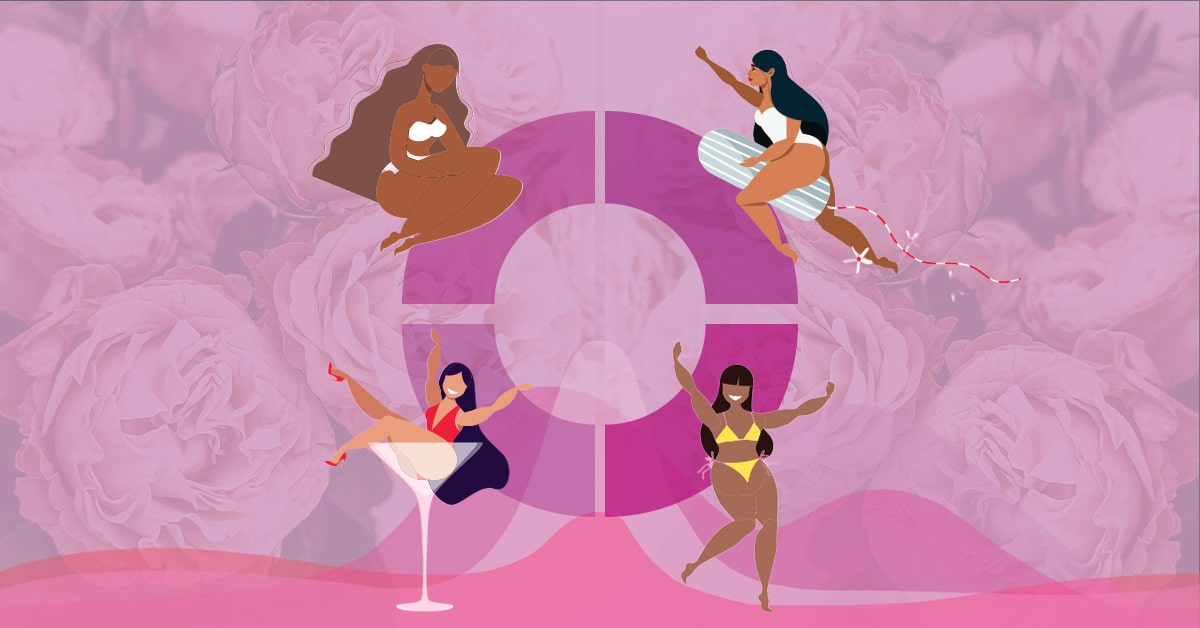
A woman’s cycle typically lasts around 28 days, though anywhere between 21 and 35 days is considered normal. The cycle begins with menstruation—the bleeding phase—and then moves into the follicular, ovulatory, and luteal phases. Let’s dive into what each of these phases actually means for your body—and why understanding them changes everything.
Menstruation (Days 1-5)

This is the most talked about phase of your cycle, given it’s when you’re actively bleeding. Biologically, your estrogen and progesterone are at their lowest levels. It’s actually the drop in these important hormones that trigger the shedding of your uterine lining (your period).
When these two main hormones are low, it also leaves you feeling fatigued, emotional, and more vulnerable. Think of it is as your inner-winter, a time to cuddle up, rest— don’t overextend your time and energy.
And that chocolate craving? It’s not all in your head. Before and during your period, your body’s magnesium levels naturally drop, making your body crave foods that replenish it, like chocolate. I know I don’t really have a sweet tooth, but right around my period, I crave chocolate frozen yogurt like you wouldn’t believe.
When your energy is this low, it’s important to plan your day accordingly. Swap that run for a long walk, and don’t cram all your errands into the heaviest days of your flow. My boyfriend and I even try to plan our trips around my cycle, knowing that, during this time of the month, I feel the worst—both physically and mentally.
Our society hasn’t historically normalized women living their lives around their cycle. But again, that’s just a symptom of centuries-long misogyny disregarding women’s experiences. It’s absolutely okay—and healthy—to be in tune with your cycle. And we as women are more powerful because of it.
Embrace your bleed, babe!
Follicular (Days 6-13)

Your follicular phase is that burst of energy you get as menstruation ends. Estrogen starts rising, and your body gears up for ovulation. During this phase, you usually feel motivated, mentally clear, and any period-related anxiety begins to lift. You’re pretty much just ready to get sh*t done.
Think of this phase as the perfect time to start any new projects you’ve been putting off. It’s also a great opportunity to get back into more intense workouts you paused while menstruating. For me, the surge of strength I feel during this phase almost feels like a superpower coming off my period.
It’s a good thing to remember you can sync your diet to your cycle as well. When you’re bleeding, it’s best to eat iron-rich and anti-inflammatory foods like red meat, lentils, and ginger. During your follicular phase you can prioritize leaner proteins, like chicken and fish, while prioritizing fiber-rich fruits and veggies.
I really try to capitalize on this time by setting intentions for the rest of my cycle and using the renewed energy to tackle any loose ends in my life I’ve been putting off.
Ovulation (Around Day 14)

Ovulation—when your body releases an egg from the ovary—typically happens around day 14 of your cycle, though this can vary from person to person. It’s also sensitive to things like stress, illness, travel, and other environmental shifts. Your body won’t ovulate unless it feels safe and supported enough to do so. Your eggs are limited and precious, and your body knows it!
Ovulation is a fascinating dance of hormones that all come together to prime your body for conception. Estrogen peaks—in fact, it soars—in the days leading up to ovulation. This surge of estrogen triggers a sudden spike in luteinizing hormone (LH), which causes the mature follicle to rupture and release an egg from the ovary.
Your progesterone also rises, preparing the uterine lining for a possible pregnancy. Think of this as the climax of your cycle, the crescendo of the female body and her attempt at creating life. Your entire cycle happens to support your ovulation; it’s something worth celebrating.
During this time, you may also feel a little extra spicy, as your body is in its only fertile window of the month. So if your partner is suddenly looking more like a snack than usual, that’s your hormones pushing you to find a mate.
For those who aren’t sure, or have heard different opinions, a woman is only fertile for around 5-6 days a month. Your ovaries release an egg during a 24-hour window, but sperm can live inside your body for several days, ready to fertilize it as soon as it appears.
When you’re in your ovulation phase, you might notice your skin glowing, your waist looking snatched, and your energy and sex drive hitting their peak. You’re feeling like your absolute best self. Unfortunately, the luteal phase is just around the corner, preparing to topple any momentum, motivation, or natural buzz you’ve got going.
Luteal (Days 14-28)

Dun dun dun. The luteal phase is a menace, the villain in every woman’s story. This is where PMS symptoms occur and your hormones do a 180, dumping you into an abyss of low energy, fatigue, irritation, and just an all-around comedown.
To break it down, as you ovulate, your body produces lots of progesterone to help thicken the lining of your uterus (to get it ready in case you get pregnant). Estrogen stays at a steady level to help out. But if you don’t get pregnant, the levels of progesterone and estrogen drop. This drop, like mentioned earlier, causes your period to start as your body sheds the lining it built up.
When your body realizes it’s not pregnant and your hormones drop off—that’s what makes you feel sad, anxious, or irritable. The fluctuation levels of your hormones also affect your nervous system and blood vessels, which can contribute to headaches, tiredness, etc. Your body pretty much crashes out after getting too hyped about getting pregnant. Can you believe we go through this every. Single. Month?
When you think about everything else women do and how we hold so much of the world together, it really makes us seem like superheroes. And to think so many men pretend to be too grossed-out or uninterested to learn about this stuff. Good thing us women have the privilege to know, own, and love our bodies and their power.
The luteal phase can be tough, but it’s also a time for reflection. When your nervous system is more sensitive and you’re feeling a bit raw, try to stay mindful of what comes up. This is your inner autumn—a time to hold yourself tenderly and show compassion when difficult emotions seem to rise out of nowhere. I love to spend some extra time doing some TLC, like a pampering skincare routine.
There are ways—just like during menstruation—to support your body during this phase. Slow down. Try to avoid alcohol and large amounts of caffeine. Prioritize sleep and nourishing foods. Your body is preparing for your period, which takes more energy than you might realize. Living a little softer during this time can make a big difference in how overwhelming it feels.
Seed cycling

Now, a little food for thought for anyone curious. I got really into tracking and understanding my cycle after coming off hormonal birth control and suddenly feeling totally lost. I was miserable for nearly two weeks out of every month, so I started researching ways to ease PMS symptoms and quickly realized that most solutions relied on mood stabilizers (like SSRIs) or hormonal birth control, which suppresses your natural cycle completely. Because I spent eight years on hormonal birth control, I didn’t want to go back on it. I had also worked hard to get off SSRIs years prior and had no interest in starting them again either.
One method I came across was seed cycling. While it doesn’t have a surplus of scientific research behind it, there are plenty of personal testimonials and small case studies that support its benefits. The idea is simple: from days 1–14 of your cycle, you eat pumpkin and flax seeds, and from days 15–28, you switch to sesame and sunflower seeds. The nutrients in these seeds are said to support hormone balance. This balancing can help ease some of the emotional and physical discomfort many of us feel during the luteal phase and menstruation.
I was desperate enough to try it, and after about two months, I noticed a real difference in my mood. It didn’t make all the discomfort disappear, but I went from lying on the floor of my bedroom to functioning. Just at a slower pace. If you struggle with PMS that disrupts your life, this might be a gentle, holistic approach worth exploring.
Of course, it’s always important to reach out for medical support when needed. Talking to a therapist or a trusted healthcare provider can be a powerful first step. Understanding what your body needs and figuring out the best path forward is unique to everyone.
You’re a boss ass b*tch

Your body is changing every day—your hormones, your mood, your energy, your sex drive, your everything. And yet, this stuff isn’t taught to women. There’s so much more to your cycle than just the week you’re bleeding. Going through life unaware of the wonder, intricacies, and quiet alchemy happening inside you is a disservice to your being.
Even if you don’t want children and have zero interest in the conception side of it all, your cycle can still be a powerful tool. You can work with it to jumpstart your life and live in sync with yourself in a way that feels both grounding and empowering.
More and more women are learning what’s really going on in their bodies. We’re stepping into that knowledge with clarity and confidence. If you’re even a little bit curious, start doing some personal research. Watch a few funny TikToks of women sharing their experiences. It all starts to feel incredibly relatable once you begin connecting the dots about what your body’s been going through—maybe without you even realizing it.