
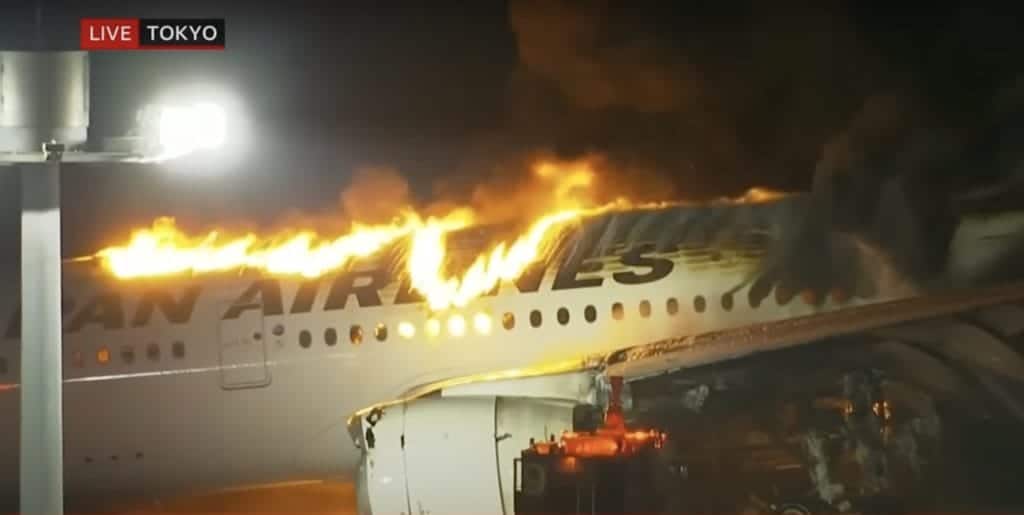
Five people have died, and over a dozen people have been injured after a jet collision earlier today in Japan. A passenger jet collided with a Japanese coastguard plane and burst into flames at Haneda Aiport, Tokyo.
This airport collision comes only a day after a 7.6 magnitude earthquake hit Japan. The earthquake left at least 55 people dead and led to subsequent tsunami warnings across the nation.
Footage from within JAL flight 516, a Japan Airlines Airbus 350-900, showed smoke pouring in from beneath the wings of the plane whenever it landed at Tokyo’s Haneda airport at 5.45pm local time.
The aircraft was carrying 379 people at the time of the collision. Those on the plane included eight children and twelve cabin crew.
By the time the plane had come to a stop, it was fully engulfed in flames. Later, rescuers rushed to evacuate all the passengers.
How did the collision occur?
What appears to have transpired was the aforementioned aircraft took off from Shin Chitose on the island of Hokkaido and, when landing, crashed into a Japanese coastguard plane.
The coastguard plane had taxied to the runway at Tokyo airport an hour before JAL flight 516 was due to land but had not yet taken off, according to Yoshio Seguchi, deputy director of the Japan Coast Guard.
Five people aboard the coastguard plane died, with the pilot surviving but currently being in serious condition.

Experts in aviation agree that the coastguard plane was likely to sustain most of the damage due to being stationary. However, 17 people evacuated from the Japan Airlines plane had suffered injuries.
Japanese Minister for Transport, Tetsuo Saito, said that the Japan Transport Safety Board (JTSB), police, and other departments would investigate the collision between the two aircraft.
Reaction to the incident
The cabin crew and pilot of the Japanese Airlines flight were praised for their efforts during the fire. Professor Graham Braithwaite, director of transport systems at Cranfield University, says that the collision serves as a reminder of “how much has gone into training cabin crew.”
Prime Minister of Japan, Fumio Kishida, offered his condolences to the five who lost their life in the collision. He also offered praise for their efforts to provide aid to those impacted by the earthquake.
Posting on X, Kishida said he wants to ensure that officials “quickly ascertain the damage situation.” He also said he hoped to provide the public with appropriate information on the collision.
A passenger onboard the JAL flight gave an account of what it was like whenever the collision occurred.
Describing what happened to Kyodo news agency, the unnamed passenger described hearing a “boom.” He went on to say that it was “like we had hit something and jerked upward the moment we landed. I saw sparks outside the window, and the cabin filled with gas and smoke.”
John Coultas, who was in Tokyo airport at the time, told the BBC that it was scary “watching the airport freeze” as news trickled in of what had occurred.