If you’ve ever gone on a trip somewhere new, you probably are familiar with the feeling of wanting to document everything so you can remember it later on. We often take lots of pictures of the places we go, even if we can easily find similar pictures on Google. With an illustrated travel journal, you can document your trip in a way that’s more unique and personal.
With cameras on our persons nearly all the time, it’s so easy to take pictures of what we do and see. But how often we actually go back through our camera rolls to look at these pictures is another story. And how often do we fail to fully appreciate the moment because we rely on a photo to capture it all for us?
Last year, I went on a trip to Chicago to learn about comics with other students from my university. As artists, we were assigned a daily task of adding to a journal to document each day. Over time, I realised that illustrating what we did helped me commit to memory more than photos ever could, and now my travel journal is my favourite thing to look back on from my trip.
What is an illustrated travel journal?
All a travel journal consists of is a log that documents what you did and where you went while traveling. Any specifications beyond that are up to you to decide. Some people lean towards a scrapbooking approach, while others may focus more on photos or writing.
For an illustrated travel journal, all that you need to include are pictures you’ve created yourself. This can be in ink, pencil, paint, or whatever other medium you like (though it might be good to choose one that’s easy to bring with you).
There really are no rules as to how you create your pictures. You may choose to sit and sketch your surroundings as they play out around you, or take pictures to use as references at the end of the day. Regardless of which method works best for you, it’s a good idea not to wait too long before recording your experiences. It’s easy to forget the details!
My trip to Chicago
While I’d done some sketching on past trips I’d gone on – such as a vacation to Mexico in 2022 – the first time I successfully kept a travel journal was on the trip I took last January to Chicago. Every day was packed with things to do, and I certainly would not have been able to remember everything if I had not made an effort to log it.
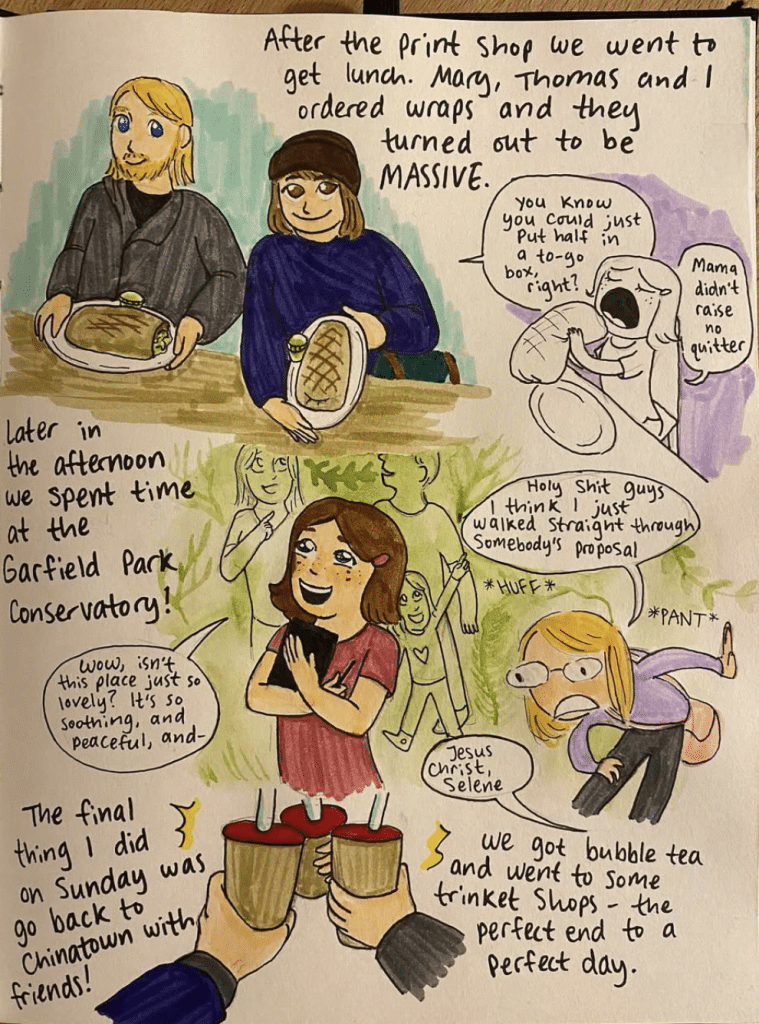
At the end of each day, I created a two-page spread to document what we’d done. I painted artwork we’d seen, drew comics to document interactions between my classmates and I, and sketched food, architecture, technology, and more.

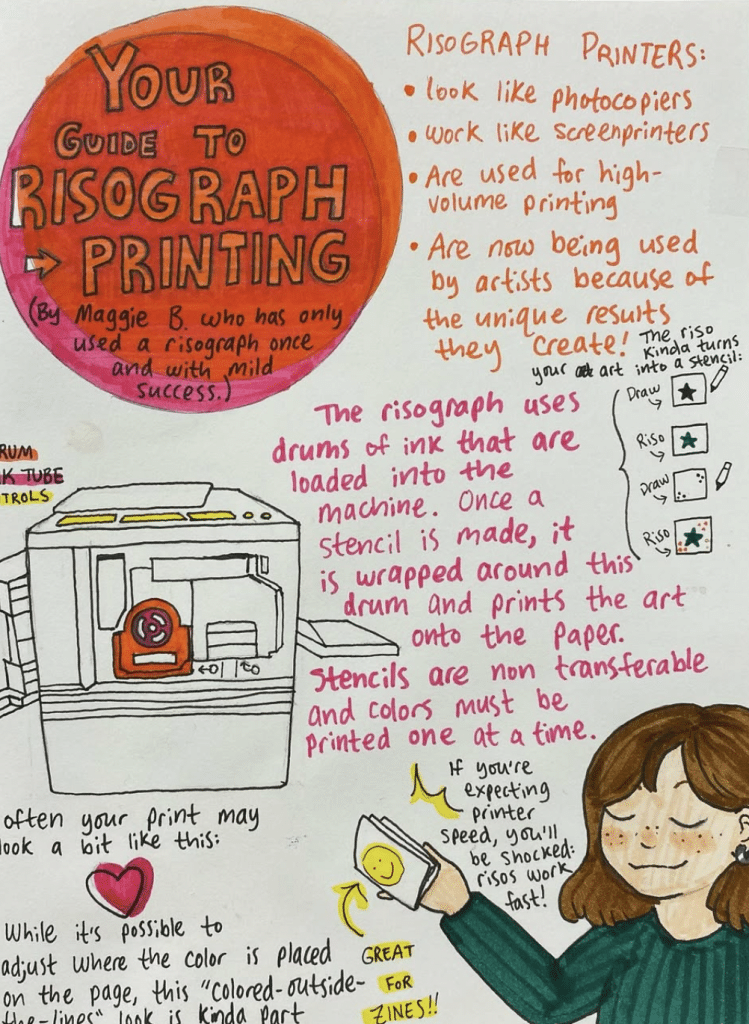
When I want to remember details about the trip, I find myself turning to my journal instead of the photos I took. My illustrations capture not only what we saw, but my perception of it. For example, if the burrito I ate was big in real life, but GIANT in my memory, I could draw it that way – and better remember how I felt about it at the time.
To learn more about travel journals, I spoke to the professor who led the trip, Mary Climes. She teaches comics at the University of Wisconsin Stout and has her Bachelor’s of Fine Arts from the School of the Art Institute in Chicago and her earned Masters of Fine Arts from University of Tennessee, Knoxville. She currently teaches comics at the University of Wisconsin Stout and because of her familiarity with the Chicago area, she was the perfect guide for our trip.
One trip, many memories
I asked Climes about whether there was anything interesting that stood out to her when grading our travel journals at the end of the week. She laughed, saying the first thing she noticed was how much she showed up in our drawings. Also,
“What was really interesting was how we all had the same experience, right? We went to all the same places and saw the same things – but almost everybody wrote about what was the most exciting thing they saw or that, you know, really grabbed them.“
Each student’s drawings captured the details that meant the most to them, which differed greatly from person to person. There were, however, a few that remained consistent, such as a large tag art caterpillar we all seemed equally entranced by.
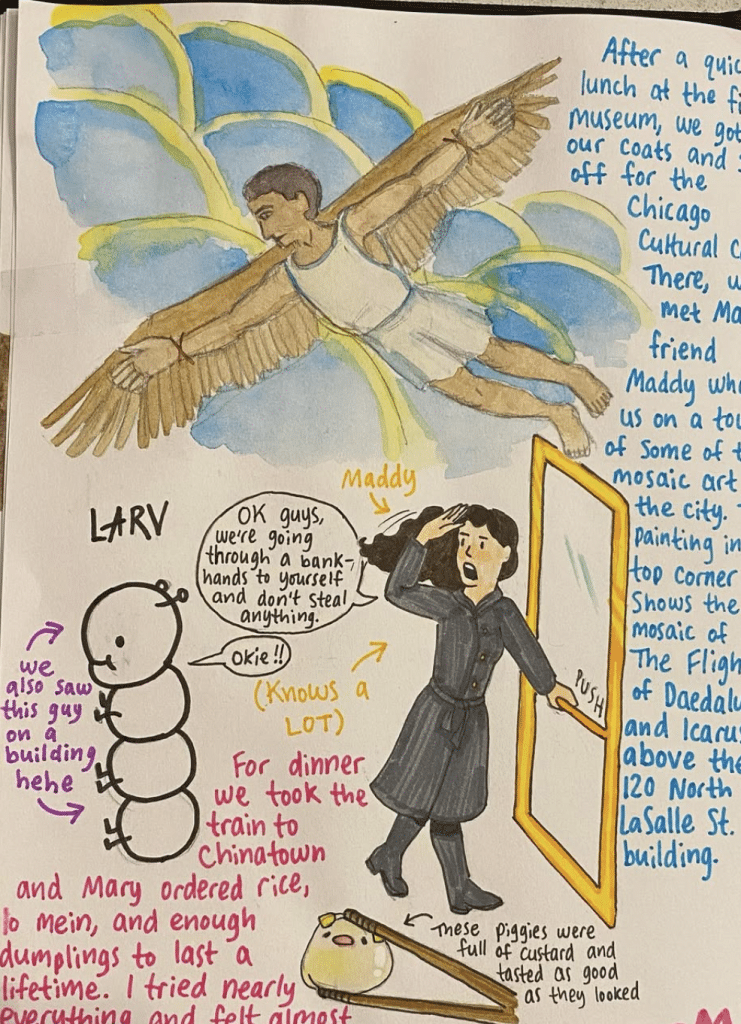
“Everyone’s reactions to what they saw and what they really valued was on display in different ways with the travel log.“
– Professor Mary Climes
Travel illustrations, as an alternative to photos alone, allow you to document more than just the scene. They also go deeper into what specifically about your surroundings interests you.
To be able to capture what you see, it’s good to gather a few necessary tools before your adventure.
Recommended supplies
To set yourself up for success, it’s helpful to choose supplies that are compact and durable. While there’s no need to break the bank loading up with a bunch of new materials, I’ve listed some suggestions below in case there are tools you don’t already have:
Journal
Finding a journal or sketchpad designed for multi-media use allows you to switch stress-free between media. Climes also suggests looking for something with a hard backing, so when you’re on the go, you don’t need to worry about finding a flat work surface.
Pencils
Really, anything will do, even if it’s a simple plastic mechanical one. I personally find my favorite pencils abandoned on the floors of empty classrooms. However, if you’re looking for something a bit more sophisticated than that, consider investing in a set of Prismacolor pencils. The quality will not disappoint. (Remember to bring an eraser and sharpener too!)
Watercolors
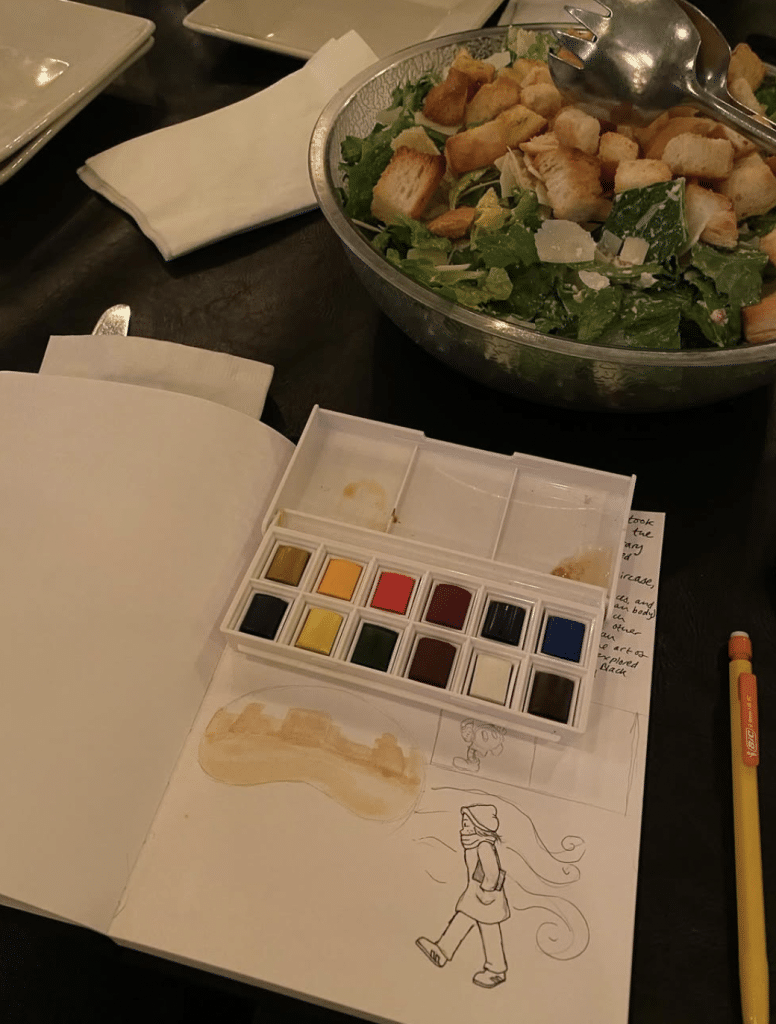
Paints can be fun, but messy. To set up and pack away with ease, consider a travel-sized watercolor kit. I’d often use water from my Hydro Flask to paint with, and simply soak up the puddle with a piece of paper towel when I was done.
Certainly a lot easier than bringing your whole oil painting setup. If you’re looking for a decent kit, this pocket box from Winsor and Newton worked perfectly for me.
Pens
For multi-media use, it’s helpful to have a pen that’s durable and smudge-proof. For this purpose, I recommend a pack of Microns – with multi-media paper, they’ll dry quickly and can be used to write, draw, and outline!
Markers
There are certainly many brands to choose from, including Copics, which are a bit of an investment but are of great quality. If you’re looking for something a bit cheaper and thinner (so you can fit a few more in your travel pack), consider a set from Tombow.
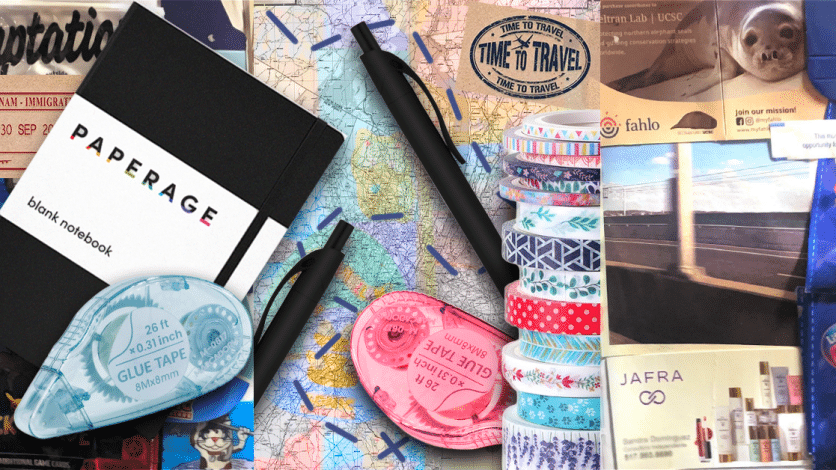
Glue stick
Climes suggests bringing one just in case you find anything interesting to stick in your travel journal – think business cards, candy wrappers, pieces of brochures, and more!
Process
Even when you have acquired all the necessary supplies, beginning the process of documenting what you see can certainly feel daunting at first. Just know that even if the first day or two doesn’t come naturally to you, you’ll start to get the hang of things over time.
Professor Climes talked about how when my classmates and I worked on our travel journals, she could visually notice the difference as we started to get better at what we were doing:
“Everyone found their way through it, and the fact that they did one per day was really interesting… You could even see the progression of people’s drawings and understanding of sketchbook space and page from day one to day seven.”
It may take a little time for illustrated journaling to feel natural, and that’s okay. If you’re looking for a few tips to guide you as you learn, here are some tricks I learned along the way:
Journal soon, and often
You’ll be surprised how many little details get missed if you fall behind too far in your log. If you can’t draw while you’re out and about, try using your notes app and phone camera to record generally what you want to include, so you have a reference at the end of the day when you take your journal out.
Remember, there are no rules about what you include
Try to capture what captured YOU – if you saw an amazing fireworks display that day but had even more fun with the stray cat you met, it’s okay to mention the show in a sentence or two and dedicate a full page painting to the cat. You’ll want to remember what was most important to you!

If you’re feeling overwhelmed, pull back
You may not always have the energy to draw an entire scene, and that’s fine – but what specifically about it made you smile? Was it a cool plant you saw or a logo you liked? Something funny your friend did? Drawing something small can be just as effective as a larger drawing and won’t feel quite so daunting.
Time to create your own!
Journaling in any form is a great way to remember, reflect, and appreciate. By creating an illustrated log to remember your trip, you end your vacation with the best possible way to preserve your experiences and share them with everyone back home. Not only will you be able to look back on what you did or saw, but you’ll also be able to remember how they made you feel and what was most interesting about them.
So next time you’re planning out a trip – whether it’s across the globe or just a few towns over – consider bringing along some paper and a pencil to see where it takes you!
If you want to learn more about the benefits of analogue hobbies, check out this article here. I also have a more extensive guide on ideas for creative goals in 2026.