Higher education has accumulated a growing number of issues in recent years. Many prospective students are wary of college because of a general decline of the institution. Established issues have been growing because of federal action. Legislation passed by the current Trump administration has created even more strain on the institution of higher education.
Families and students have had growing concerns about affordability, loans, and the worth of a degree in recent years. Due to the current job market, many students are debating whether it is worth it to get a college degree when there is no guarantee of a job.
In Maine, students, families, and workers are taking the brunt of damage from the lack of public funding for higher education. Wages don't keep pace with the cost of living and workers are asked to do more with less while students pay more. Does that sound familiar? pic.twitter.com/8tDd0PEU1I
— Higher Education Labor United (HELU) (@HigherEdLabor) May 5, 2026
A recent study done by The Change Leader, Inc. states that national enrollment has dropped by 2.6 million to 15.5 million as of 2025. The study also states that the rising cost of higher education has left students with an average student loan debt of $40,000. Many students have lost trust in the institution of higher education because of its high cost and uncertainty in the job market.
The Trump administration
The current Trump administration has been actively contributing to the decline of higher education. The American Council on Education has been tracking over thirty of Trump’s executive orders regarding higher education.
The Trump administration has included a wide array of legislation aimed at restructuring higher education policy. These actions have resulted in dramatic staffing reductions within the Department of Education, reduced funding and grants, and decreased enrollment of international students.
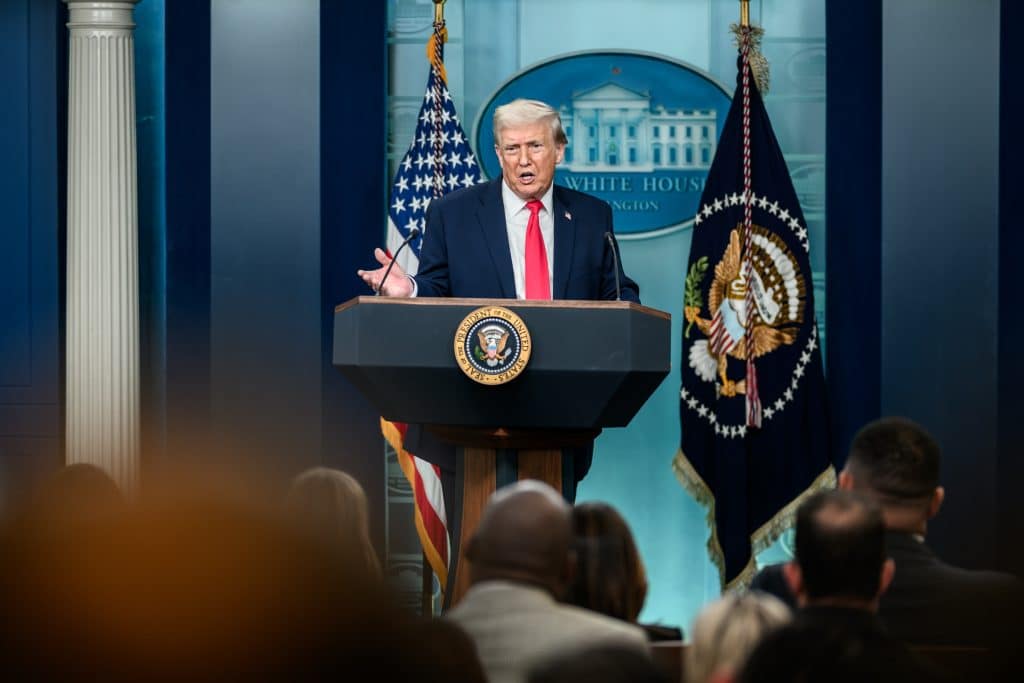
The Trump administration’s actions work together to diminish the institution of higher education as a whole. However, there are certain acts that will greatly impact students directly, such as loans and inclusivity.
Federal loans and financing
The Trump administration has finalized new regulations on higher education loans and financing. The regulation includes new limits for federal loans. Federal loans for “professional” degrees now have limits of $50,000 per year and $200,000 total. The definition of “professional” degrees only has eleven degree programs now. The regulation lists the programs as pharmacy, dentistry, veterinary medicine, chiropractic, law, medicine, optometry, osteopathic medicine, podiatry, theology and clinical psychology.
All other degrees are labeled “graduate” and have a lower student loan limit. “Graduate” degree loans now have limits of $20,500 per year and $100,000 in total. This dramatic gap in funding between degrees will prevent students from getting other expensive and high-demand degrees that are not labeled “professional.”

The Trump administration has also eliminated the Grad PLUS program to “curb tuition growth by ending unlimited borrowing.” This action decreases the options students have for borrowing money. The elimination is especially harmful when paired with the loan limits between “professional” and “graduate” degrees.
DEI and inclusivity
Higher education has also been attacked because of DEI and inclusivity initiatives. There has recently been developments in how DEI regulations are enforced. The Trump administration proposed in January that federally funded universities must certify their compliance with established anti-DEI regulations.
The act outlines punishments for universities that do not obtain certification or align with DEI regulations. These penalties may cause universities to lose some or all of their government funding. This will cause many institutions to choose between funding and fostering an inclusive environment. The majority of universities do not have the financial flexibility to risk not complying with the certification requirement.
Many are concerned about this being an act of federal overreach. Legal issues have been raised on how the certification requirement will interact with already established state and local DEI laws.
There has been bipartisan concern about the certification being an attempt to control the goals and values of higher education. A member of the American Enterprise Institute, a conservative think tank, has stated her issues with federal control over higher education.
“What we’re seeing is the administration trying to achieve a higher ed sector that is sort of rebuilt in its image with its values… That’s concerning in part because I don’t think that’s the federal role in higher education and, in part, because I wouldn’t want to see a Democratic president do the same thing when they were in office.”
Beth Akers, senior fellow at the American Enterprise Institute
The fear of federal control in higher education has also impacted inclusivity in universities. The Department of Education has opened a civil rights investigation into Smith College, a historically women’s private college that has recently started admitting transgender women.
The investigation is based on whether admitting transgender students into a historically women’s college goes against anti-discrimination laws. The concern derives from the fear of “biological males” in “women-only” spaces violating civil rights protections for women.
The Smith College investigation and DEI certification requirements will lead to drastic changes in diversity and inclusivity in higher education. The federal government has been asserting its power over higher education to align with the current administration’s values.
How this affects college students
Federal loans and diversity legislation directly impacts current and prospective college students. At a time when higher education is already declining, these acts will cause even more distrust and hesitation about the institution. Restrictions to funding options and diversity initiatives will reduce inclusive and safe environments for lower class and minority students.

The reduction of federal loans will reduce financial accessibility to college. Fewer students will be able to attain enough funding to pursue their degrees. The limitation of what is deemed a “professional” degree will also impact students and the job market. More students will favor “professional” degrees to get more funding. However, this may create competition for those degrees in university admissions or oversaturate the job market. The limited “professional” degrees will also discourage students from pursuing “graduate” degrees that are still in high demand despite their federal label.
Federal DEI and inclusivity action will also cause fewer people to enroll in college. The Smith College investigation may create a precedent that more colleges are required to follow. This, in tandem with anti-DEI regulations, will drastically reduce accessibility to higher education for transgender students and other minority groups.
Overall, students will have less access to higher education due to federal actions. Students are already wary of higher education in today’s job market and economy. The Trump administration has only been increasing these concerns and expediting the decline of higher education.