
It is increasingly more difficult for students to support themselves financially whilst they go through college. Many students worry about the cost of essentials such as food and rent alongside their education. The number is much too high, so what are universities doing about it?
Student Loans
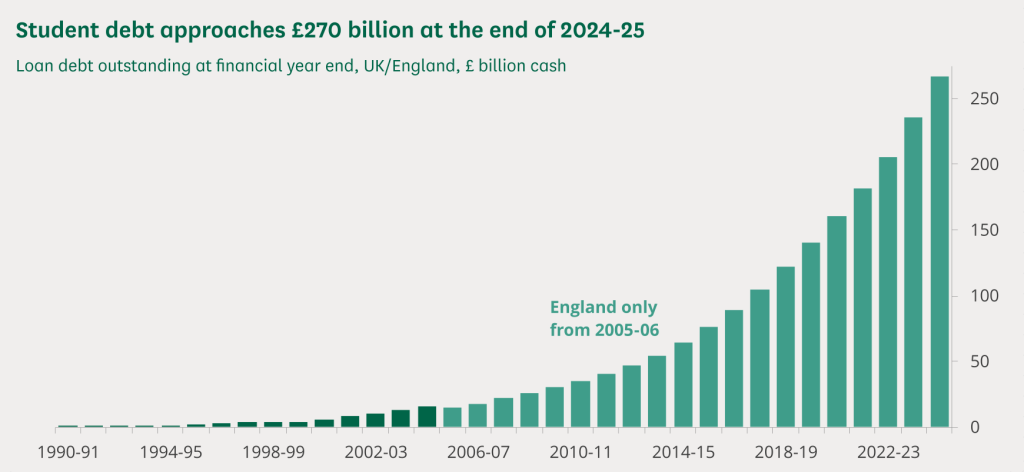
In the UK, 150,000 graduates have a student loan of more than £100,000. According to The Guardian, this has sharply increased by a third having a six-figure debt in the last six months. In January 2025, more than 2.6 million people in the UK owed £50,000-plus in student debt. One in six Americans has a student debt, and those figures are also increasing.

Borrowing money from the government, for the vast majority of students, is necessary in order for them to pay for higher education. With student loans increasing, more people are dissuaded to pursue higher education. 41% of students have considered dropping out of university due to money related issues.
Food Shop Struggles
Unfortunately, students are now taking drastic measures to stay in higher education. The Save the Student survey found that 61% of students skip meals at least some of the time to save money. Student discounts are not in every shop. Students need to rely on club cards and coupons for small discounts off their food shop in supermarkets, due to the rising inflation costs.
10% of students also frequent foodbanks to be able to feed themselves. Even though this is a fall from 18% in 2023, Save the Student says “it’s still too high a figure.” Students should only have to worry about their grades. They shouldn’t have to worry about putting food on the table.

27% of universities in the UK have their own food banks to support students. Also, American colleges are also taking hunger seriously, which is a really good sign. Swipe Out Hunger made a huge impact in 2024, partnering with over 900 campuses, not just in the States, but also in other places such as China and several countries in Africa. They enabled 8,280,944 meals, serving 766,600 students. Needless to say, higher education establishments are taking actions against student hunger.
Cost of Living Crisis
The cost of tuition and living fees is a huge concern for students in higher education. According to the Office of National Statistics, in the 2021/22 academic year, 91% of students have noticed an increase in the cost of living, and was concerned by it. This number is colossal. 50% of students expressed they had financial difficulties, with 15% saying those difficulties were major.

Students are having to budget. Cutting back on essential items has become a necessity for some students, and many have stopped buying non-essential items. It was found that students are now spending £1,142 a month, and £1,279 in London. Many people have to rely on extra funding from parents or from a part time job, just to make ends meet.

Maintenance Loans
In the UK, the maintenance loan is supposed to cover costs of living, including food, essential products and rent. Save the Students’ National Student Money Survey found that the maintenance loan does not cover the cost-of-living crisis and falls short by £502 a month. 56% of people have said that the maintenance loan is not enough to live on. The absence of an above-inflation increase to Maintenance Loans has significantly affected student living.
Part-time Jobs
58% of students in the UK have a part time job alongside their education. This is a testament to the fact that the maintenance loan is not sustainable. The average amount that students are making from their part time job is £547. People who have part time jobs have to juggle their work hours with getting their degree. 40% of people stated that their studies suffered due to having a job.

However the good news is that some universities offer work for their students. Many have a student ambassador scheme. This allows for flexible hours, as students work on open days, create content and making telephone calls to prospective students. The student ambassador scheme is a great way to make some extra cash!
Rent Prices
It isn’t just living and tuition costs that students have to worry about. The vast majority of students move away from home, and have to pay for rent. According to the UCAS website, you usually will be spending half of your living costs will go towards your rent for campus accommodation. You may also have to pay utility bills such as electricity and gas, and internet bills. Luckily, most university accommodation has bills included in the rent. Most universities and colleges are very understanding if you can’t pay rent, and can give you suggestions on how to manage your money and come up with solutions.

Save the Student’s money expert, Tom Allingham says,
But across the board, the results suggest that the landscape is still far tougher than before the cost of living crisis. For instance, while 59% of respondents saying they struggle with rent is an improvement on last year’s 64%, it’s still far higher than the 50% who said the same in 2021. And, of course, even that was far too high.
It’s clear that universities and colleges are doing what they can to assist their students. However, the rising costs due to inflation makes it especially hard for students to pay for essential items. It is necessary for many students to take up part-time work, which can lead to a drop of attendance and grades. It is definitely a struggle being a student in higher education. In some cases, turning to a custom paper writing service for support with demanding assignments can help learners keep up with deadlines while balancing work and financial responsibilities.