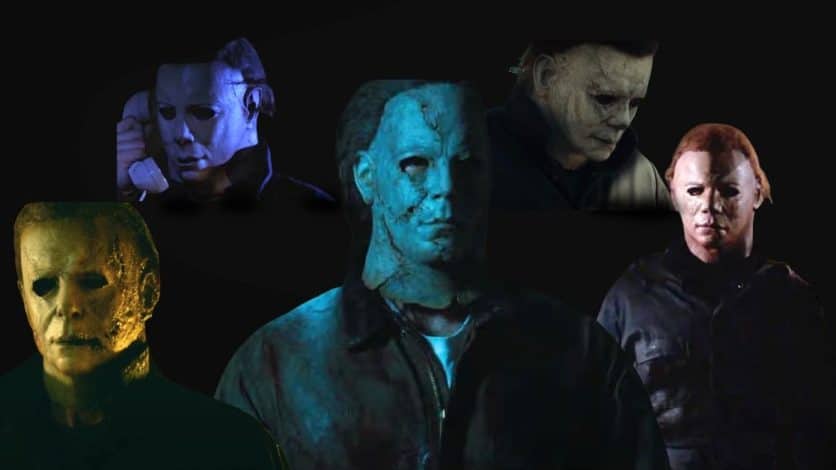
Ever since the iconic slasher Halloween (1978), the Halloween franchise has maintained a long-standing presence in pop culture. However, with thirteen total films, few casual horror fans have the time to watch the series to completion. So, with the titular holiday on the horizon, here’s a guide to the best, weirdest, and worst parts of Halloween — the saga that defined horror movies as we know them today.
A few years ago, a friend and I decided to watch the Halloween series all the way through. It started as a simple challenge and a way to build up our tolerance for scary movies. It ended with us becoming entrenched in the complex and contradictory lore of a story that has been rebooted and rewritten far too many times.
Basically, I watched every Halloween movie so you don’t have to.
Slasher origins
For those unfamiliar, slashers are a fairly simple sub-genre of horror movie. They usually involve a mysterious killer stalking and murdering a group of people in a secluded setting. Anyone familiar with these movies can assume (more or less) how they’ll turn out. The entertainment comes from guessing how the kills will occur, when they’ll occur, and who, if anyone, will survive. Hitchcock’s Psycho (1960) is considered to be one of the most influential early slashers.
While Halloween (1978) is far from the first ever slasher, it’s an important one for fans of the genre. Pre-dating the Friday the 13th series by two years, Halloween popularized many now-ubiquitous horror tropes, like:
- The masked killer (Michael Myers)
- The small-town suburban setting (the fictional Haddonfield, Illinois)
- The “killer-pov” (filming the scene as if the audience is seeing from the eyes of the killer)
- The “final girl” (in many horror films, the last character left alive is a teenage girl, who is often intelligent, reasonable, and cunning. Laurie Strode, in Halloween.)
The iconic original
The plot of the original Halloween is fairly straightforward. Because I’d recommend this one the most, I won’t spoil too much of it here. Basically, it follows Michael Myers, a killer who escapes from a mental institution on Halloween night and returns to his hometown to…well, kill some more people. It’s not exactly complex, but it’s incredibly suspenseful and has a great overall atmosphere.
While many of the later films contain near non-stop killing sequences, this one takes its time to develop a large cast of characters in the town of Haddonfield before the real nightmare begins. Not many horror films these days do this, and it’s interesting to see how the formula has changed over the decades.
Many of the characters from Halloween (1978) will appear constantly throughout the franchise. There’s Michael Myers, of course, the silent killer who (almost) always sports a jumpsuit and a spray-painted Captain Kirk mask. Laurie Strode (played by Jamie Lee Curtis), is the final girl of many, though not all, of the Halloween films. Then there’s Dr. Loomis (Donald Pleasance), a psychiatrist obsessed with Michael who often appears to propose theories about his motivation as a killer — the most consistent of which is that he is simply the manifestation of pure evil.

Branching timelines: How halloween went off the rails
So, there are thirteen of these films. Things are bound to get a little wacky when a simple story like this gets brought back time and time again.
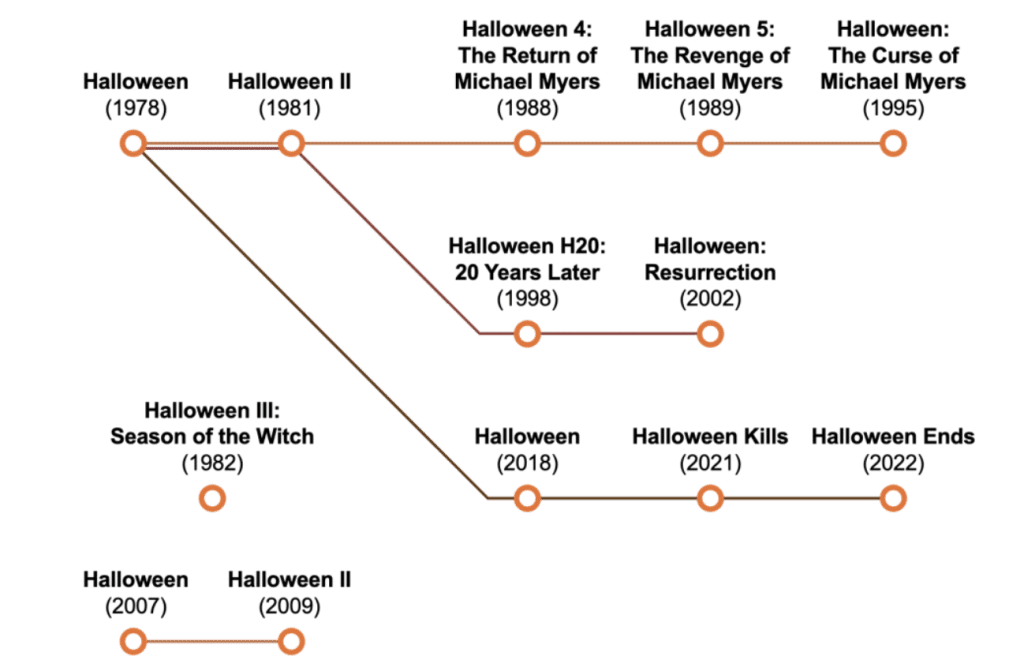
A complete list of all the films, their titles, and their release dates can be found here. And now, the way they all fit together:
Initial timeline
The first six movies exist in the original timeline of Halloween (1978). Sort of.
Halloween (1978) and Halloween II (1981) tell a continuous story that takes place on the same night. Series creators and producers John Carpenter and Debra Hill originally intended to end the story of Michael Myers with Halloween II, so if you ignore everything after this, these two movies are pretty cohesive (and fun!).
Halloween III: Season of the Witch (1982) has nothing to do with any other film in the franchise. Michael Myers, the star antagonist, does not even appear in this film. With Halloween III, Carpenter and Hill were attempting to move into an anthology-based story model for their series. Halloween III is a pretty interesting series black sheep about witchcraft, Stonehenge, evil corporations, and killer tv commercials. However, audiences wanted Michael Myers and nothing else.
So, in Halloween 4: The Return of Michael Myers (1988), Michael Myers (predictably) returns.
Halloween 4 and 5 mostly follow Laurie Strode’s daughter, Jaime, and the psychology of her connection to Michael Myers. And then Halloween: The Curse of Michael Myers comes along and concludes this version of the story with Paul Rudd in a starring role and a plotline about a brainwashing cult. It makes even less sense when you watch it, believe me.
The weird years: H20 and resurrection
Here’s where it gets really strange. Halloween H20: 20 Years Later (1998) considers Halloween (1978) and Halloween II (1981) as the only canonical entries in the series. Halloweens 4-6 will never again matter. Confusing? Absolutely.
Halloween H20 is surprisingly a pretty solid film though. It’s the highest grossing movie in the series, and for good reason. It follows Laurie and her teenage son (forget about her daughter Jamie, she doesn’t exist anymore) and their attempt to escape from Michael Myers twenty years after the events of the first two movies. The film actually explores the impact of Laurie’s trauma from her previous encounters with Michael, and it has a very satisfying ending. If you ignore the events of the next film.
Halloween: Resurrection (2002) is not a great movie. It takes place in the same continuity as H20, but completely ruins that film’s conclusion by rewriting it entirely within the first five minutes. The concept isn’t bad — a group of college students compete in an internet reality show to see if they can spend the night in Michael Myers’ childhood home. Of course, they’re unaware that the killer himself is actually there. Still, the movie isn’t good enough to justify its own existence. After it ruined H20‘s finale, it’s hard to enjoy any part of it. Especially knowing that Jamie Lee Curtis, who is barely in this film, wanted to end the franchise sooner. Busta Rhymes is in this one though, and he plays a reality-show-host-slash-kung-fu-enthusiast. That’s maybe the best part.
The Rob Zombie-verse
In 2007, Rob Zombie (of “Dragula” fame) directed a modern remake of Halloween (1978). In 2009, Zombie followed this with a sequel, Halloween II (2009). These films stand on their own and don’t take the events of any previous installment into account.
Both of the Zombie movies are grittier, gorier, and more sexual than Halloween usually gets. The first one takes a unique approach to Michael Myers as a character, giving him a more thorough backstory. Zombie’s Michael isn’t exactly the manifestation of pure evil, but a victim of horrific childhood abuse. Making Michael into a real protagonist with a history and a face was definitely a fresh and intriguing take on the series’ infamous villain.
Zombie’s Halloween II (2009) is an incredibly violent and dreamlike sequel that has nothing to do with the original Halloween II (1981). It attempts to delve deeper into the connection between Michael and Laurie (now played by Scout Taylor-Compton), though very little of it makes sense in the end.
A third Rob Zombie sequel was set to come out in 2012, but it never saw the light of day, and I have to say, I’m a little grateful. For me, these films were just a little too grotesque and grungy to enjoy. However, some other fans of the series see these ones as cult classics. It’s a matter of personal taste and whether or not you enjoy Zombie’s unique brand of brutality.
The modern trilogy
The Halloween franchise was rebooted for (maybe) the last time seven years ago, with Halloween (2018). This movie only considers Halloween (1978) as a canon precursor.
This matters due to a major plot twist at the end of Halloween II (1981), considered canon in every movie that followed (including the Zombie films), up until 2018. Again, I won’t exactly spoil it, but this plot twist worked sometimes and failed to be interesting at others. Halloween (2018) definitely felt like it had more room for creativity after it discarded this, though.
Halloween (2018) and its direct sequel Halloween Kills (2021) focus on Laurie (once again played by Jamie Lee Curtis), her daughter Karen (Judy Greer), and her granddaughter Allyson (Andi Matichak). Forget about Laurie’s son from H20. He doesn’t exist.
While Halloween (2018) delves more into family aspects and generational trauma, Halloween Kills focuses pretty heavily on the town of Haddonfield, bringing back many side characters from the original film. Kills feels like a revenge story for a town that terrorized by a killer for many years, across several timelines.
The final conclusion
Halloween Ends (2022), the most recent series entry, is unfortunately a bit of a letdown. It does have a good finale overall, especially for the character of Laurie Strode, but for some reason this film spends a lot of its runtime exploring the idea of a Michael Myers copycat-killer. This isn’t a bad concept, nor is it the first time the series has hinted at the idea, but it’s a weird tangent in what is meant to be the story’s ultimate climax.
Compared to Halloween Kills, Halloween Ends feels a bit dead. It lacks momentum and gravity. It’s clear with this one that the creators of the trilogy, Danny McBride and David Gordon Green, only intended to make two films at first.
Scarily silly sequel lore
Now, I completely understand that not everyone is going to watch all of these. So, I’ve compiled the best fun facts and pieces of lore from this wacky multiverse to share right here:
- As you might have noticed, there are three separate films in this series that are simply called Halloween. There are two that are called Halloween II.
- The Halloween theme song is iconic, but one of the most memorable pieces of music from the series actually comes from Halloween III. Yeah, the one film that’s not related to any of the others. In-universe, it’s a tv jingle, so its catchiness is certainly intentional.
- Halloween: The Curse of Michael Myers has a substantial alternate ending. Likewise, the director’s cut of Rob Zombie’s Halloween II changes the film’s conclusion, as well as who survives and who dies (as if these timelines aren’t already confusing enough).
- Michael Myers is stopped or defeated at the end of almost every film. However, he constantly either gets away at the last minute or his “death” is retconned in the following film. The most ridiculous not-actual-death involves Michael being (not actually) beheaded. However, with alternate endings taken into account, he does canonically die in two of the thirteen films. Laurie Strode canonically dies three times.
- Laurie Strode has three different children across these timelines, and the films never acknowledge her children from previous timelines.
- Weird Al appears in the franchise one time. He has a cameo in Rob Zombie’s Halloween II, as himself. He’s the only person in the whole series to acknowledge the name similarity between Michael Myers, the fictional killer, and Mike Myers, the real life comedic actor.
- And lastly, Halloween: Resurrection was almost (but unfortunately not) titled Halloween: MichaelMyers.com.
Series standouts: Which should you actually watch?
I love this series, and if you’re willing to take a deep dive like I did, every one of these movies has something to enjoy. However, they’re not all on equal ground.
In my humble opinion, the following are genuinely great movies: Halloween (1978), Halloween II (1981), Halloween 4, Halloween 5, Halloween H20: 20 Years Later, Halloween (2018), and Halloween Kills.
The Rob Zombie reboots aren’t my favorite personally, and I’d say Halloween: Resurrection and Halloween Ends are definitively bad.
Halloween III: Season of the Witch and Halloween: The Curse of Michael Myers are so bad, they’re good.
None of the official timelines have perfect endings, but if you want a satisfying conclusion to the Halloween story, watch Halloween (1978), Halloween II (1981), and then Halloween H20. Stop there, and you’ll be happy.
At the very least, give the original a shot. Or, don’t take my word for anything, and just pick one that sounds entertaining to you. Either way, if you’ve never experienced this horror hallmark series before, there’s never been a better time to jump in.
Happy Halloween-ing!