Picture this. You’ve worked on a book for ten years. You start promoting it on social media, and the response is amazing. Hundreds of potential readers express their enthusiasm. You prepare to self-publish and receive thousands of pre-orders. But when the book comes out, everything turns on its head. Within weeks, you’re the most controversial figure on BookTok. What did you do wrong?
This is the story of Audra Winter.
How it all began
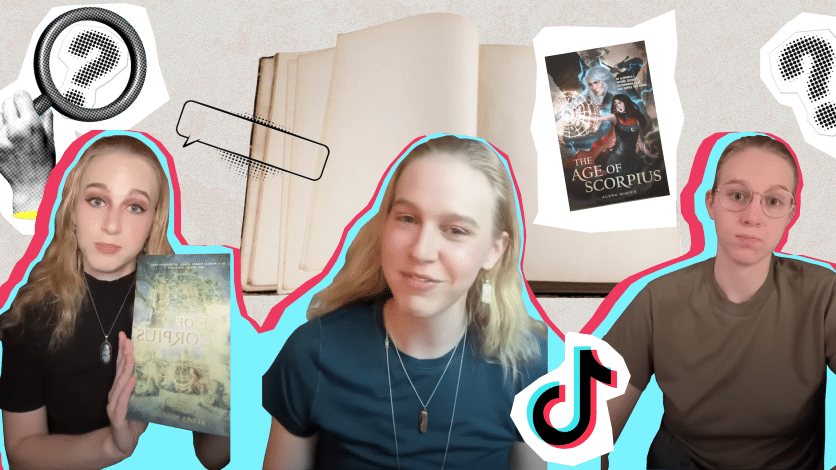
In the beginning of 2021, Audra Winter started posting on TikTok about the astrology-based fantasy world she created as a child. The magic system of this world revolves around the zodiac signs, and it’s more than just the setting of her novel The Age of Scorpius. It’s also the name of the business she set up to encompass all the projects within it: The World of Gardian LLC.
Audra shared videos on her worldbuilding, her writing journey, and her dreams of seeing her book published. Her progress videos quickly gained traction, one earning over 2.9 million views.
In fact, Audra was able to generate so much excitement about her book among viewers that when she announced her publication date in early 2025, she received thousands of pre-orders. For a debut author publishing independently, these numbers are nearly unheard of. Before the book was even out, all signs pointed to it being an immense success – and Audra didn’t hesitate to take advantage of this. She began to post videos about how she hired a team of independent artists, championing her anti-AI values and proudly describing herself as the owner of a six-figure business.
How it went downhill
The big issue arose when people got access to the book itself.
Everyone who preordered the book loved its concept and wanted to support an independent author they believed in. But part of the reason they believed in Audra was because she emphasized the years of hard work and refinement that went into The Age of Scorpius. Audra repeatedly mentions in her videos that she began working on the book ten years ago, going through version after version, drafting and discarding and rewriting, until she figured out the best way to tell the story that meant so much to her.
All that bolstered confidence among her audience, who felt sure that after so much care and revision, they were in for a superb reading experience.

That wasn’t the case.
As soon as the first few pages were available to read, an influx of constructive criticism began flowing Audra’s way. Readers weren’t happy with the writing style, deeming it to be amateurish and unedited. Some of the most common issues people had were the awkward sentence structure and frequent repetition of proper nouns, such as “Conviction Woods.” A general sense of disappointment pervaded, and many of those who had purchased preorders felt as if they’d been fooled into buying the product.
As most people eventually do when faced with the possible deterioration of their public image, Audra posted apology videos. Yet viewers weren’t satisfied, feeling that her response accepted the feedback only at a surface level, without taking full accountability. She was further criticized for framing herself as the victim and not accepting that she had any issues with her writing.
For instance, Audra defended herself by stating that her main character has ADHD and often repeats words, framing the repetition in the narrative as a purposeful choice. But in reality, that was far from the only flaw.
In what seems to be a reaction not only to the issues with Audra’s writing, but more so her handling of the the critique, other creators on BookTok began posting videos dissecting the situation. Some creators hypothesized that Audra ignored most of the feedback from her editors. Others proclaimed that she would be better off working in book marketing for other people’s books, since that was the aspect of the job she excelled at. They said she seemed more interested in being a business owner than a writer: too focused on the idea of running a multimedia franchise.
Most videos framed their videos as constructive feedback, but the escalation of the situation begs the question: Is it our place to give Audra career advice? Or should we just leave her alone? After all, no one is forcing you to buy her books if you don’t want to.
It’s understandable why Audra was hurt and defensive. She’d poured years of thought into a world and story that clearly meant a lot to her. Gardian was a big part of her life; something she’d invested in with the strong support of her audience.
When all the negative feedback flooded in, Audra might’ve felt like her foundation of support was crumbling. The future she’d imagined was at risk. That’s a scary situation for anyone to experience.
What this says about indie vs. traditional publishing
Traditional publishing creates guardrails against situations like this one. Public backlash over poor quality is very unlikely when manuscripts go through a rigorous screening process by a team of unbiased professionals. With the publishing company’s name on the line, everyone behind the scenes is motivated to ensure that only the best possible work makes it into bookstores (Although once in a while, certain questionable practices may result in quality being sacrificed.)
If you love the craft of writing but hate the business side of marketing your work, traditional publishing is for you. If you consider yourself business-savvy and this aspect of the job lights up your creativity, self-publishing might be the way to go. But that doesn’t mean that all it takes is business prowess. The writing itself is still just as important. To reach a notable level of success, you need both.
In many ways, indie publishing is more difficult than traditional publishing. You have to handle everything yourself: not just marketing, but also cover design, printing the books, shipping them out, and potentially hiring support staff to assist you. It’s a lot to deal with in addition to writing the book. Meanwhile, traditional publishing takes care of all that extra work for you.
But one key factor of traditional publishing is much harder: breaking in.
To get your book traditionally published, you have to find an agent willing to represent your book. Agents read through hundreds of submissions and choose only the very best of the best or even just what appeals to them personally, rejecting all the rest. If you’re lucky enough to get an agent to represent you, you still have to submit to editors, and your book could fall by the wayside at that stage, too. All in all, only a very small percentage of those seeking to traditionally publish end up succeeding.
If you’re lucky enough to get an agent to represent you, you still have to submit to editors, and your book could fall by the wayside at that stage, too.
That’s part of the appeal of indie publishing. Instead of wasting years of your time querying (the process for submitting your manuscript to agents) and potentially never being accepted, you can take matters into your own hands and give the green light to the project you believe in. For many authors, this works out terrifically. Sometimes, great books slip through the cracks and get ignored in the querying process, and indie publishing gives them the chance they deserve. Paired with strong marketing tactics, those books end up flourishing.
Other times, however, indie authors may fall prey to self-indulgence.
The roadblocks in traditional publishing may be frustrating, but they exist for a reason. An expert eye can review your work and decide if it’s ready to be taken to the next level. They can spot the difference between an amateur’s clumsy endeavor and a story with real potential. When there are no barriers between you and publishing, you can end up releasing your work to the wild before it’s ready.
Writers love their stories dearly, and as the saying goes, love is blind. Other people can open your eyes to the flaws that need changing, and traditional publishing provides those people for you. In indie publishing, you have the choice to take the quicker and easier route, bypassing most roadblocks. You can hire an editor, of course, but you can decide that they’re wrong and that your work is better as is. You can also hire an editor who tells you that it’s perfect already. (They’re lying – if an editor says this to you, run! It’s a scam!)
If you rush your book straight through to publication, you’re opening it up to direct critique from readers, harming your overall chance at success. Just like Audra Winter.
Writers love their stories dearly, and as the saying goes, love is blind.
No matter how passionate you are about your story, it doesn’t erase the fact that writing is hard, and producing high quality work takes thick skin. You have to be able to accept critique, kill your darlings, and make significant changes to ensure that your story is the best that it can be.
So if you choose to self-publish your book, confirm that it isn’t just good in your own head. Your vision must translate into something that others will enjoy as much as you. Or you risk giving indie publishing a bad reputation, harming other authors within the space who deserve better.
Character arcs
Audra’s greatest success was in her fantastic TikTok marketing strategy. But in a way, it was also her downfall. If her audience hadn’t built up such high expectations from her videos in the lead-up to publication, the backlash wouldn’t have been nearly as bad.
When you not only put your art into the world for the public to see, but you attach a price tag to it, it becomes a product, like it or not. And consumers are free to give whatever opinions they want. Such widespread criticism can quickly become too much.
At the core of everything, Audra Winter is trying to pursue her dream, not to hurt others. She’s only human, and she deserves the space to learn and grow without this intense public scrutiny.
If Audra were a character in a book, we’d give her the chance to transform and take her skills to the next level, to prove that this is only the start of her personal arc. So let’s sit back and observe from a distance, as readers do. Who knows where the future will take her?