All avid readers know that when the choice paralysis hits, it hits. My TBR list is incredibly long, and it only continues to grow. The different options feel so overwhelming that I end up unable to commit to a single book.
Instead, I opt to doom scroll and feel miserable.
What’s choice paralysis?
Put simply, it’s when your brain is faced with too many choices and ends up freezing. You may have heard of people being unable to pick a place to eat for dinner because they’re overwhelmed by the options. The same thing can happen with books. Do I want a fantasy, mystery, or romance? Do I want something simple or more complex? To start a series or not to start a series? These are the kinds of questions that swirl in my brain.
There are countless strategies out there for tackling a “To Be Read” list. Different ways to pick from a mountain of books in a reader’s collection. Did I employ any of these? No. Instead I set a seven-year-old loose in our local library to pick out a book for me.
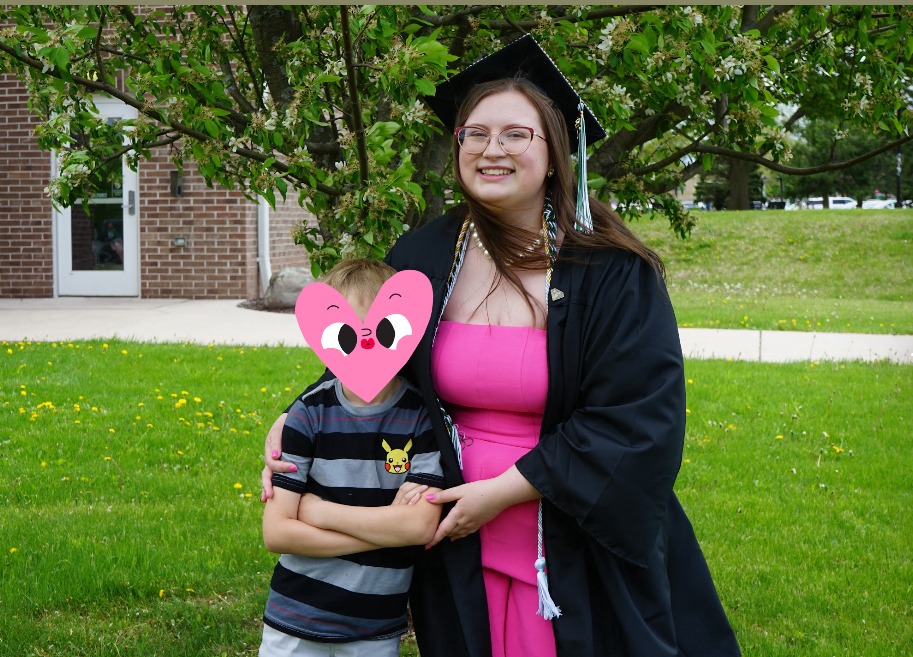
My brother, Conor, is a not the biggest reader. He likes to play Roblox, watch YouTube, and make Legos. He owns plenty of books, but the only ones he has truly read of his own accord are the Dog-Man books. Conor supports my reading though, occasionally even asking what I’m reading. So I thought it would be intriguing to see what this lightly reading-averse youngling would pick for his book-obsessed sister.
Choosing the book
After driving my dear brother to the library, I explained his mission to him. I would have him pick 5 books to start with, and we’d narrow it down from there. Conor nodded in understanding, an evil grin slowly spreading across his face. He proceeded to utter the most diabolical thing: “So pick the 5 biggest books I can find. Got it!” He and his devil horns then ran down the aisles looking for the heaviest books he could find.
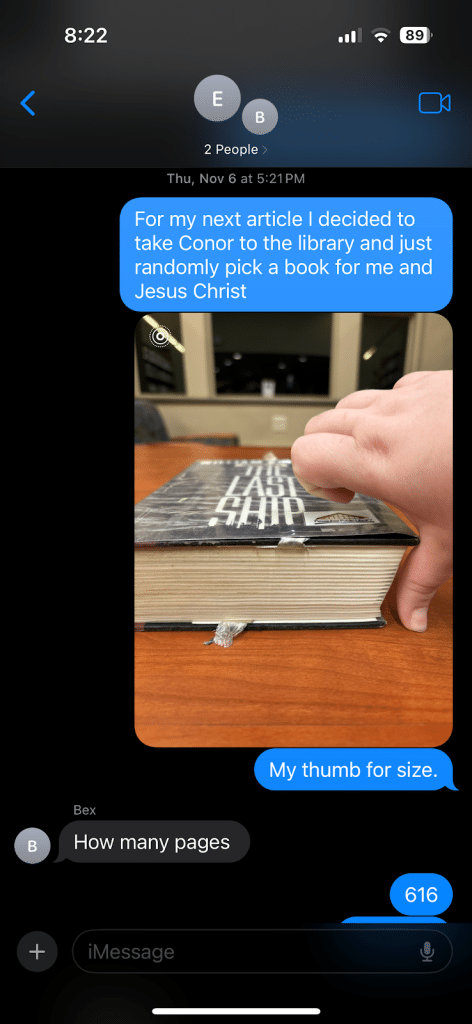
After his initial sweep, he grabbed one mystery with a Bollywood twist, a post-apocalyptic story set on a Navy vessel, a novel following a traditional wife as she becomes more feminist, and two Stephen King novels, as they were closest to our table. All of the books were over 450 pages. I suggested that Conor pick a criterion to narrow down to three. Unsurprisingly, he wanted to weed out the two shortest books. Once we had three options, I told him to choose exclusively based on the cover. Down to two, we employed an ancient, foolproof method to make our final choice…
“Eenie, meenie, miney, moe,
Catch a tiger by the toe.
If he hollers, let him go,
Eenie, meenie, miney, moe.”

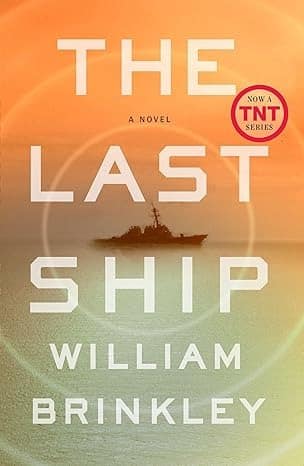
Which left me with The Last Ship by William Brinkley. Cue the confetti.
The Last Ship
William Brinkley was born on September 10th, 1917, and passed away on November 22nd, 1993. He was known as both a writer and a journalist. Interestingly enough, Brinkley documented the exorcism that inspired William Peter Blatty’s The Exorcist. Another notable work is his novel Don’t Go Near The Water, a naval story that was adapted into a film in 1957. Like The Last Ship, Don’t Go Near The Water was rooted in Brinkley’s own time in the Navy during World War II.
Published in 1988, The Last Ship follows the fictional USS Nathan James, a ship in the midst of a nuclear war. The story is told from the perspective of the Nathan James‘s captain, who is referred to only as Thomas. The novel was eventually adapted into a TV series of the same name that aired on TNT. The series ran from 2014 and 2018 with actor Eric Dane starring as Tom Chandler, the show’s equivalent to Thomas.
First thoughts
My initial reaction was one of hesitation, mostly because of the length. I mean, I did have a deadline for this article. Not to toot my own horn, but I can be a pretty fast reader. That being said, even I struggle with books over 300 pages. I hoped I would be able to read most of it in time. After logging onto Libby (a digital library resource), I realized that an audiobook would help.
I was fairly amused by the fact that I ended up with a book featuring a ship on the cover. My brother Conor is obsessed with any sort of transportation, so it seemed fitting.
Reading the book synopsis, I was a little nervous. It wasn’t a book I’d normally pick for myself, as I am not the biggest science fiction fan. In fact, I can count all of the science fiction books I actually like on one hand. Ender’s Game by Orson Scott Card, Divergent by Veronica Roth, Four by Veronica Roth, and The Giver by Lois Lowry. (I despise Insurgent and Allegiant, for the sake of keeping the record straight). But that was the point of the experiment: to try something new and broaden my horizons! Maybe it would even become my new favorite book, beating Midnight Sun by Stephenie Meyer.
At this point, you’re probably wondering, “Well, did it become your new favorite novel? Did it teach you something about stepping outside of the box?”
No. No, it did not. In fact, I didn’t even finish the book.
I’ve never DNFed a book faster
Y’all, when I tell you this was the most boring piece of literature I have ever come in contact with, I don’t even think I’m being dramatic. As an English major, I have read some pretty dull books. But even Robinson Crusoe was more interesting to me than this book. Which is saying a lot for me.
The prologue was especially excruciating. It went into meticulous detail about the Nathan James, including the specific type of ship that it was and the missiles it held. You could have told me I was reading a history or engineering book about a famous navy ship, and I would have believed you. To give myself a break, I pulled out the audiobook sooner than I had planned. But of course, as fate would have it, the audiobook was read in a slow monotone, only compounding my struggle to pay attention and retain anything from the book.
Clearly, it started out rough. But sometimes prologues can feel slow compared to the novel as a whole. No need to give up hope, right? So I persevered. And at first there seemed to be potential, as we finally had a character to read about: a character that was straitlaced but passionate about his career. I began to wonder how the character of the commander would grow after all the terrors that still to come. I can work with some character growth as a result of traumatic events.
I was too hopeful. Any chance Brinkley saw to use more concise language, he actively swerved away from and chose to use the most words possible. Honestly, I would be so curious to see a modern editor tackle this novel. There were so many things that I felt weren’t needed in the slightest. It was like reading a creative writing assignment that had a high minimum word count. Even at 1.5 speed, the audiobook barely moved along. I felt like I had years drained from my life listening to it.
And that’s not even the worst part. The worst part was the sheer number of times in the first 100 pages that the protagonist brought up his reservations about women joining the Navy. He kept oscillating between thinking that nature was going to punish them for having women aboard and noticing their skills. It was never-ending!
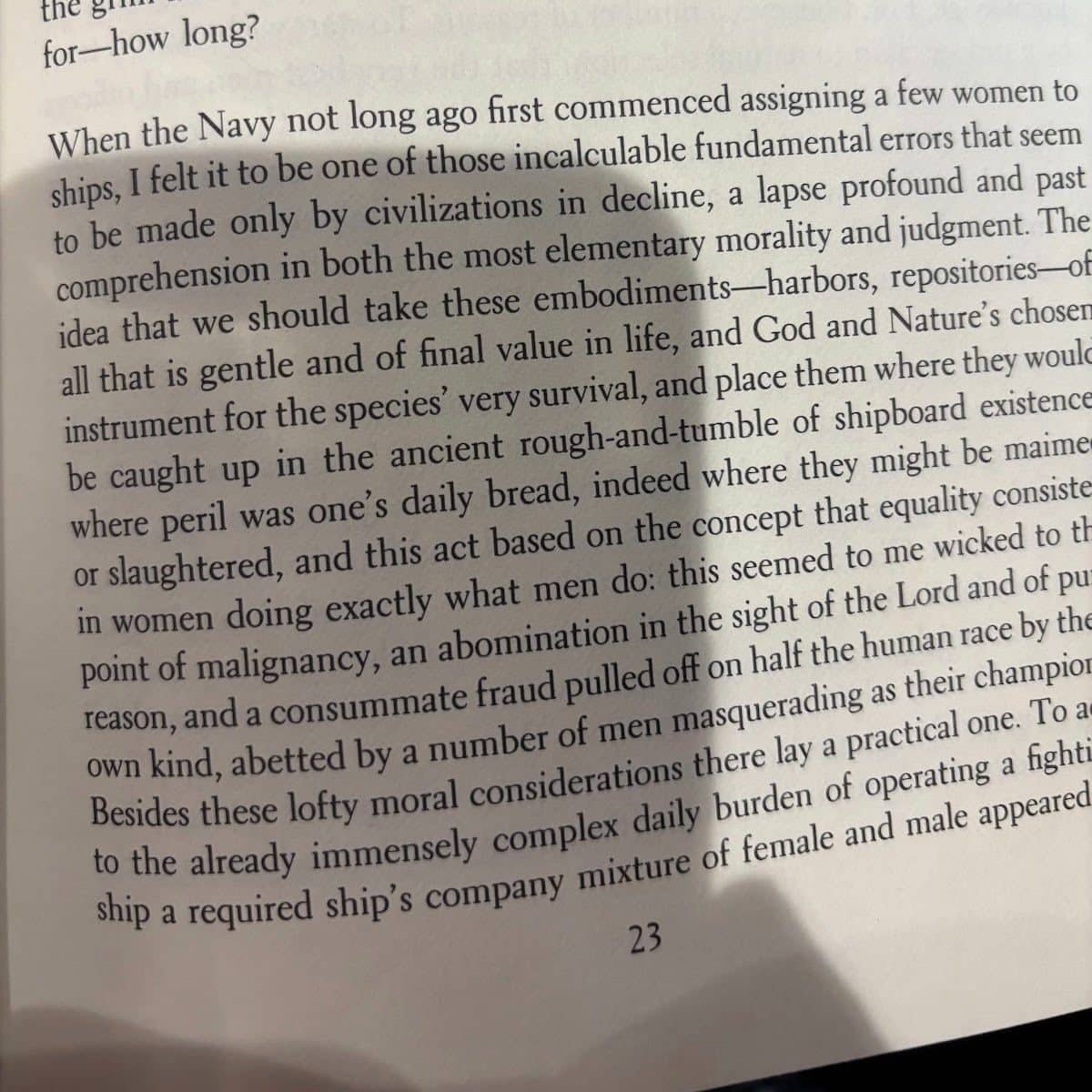
I’m aware that this was written by a man in the 80s, but that doesn’t mean I have to keep reading it as a woman in 2025. Since I decided not to finish the book, I’ll never know if he came to change his perspective. But I gave three hours of my life to the book already, and that was more than enough!
What did I learn?
Next time, I’ll have my brother choose from books I already own. That way, I’ll be tackling my TBR, I won’t have to choose myself, and I won’t entirely regret dedicating my time to said book. A win all around. I also learned that my brother is a little sicko who derives joy from causing his sister stress.
Don’t read this book. I cannot stress that enough. Obviously, I can’t stop you, so if some morbid curiosity fuels you to give it a try, good luck. In the meantime, I’d recommend reading this article about Katabasis: R.F. Kuang’s ‘Katabasis,’ Dark Academia, and The Rise of Anti-Intellectualism. It’ll be a better use of your time!
Happy reading!