Overview
- Caffeine gum absorption is faster, whereas coffee absorption is slower and more variable due to its distinct pharmacokinetics.
- Caffeine gum typically delivers only ~2 calories per piece, but coffee drinks may carry significant hidden sugar and calorie loads.
- L-theanine, combined with caffeine in gum formulas, reduces jitteriness and smooths the post-caffeine crash, but plain coffee contains little to none.
- Caffeine gum offers precise, labeled dosing (e.g., 40 mg or 100 mg per piece), whereas coffee dose varies widely and unpredictably.
- Xylitol-sweetened gum may support dental health by increasing saliva production, but coffee can stain teeth over time since it’s acidic.
- Caffeine gum suits dose-sensitive and on-the-go moments; however, coffee offers a more enjoyable ritual and experience.
- You can use both on the same day, as long as you keep an eye on your total caffeine intake.
Table of contents
- Overview
- Why This Question Matters
- Absorption Speed — What the Pharmacokinetics Show
- Sugar, Calories, and Hidden Loads
- The Crash Problem — Where L-Theanine Comes In
- Dental and Oral-Health Comparison
- Dose Control and Tracking
- Practical Scenarios — Where Gum Wins, Where Coffee Still Does
- Decision Matrix — Which Do You Need?
- FAQs
For most of the working world, “I need caffeine” and “I need coffee” are the same sentence. They don’t have to be. Coffee is a wonderful drink, but it is only one delivery method for one molecule, and in 2026, it’s no longer the only practical one. Caffeine gum has moved from a military-issue curiosity to a mainstream pocket option, which raises a fair question: which one actually wakes you up faster?
The honest answer is that the two aren’t really competing for the same job. Coffee and caffeine gum have genuinely different pharmacokinetic profiles, different calorie and sugar loads, different effects on your teeth, and very different reliability when it comes to knowing how much caffeine you just took. Rather than choosing between gum and coffee, what actually matters is which delivery method serves which moment. Here’s what the research actually shows.
Why This Question Matters
Americans spend enormous sums on caffeine every year- on the order of tens of billions of dollars on coffee and tens of billions more on energy drinks, by widely cited industry figures. That spend buys a lot of alertness, but it also buys a lot of sugar, a lot of variability, and a lot of acid on tooth enamel.
Coffee isn’t “wrong.” For a slow Sunday morning, a warm cup is part of the point. But for a 2 p.m. focus block, a long highway drive, or a flight where liquids are a hassle, the ritual becomes friction rather than benefit. Looking at the trade-offs head-on, including speed, calories, the crash, your teeth, and dose control, makes it much easier to pick the right tool for a given moment instead of defaulting to the mug out of habit.
A note on method before we start: every health and pharmacology claim below links to its primary source so you can check it yourself.
Absorption Speed — What the Pharmacokinetics Show
This is the headline question, so let’s be precise about what the literature supports, focusing on the molecule and the format rather than any single product.
Caffeine delivered via chewing gum. A frequently cited study by Kamimori et al (2002) compared the rate of absorption and relative bioavailability of caffeine in chewing gum versus capsules, and found the gum format reached peak concentration with a shorter time-to-peak (Tmax) than swallowed capsules.
Separate work by Morris et al (2008) on caffeine release from gum reported that the majority of the caffeine is released within the first several minutes of chewing. A randomized crossover study (Sadek et al., 2017) compared caffeinated gum against a marketed caffeinated beverage, and a review of caffeine in alternate forms (Wickham & Spriet, 2018) places these findings in context.

Caffeine delivered via coffee. Caffeine from a beverage is absorbed through the gastrointestinal tract and is nearly completely bioavailable, at approximately 99–100%. But its time-to-peak is variable, anywhere from roughly 15 to 120 minutes depending on the size of the drink, what else is in your stomach, and how fast it empties.
The translation. Both routes get caffeine into your bloodstream and the endpoints are similar. The difference is the shape of the curve: gum-format caffeine tends to reach its peak sooner in controlled studies, while a large coffee delivers more total volume over a longer, more variable window. Neither is universally “better.” A pre-meeting jolt and a sip-it-for-an-hour desk companion are simply different needs.
What this comparison will not do is claim that any specific gum “kicks in” at an exact minute since individual response varies, and precise onset claims for a product aren’t something a responsible writer should pin down. The science above describes the format in general.
Sugar, Calories, and Hidden Loads
This is where the gap gets wide, because caffeine almost never travels alone in a drink.
- Black coffee (8 oz): ~0 calories, ~95 mg caffeine — the cleanest coffee option.
- Latte (16 oz): ~150–220 calories, ~170 mg caffeine.
- Blended mocha “Frappuccino”-style drink (16 oz): 400+ calories, ~75 mg caffeine.
- Red Bull (8.4 oz): ~110 calories, 27 g sugar, ~80 mg caffeine.
- 5-Hour Energy-style shot: ~4 calories, ~200 mg caffeine.
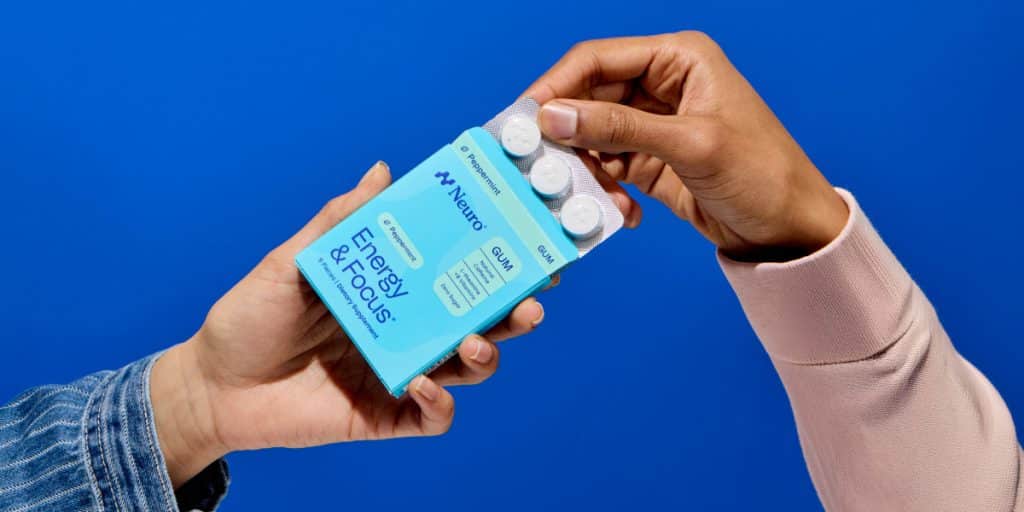
Caffeine gum sidesteps that hidden category almost entirely. As a representative example, one piece of NeuroGum’s Energy & Focus Gum is listed at 40 mg of caffeine plus 60 mg of L-theanine and B6/B12, at roughly 2 calories per piece, sweetened with xylitol rather than sugar, and labeled vegan, non-GMO, and aspartame-free. Here, nothing magical about gum. It removes an entire column from the spreadsheet that a flavored coffee drink quietly adds.
The Crash Problem — Where L-Theanine Comes In
Caffeine on its own can deliver the jittery edge and the post-peak slump that frequent coffee drinkers know well. This is the area where formulation, not format, makes the biggest difference.
- L-theanine, an amino acid found in tea, is the relevant ingredient. In a study by Owen et al (2008), the combination of L-theanine and caffeine improved attention and was associated with fewer jittery side effects than caffeine alone.
- Giesbrecht et al (2010) reported that the pairing helped smooth the post-caffeine decline, and work by Nobre et al (2008) documented L-theanine’s effect on alpha brain-wave activity, associated with a state of relaxed alertness.
- A broader caffeine review (McLennan et al., 2016) covers caffeine’s cognitive effects more generally.
Plain coffee contains very little L-theanine unless you’re also drinking tea. Caffeine gums formulated with both compounds- Neuro Energy & Focus being one example, at a 40 mg caffeine to 60 mg L-theanine ratio- are built specifically around this pairing. If the caffeine crash is your main complaint about coffee, the ingredient list matters more than the delivery method.
Dental and Oral-Health Comparison
Teeth rarely enter the coffee-versus-alternatives conversation, but they should.
Coffee stains enamel over time, sits at an acidic pH (roughly 4.8–5.5) that contributes to erosion risk, and, when hot, adds thermal stress. None of this is catastrophic, but it accumulates over years of daily cups.
Xylitol-sweetened caffeine gum flips a couple of those factors. Xylitol has been associated with reduced cavity-causing bacterial activity (Ryley at al, 2015). Chewing also stimulates salivary flow, which contributes to oral buffering and remineralization processes.
One important warning that applies to xylitol products of any kind: xylitol is toxic to dogs (FDA, 2024). Keep gum away from pets.
Dose Control and Tracking
If you’ve ever felt wired after one coffee and nothing after another, the reason is that you have almost no idea how much caffeine is in a given cup. A home brew, an office drip, and a coffee-shop “medium” can range from roughly 80 mg to 200 mg or more, depending on bean, roast, grind, and size.
Gum trades the ritual for arithmetic you can actually do. A single piece is a fixed, labeled dose — 40 mg in a standard piece, or 100 mg in Neuro’s Extra Strength version. That makes it straightforward to keep your daily total under the U.S. Food and Drug Administration (FDA, 2024) 400 mg/day guideline for healthy adults, which matters most for people in alertness-critical situations— long-haul drivers, shift workers, students mid-exam— where knowing your exact intake is part of using caffeine responsibly.
Practical Scenarios — Where Gum Wins, Where Coffee Still Does
A fair comparison admits that coffee is genuinely the better choice sometimes. Here’s an honest, scenario-by-scenario read:
- A long highway drive (sustained alertness): Gum. Portable, dose-controlled, and no bathroom stops.
- Final-exam week in a library: Gum. No coffee-shop dependency, usable mid-session where allowed.
- A night shift (nursing, paramedic, security): Gum. Dose-consistent and pocket-ready, no prep.
- Pre-workout for an athlete: Gum. Fast onset for the format, with no liquid sloshing in the stomach.
- A slow weekend morning: Coffee. The warmth, aroma, and ritual are the benefits.
- An after-dinner social moment: Coffee. Gum would feel out of place at the table.
- Dessert-adjacent caffeine: Coffee. Some pairings are cultural, not functional.
The pattern is clear: gum tends to win the utilitarian, on-the-move, track-your-dose moments, and coffee wins the moments where the experience itself is the point. Rather than locking in one choice permanently, what most people actually need is to match the tool to the moment.
Decision Matrix — Which Do You Need?
| Need | Coffee | Caffeine Gum |
| Cleanest onset for a quick task | ✅ | |
| Lowest calories | (black only) | ✅ |
| Dose precision | ✅ | |
| Portability / travel-friendly | (TSA liquid limits) | ✅ |
| Ritual & pleasure | ✅ | |
| Sustained, high-volume caffeine | ✅ | ✅ (Extra Strength) |
| Dental-friendly profile | ✅ | |
| Reduced jitter/crash | (only if tea-paired) | ✅ (with L-theanine) |
| Low acidity | ✅ |
*These statements have not been evaluated by the Food and Drug Administration. This product is not intended to diagnose, treat, cure, or prevent any disease.
FAQs
Does gum give you energy faster than coffee?
Research on caffeinated gum, such as Kamimori et al (2002), shows the gum format reaches peak caffeine concentration faster than swallowed capsules, while coffee’s gastric absorption is complete but variable (roughly 15–120 minutes). In general, gum-format caffeine tends to peak sooner, though individual response varies.
Can I replace my morning coffee completely?
Many people do, especially those prioritizing calorie control, portability, or dental health. Others keep coffee for the ritual and use gum for focused work blocks. It’s additive, not strictly either-or.
Can I use both on the same day?
Yes, just track your total against the FDA (2024)’s 400 mg/day adult guideline. For example, one cup of coffee (~95 mg) plus two standard 40 mg pieces (80 mg) totals about 175 mg, well within the limit.
How much caffeine is in caffeine gum versus a cup of coffee?
A standard piece of Neuro Energy & Focus gum is 40 mg, about half an 8 oz brewed coffee (~95 mg). The Extra Strength piece is 100 mg, roughly equivalent to a full cup.
Is caffeine gum better for my teeth than coffee?
From a dental standpoint, it has advantages: xylitol is associated with reduced cavity-causing activity (Ryley at al, 2015). Chewing stimulates protective saliva, whereas coffee stains enamel and is acidic.