
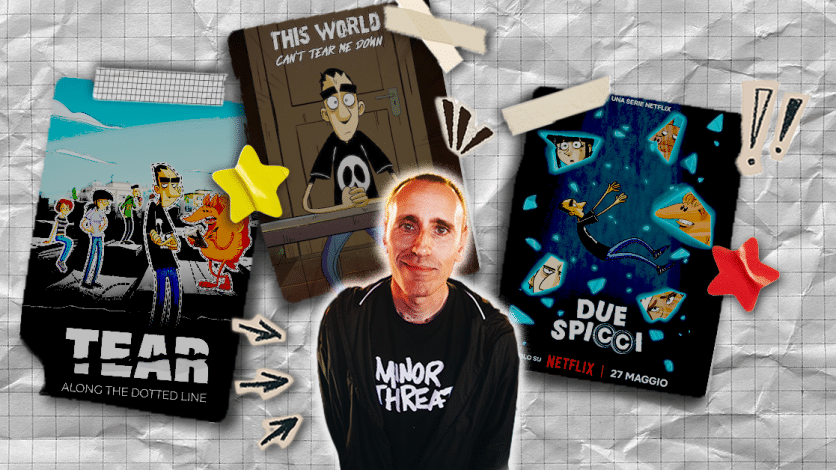
On May 27th, Netflix released My Two Cents (Due Spicci), its third animated miniseries written and directed by Italian comic artist Zerocalcare. While Zerocalcare’s work is well-known in Italy, his international popularity is just beginning to kick off. Here’s a guide to his three interconnected Netflix specials, each of which perfectly blends cynicism, relatable humor, semi-autobiographical anecdotes, and true heart.
Zerocalcare, real name Michele Rech, is an artist from Rome who has been creating comics for most of his life and publishing his own autobiographical graphic novels since 2011. The pen name “Zerocalcare” comes from an old commercial for a cleaning product, literally meaning “zero limescale” (the white stuff that builds up on metal surfaces when you don’t clean them). Rech chose the name years ago at random as an internet username, and it’s since become his iconic moniker.
The real Roma
Zerocalcare’s stories usually follow his own life in the periferia — or, the outskirts —of Rome. His Rome is probably unlike anything you’ve seen in Hollywood films. Rebibbia, the primary setting of all of his Netflix shows, is a rough, real, and unromantic neighborhood at the end of the metro line.
I’m not Italian myself, but I did just spend a year living and teaching in a very similar neighborhood in Milan. I found a strange sense of representation watching Zerocalcare’s work. It was more true to my own experience of Italy than, say, Roman Holiday.
That’s not to say that Zerocalcare’s presentation of the “real” Rome is negative. His characters are just authentic, everyday people with authentic, everyday problems. Which is what you’d expect, given that most of the people and plot points in his stories have real-life counterparts.
So there are three Netflix miniseries in total: Tear Along the Dotted Line (Strappare lungo i bordi), This World Can’t Tear Me Down (Questo mondo non mi renderà cattivo), and the latest, My Two Cents (Due spicci).
All three of these stories are connected. They truly seem like three seasons of the same show rather than three separate ones. Even though each has its own central storyline, you’ll be missing some details if you don’t watch them in order.
I’d also recommend watching in the original Italian with subtitles, though there is an English dub available too.

Cast of characters
Though a large cast of characters come in and out of these stories, there are four important protagonists you need to know.
First is Zerocalcare himself, often referred to by others as simply “Zero.” He serves as the main character and narrator, frequently breaking the fourth wall to explain certain concepts or go off on rambling tangents about the way he views the world. He’s sarcastic and nerdy, using constant pop-culture references to communicate his predicaments. However, he also tries to do the right thing and cares deeply for the people around him, despite feeling lost in his own adulthood.
Then, we have Zero’s two best friends, Secco and Sara. Sara is Zero’s “moral beacon.” She’s the person who always has solutions for him when he encounters problems. Though she’s the most level-headed one in the friend group, Zero tends to forget that she has her own problems. Secco is a lifelong burnout who makes money playing online poker. When faced with any problem, his solution is to get gelato. Though his deadpan carelessness is mostly used for comic relief, Secco can have his rare moments of wisdom, too.
The last, possibly most important character is the Armadillo. The Armadillo is Zero’s conscience. Naturally, the two are frequently at odds. They have a constant back-and-forth banter full of insults, and the Armadillo often has to force Zero to understand the reality of the situations he puts himself in.
Some of the best scenes in the series occur when Zero has to respond in an awkward situation. When this happens, the audience gets to look inside his brain for an Inside Out-like intermission where he and the Armadillo go over his options.
“Tear Along the Dotted Line”
Tear Along the Dotted Line (Strappare lungo i bordi) was released in 2021. The primary theme of Zerocalcare’s first series, adapted from various graphic novels, is adulthood.
The title comes from a concept explained by Zero throughout the six episodes. While growing up, everyone believes that if they follow the right path or “tear along the dotted line,” they’ll end up successful and happy. However, the metaphorical paper can rip unexpectedly, and sometimes things don’t turn out the way you planned. Mental health issues, career changes, relationships that end poorly, all of these things are painful but inevitable.
This series is my favorite of the three. It comments on the universal feeling of not knowing how to handle the things life throws at you, oscillating between a tone of hopefulness and hopelessness.
Brutal observations about adulthood are intercut with hilarious moments in which Zero relatably overreacts to normal situations. For example, in one episode, he’s writing a funny tweet that he ends up not being able to post. He’s currently ignoring phone calls from someone and doesn’t want her to see that he’s online.
“And yet,” he laments, “the tweet was phenomenal. It was funny. I’d have gotten 800 million likes. I would have been asked for the movie rights.”
This series also has an incredibly heart-wrenching ending, which I won’t spoil for you. I think it’s best to experience it yourself. Personally, I did cry.
“This World Can’t Tear Me Down”
This World Can’t Tear Me Down (Questo mondo non mi renderà cattivo — literally, “this world won’t make me bad”) came out in 2023. It follows some of the same themes of adulthood as Tear Along the Dotted Line, but has a greater focus on relevant political issues.
If you’re unfamiliar with the situation, Italy has many of the same problems with immigration as the United States. Migrants, often from North Africa, come to the country to seek asylum or better opportunities, but are treated incredibly poorly by the Italian government and population. Italian citizenship is hard to get for foreigners. Even children of migrants born in Italy do not have citizenship. Current right-wing Italian prime minister Giorgia Meloni campaigned on an anti-immigration platform.
In This World Can’t Tear Me Down, local nazis are threatening a refugee center in Zero’s neighborhood. Zero even explains that he uses the word “nazi” to describe them because people have become too comfortable identifying with the term “fascist.” The politics of Zerocalcare, the author, come through loud and clear here. As an authentic punk-rocker, he’s unapologetically against the resurgence of the right-wing in Italy.
This series has a lot of nuance, despite firmly denouncing the anti-immigrant ideology of the nazis. The character of Cesare, a friend from Zero’s youth who spent years in rehab, provides an interesting look at why people who are left behind by society fall for fascist ideologies.
This World Can’t Tear Me Down examines real, intense issues. Yet, it maintains the same beloved cast of characters and sarcastic sense of humor as the previous series.
“My Two Cents”
My Two Cents (Due Spicci) is the latest of Zerocalcare’s Netflix specials. It was just released on May 27th, with a much longer runtime than the previous two. My Two Cents has eight episodes rather than six, and some of these episodes are almost an hour long.
My Two Cents follows a dramatic storyline in which Zero’s friend Cinghiale (“Wild Boar”) ends up owing a debt to a gang of criminals after opening his restaurant. Zerocalcare has stated that this story is not a real one, but is based on elements of his life and the lives of people around him.
This series explores different types of romantic relationships. Zero’s friend Smeralda, whom he has always had a crush on, has to stay with him because of her abusive boyfriend. Sara, meanwhile, is dealing with her own issues as her relationship with her long-term girlfriend becomes toxic. Cinghiale has to hide his financial and legal troubles from his wife Christine, which is incredibly hard for him, since the two of them have always shared everything.
My Two Cents is more weighty and emotionally-driven than its predecessors. It’s a very cinematic shift, but still comical even in its dark moments.
In one scene, Secco pepper-sprays one of the gang members, and Zero berates him for being so impulsive. Secco insists that he won’t do it again, because the situation has changed. Zero tells him, “I’m glad that’s sunk in,” before Secco pulls out a taser.
The relatable ethos of Zerocalcare
I think my appreciation for Zerocalcare’s shows can best be summed up by a description of two of my favorite moments from his work.
In My Two Cents, Zero talks with his mother, who states that she just wants him to be happy in his life. Zero then goes on a complete internal spiral about how difficult it is to just be happy. He knows his parents have done everything they can to give him a good childhood, so it isn’t their fault that he can’t figure things out.
“Maybe there are emotions that some of us just can’t access at all,” he says. “You know they’re there, behind a door, but you don’t know how to open it. But you simply can’t tell those who love you this, because it would all just end in heartbreak.” Zero continues to hide his discontent and tells his mother that he’s perfectly happy.
This scene is gut-wrenchingly relatable and feels like a moment in which the author is truly baring his soul to the viewer, asking us to recognize ourselves in his struggle.
My other favorite Zerocalcare moment is from Tear Along the Dotted Line.
Sara and Zero are waiting outside Secco’s apartment. They’re late to catch a train, and Zero is getting increasingly annoyed with Secco’s tardiness. Sara tells him to relax; they have plenty of time.
Zero combusts into flames and tells her, “No, we do not! I never have plenty of time! I don’t operate like other people!” Sara looks at him like he’s crazy.
Chicken soup for the souls of the cynical
Zerocalcare’s ability to effortlessly include moments like these in each episode is what makes his storytelling stand out. In one scene, Zero is going on, and on about a mundane problem, and in the next, he’s speaking harsh truths about the human condition. It’s the balance between these two starkly different tones that makes all three of his series feel real, but not depressingly so.
Anyone who is at all anxious about adulthood, society, employment, or relationships will be able to see themselves in these stories. They’ll also be able to laugh with (or at) the characters who share their predicaments. And laughter is the best medicine, after all.
Oh, and one last thing. The soundtrack to anything Zerocalcare is impeccable. If you’re a fan of ’80s and ’90s alternative music (as I am), you’ll love these shows. I was thrilled to hear music from the Clash, Generation X, the Cure, and Counting Crows, among many others. I can’t do enough to recommend giving this a watch.