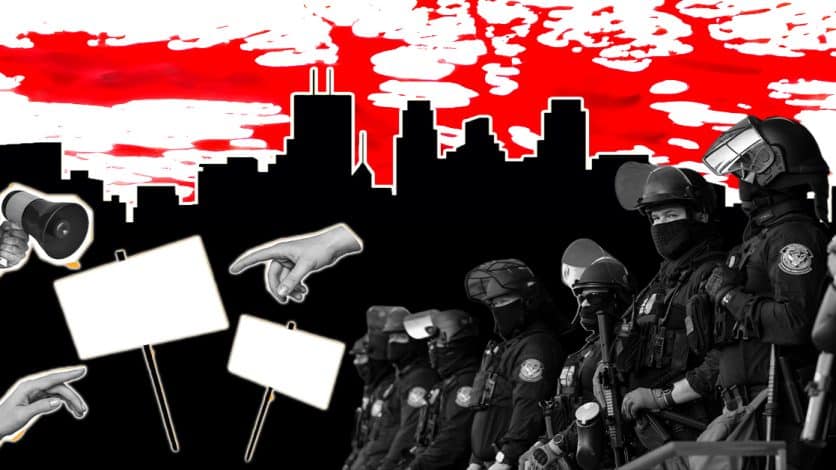
On Friday, January 30, 2026, demonstrations against Immigration and Customs Enforcement (ICE) mobilized across the country in a nationwide “shutdown.”
These demonstrations come after months of heightened ICE activity, with numerous videos showing violent altercations between the agency and community members. Trump’s campaign promise of “mass deportation” has materialized in the detention and attempted deportation of 5-year-old Liam Ramos.
Some of the most alarming recent incidents involving ICE took place in Minneapolis, Minnesota, during Operation Metro Surge. (Metro Surge was the largest immigration enforcement operation yet, sending thousands of agents into Minnesota.)
The first peak of nationwide outrage came after an ICE agent shot 37-year-old Renee Good. But, that wasn’t all. The day after nationwide protests and a ‘strike’ in Minneapolis, ICE killed an ICU nurse named Alex Pretti.
In the aftermath of these incidents, there’s more to say about what recent developments mean for ICE and the communities calling for its abolition.
Reckoning with immigration
In 2020, Minneapolis was home to a national racial reckoning that spurred the Black Lives Matter movement. Six years later, the same grounds are now flush with renewed activity protesting ICE. Even outside of the city’s bounds, people have once again mobilized in solidarity across the nation.
Far from more notorious American cities like New York City and Los Angeles, Minneapolis may seem an unlikely center of opposition to law enforcement actions. But, as ground zero for the Trump administration’s ICE escalation, it might be a microcosm of another national reckoning. This time, with US immigration policy.
The once-fringe exhortation to “abolish ICE” is circulating further than ever before. The idea of a “general strike” (in which workers across industries organize a widespread strike, or labor stoppage) is spreading.

Rejecting the evidence
As communities have gathered to call for an end to ICE operations, the Trump administration is on the defensive. In the aftermath of Good’s killing, administration officials—including the likes of Homeland Security Secretary Kristi Noem—openly lied about the circumstances of her death.
Labeling Good a ‘domestic terrorist,’ Noem claimed that she “weaponize[d] her vehicle” in an attempt to run over an ICE agent. Actual bystander video of the shooting, however, shows that the agent wasn’t at risk of being run over when he fired at Good. (Some Democratic lawmakers are now calling for Noem’s impeachment.)
A similar story unfolded after Pretti’s death. Again, Trump administration officials used the language of ‘domestic terrorism’ to justify what happened. There was even an attempt to blame the shooting on Pretti’s legal carrying of a handgun. However, video showed that Pretti was holding only his phone in the moments before his death. (ICE agents had also disarmed Pretti entirely before firing at him.)
Both of these instances, considered together, highlight a pattern of behavior in the Trump administration. Facing increasing public opposition, administration officials have parroted verifiably false narratives in an attempt to justify ICE violence.
It’s clear that these shootings have only reinforced growing public outcry over ICE operations. The blatant targeting of legal observers—US citizens who don’t at all resemble the White House’s ‘violent criminal’ immigrant profile—seems to represent a tipping point.
But, this sort of violence isn’t exactly new. As some oppositional rhetoric has adopted a specific focus on ‘Trump’s ICE’ to contextualize the recent, widely-publicized shootings, it’s worth considering the pre-Trump history of the agency. And, with it, the violence that happens off-camera, behind closed doors, to ‘imperfect’ victims.
Behind the camera
Contemporary controversy over the inhumanity of immigration policy seems to be a relatively recent development. It has its prior roots in the national debate that Trump sparked in his first campaign. Particularly, with the 2016 rhetoric of ‘building a wall’ to keep ‘bad hombres’ out of the country. However, those criticisms tended to center the audacity of the idea over any foundational rejection of the US immigration system.
In his first term, Trump became associated with the imagery of kids in cages and family separations at the border. But, it didn’t start with him.
The origins of today’s immigration enforcers
Though it may seem hard to believe now, ICE was only established in 2003. There are members of Gen Z who are older than this government agency. Like other agencies and initiatives at the time, such as the PATRIOT Act and the Department of Homeland Security itself, ICE was created in response to the 9/11 attacks and consequent national security concerns.
Agencies such as ICE and CBP (Customs and Border Protection) replaced the preexisting Immigration and Naturalization Service (INS). The change in language represented a corresponding shift in focus from pathways to citizenship to border control.
The rhetoric of terrorism, especially when foreign and attributable to a ‘shared enemy,’ was much more successful back then. The activities of immigration enforcement, even in the acts of detention and deportation, were widely acceptable. So acceptable, in fact, that agencies like ICE grew in scale.
President Barack Obama’s administration set a record high in annual deportation numbers, surpassing 400,000 annual removals during several years of his presidency. Obama’s deportation numbers may have rivaled his successor’s and have earned him a moniker of “deporter-in-chief.”
Alongside this increase in deportations, which totaled over 3 million in Obama’s eight years in office, there was a corresponding growth in ICE’s budget. The value steadily climbed throughout Obama’s presidency, even before the uptick of Trump’s first term. In 2012, even under Obama, immigration enforcement spending neared $18 billion.
Democratic Party support for immigration enforcement didn’t end with Obama, either. President Joe Biden’s administration largely maintained Trump’s ICE funding. The Biden administration also turned a record number of migrants away at the border.
Even as Biden’s administration used the same immigration mechanisms, Trump raved about ‘open borders.’ The smear seemed to affect Vice President Kamala Harris’s presidential campaign. Harris released ads where she positioned herself as the border security candidate, declaring support for increasing the number of border patrol agents.
Under the surface
With all of this background in mind, it’s clear that there are more substantive national discussions we need to have about US immigration policy. The most visible ICE operations nationwide have brought immigrant rights into the forefront of the national consciousness, but it’s worth considering the violence that has been normalized. The inhumane policies and deportations that have gone on for several administrations before now.
Even today, there aren’t always cameras to capture what’s happening. While there have been reports of the conditions in immigrant detention centers, it will take time to understand the totality of detainee experiences.
As of mid-January, over 70,000 people were in immigration detention. In a press release from December, the administration claims to have deported over 600,000 people. Of those numbers, the names and stories we’re aware of are few and far between. In the absence of publicly available bystander video, the stories of people like Keith Porter and Marimar Martinez took time to come to light.
A new normal
One of the real dangers of this moment is further normalization. As ICE continues to tread over the line of ‘acceptable’ immigration enforcement action, that line may shift to permit more violence. As necessary as it is to focus on the cases of people like Good and Pretti, it’s important not to forget who the primary targets of this violence are: immigrants and people of color, sometimes documented and sometimes not.
Associating this long history of violence exclusively with Trump—or even with ICE, for that matter—misses the point. National policy relies on variations of this exact type of disproportionate violence. Ignoring this endangers those who will continue to be targeted by ICE, or whatever future agencies may take its place, even when Trump is gone.
Looking back at prior immigration policies from recent decades can provide us an idea of what to expect today. In the 2010s, federal immigration enforcement became increasingly linked to local police through 287(g) agreements and Arizona’s SB 1070. The latter, which some labeled a “show me your papers” law, empowered local law enforcement to investigate immigration status during stops and arrests. These policies could develop into more extensive collaborations between local police and federal agents.
While many are framing their criticisms of the current administration with an imperative to return to normalcy, we have to consider if that desire may be part of the problem. As Martin Luther King Jr. said, “True peace is not merely the absence of tension; it is the presence of justice.”
Banal violence
In this moment of reckoning, we can go beyond reflexive rejections of ICE’s escalating violence. It’s also a time to question the violence that has been previously accepted, overlooked, or undetected.
This administration’s routine need to lie (even in the face of overwhelming video evidence) is only another indicator that they, too, see potential for this dam to break. As the White House continues to construct implausible justifications for ICE actions, communities across the country reject its explanations with increasing fervor.
It’s not just the American public that could impede ICE. Congress might be heading into another government shutdown. Democrats are currently leveraging Department of Homeland Security funding, including $11 billion for ICE, in exchange for demands to reform ICE. (It’s worth noting that reducing ICE funding doesn’t fall under the list of reforms. How said reforms would be enforced, with non-compliant agents held accountable, is unclear.)
If Minneapolis does end up being a microcosm of the country, foreshadowing the operations to spread nationwide, many more of us will be forced to come face-to-face with a system we’ve never experienced firsthand before. We will have to consider how policy, how law, can be violence.
We will have to decide for ourselves: When will enough be enough?