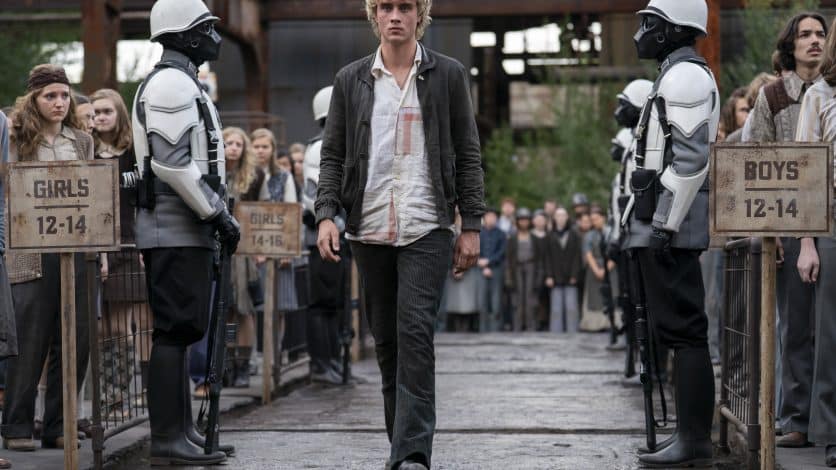
The newest Hunger Games movie, Sunrise on the Reaping, releases 10 months from now on November 20. But for diehard fans like myself, that’s 10 months too many.
To help pass the time, I’ve compiled a list of movies and TV shows with similar premises or themes to The Hunger Games. Featuring dystopian worlds, fast-paced action sequences, and parallels to real-world issues, these picks are perfect for fans who want to stay entertained until November.
The Long Walk (Starz, 2025)
The Long Walk is based on a Stephen King book he wrote under his first alias, Richard Bachman, in 1979. The story’s premise is simple, but it serves as a profound metaphor of war. The movie follows 50 young men in a near-future, dystopian America who volunteer for the country’s annual long walk. The only rule is to keep a pace of 3 mph. Fall below that pace, the walker gets a warning; three warnings, they’re shot. There’s no finish line, and the last man standing wins tons of riches and one wish for anything he wants.
The only things that happen in this movie are walking, talking, and gruesome deaths. Yet it manages to keep watchers enthralled throughout the entire movie-watching experience. Although it falls under the Stephen King banner, it forgoes supernatural horror for psychological suspense. The walkers’ exhaustion and anxiety over their inevitable death are visceral. Their turmoil is palpable and makes the audience feel the weight of each grueling step. However, the boys’ camaraderie makes viewers grow so attached that each approaching death is gut-wrenching to watch.
The Running Man (Paramount+, 2025)
This movie is another 2025 adaptation of a Richard Bachman book, and is also a remake of the 1987 original. Set in a near-future, dystopian America ruled by a totalitarian media apparatus known as the Network, the movie follows Ben Richards — a desperate father who enters the network’s most popular, yet gruesome reality TV show, “The Running Man,” to earn money to save his sick daughter. Contestants must survive thirty days hunted by professional assassins. As Richards continues to stave off assassins one-by-one, his rebellious nature makes him a threat to the system.
Fast-paced, gritty, and filled with dark humor, this is an engaging action movie balanced with social commentary. The political messaging is apparent, yet the film opts for spectacle rather than substance. Nonetheless, fans who like The Hunger Games for its high-stakes action will surely enjoy this adaptation.
The Platform (Netflix, 2019)
In this Spanish Netflix original, inmates in a prison are fed once a day from a descending platform. When the platform reaches their level, they only have two minutes to eat. Those on the upper levels take more than their fill, leaving the lower levels with scraps or nothing at all. The inmates randomly move levels every 30 days; the high levels guarantee food, while being on a lower level is basically a death sentence. The story follows one inmate’s fight for survival as he moves around the floors month-by-month and plots to break the system.
The movie is a straightforward metaphor for capitalism, human greed, and what humans will resort to in order to survive. The prisoners confront human nature in extreme conditions when faced with choosing whether to eat only what they need or take more at the expense of others.

Circle (Netflix, 2015)
This recommendation is not to be confused with the 2017 movie, The Circle, starring Emma Watson and Tom Hanks. Rather, the low-budget, indie movie is about fifty strangers who wake up in a dark room where one person must die every two minutes at random. The group quickly discovers that they have the power to vote who dies next, and a panicked conversation soon turns into heated arguments over who deserves to be killed next and who deserves to survive until the end. The ensemble includes a pregnant woman, a little girl, a cancer survivor, a cop, a doctor, a veteran, and many others of different backgrounds.
Like The Long Walk, it is the dialogue that drives the story forward and keeps it so engaging. The movie brings up ethical dilemmas, leaving viewers pondering what choices they themselves would make in that situation long after the rolling credits.
Battle Royale (2000)
Before there was The Hunger Games, there was Battle Royale. The term “battle royale” — describing a fight-to-the-death tournament with dozens of contestants and one last person standing — was coined after Koushun Takami’s 1999 cult-classic novel. In Battle Royale, 42 junior high students are randomly selected, brought to an island, and then forced to fight to the death in an annual state-sanctioned event.
Battle Royale is credited with popularizing the “battle royale” genre. Interestingly, some have controversially accused The Hunger Games of being a rip-off of Battle Royale. Most notably, the Pulp Fiction and Kill Bill director Quentin Tarantino openly called it one. However, for Hunger Games fans, Battle Royale is the closest they’ll get to another story featuring a high-stakes survival story with sharp social commentary in a dystopian world.
The Purge franchise (2013-2021)
The Purge horror movies expand on such an interesting concept. In a dystopian America, all crime is legal for one night a year. The government claims it is to bolster the economy, but the real reasons are far more sinister. The anthological franchise follows a different set of characters and storylines in each movie.
From a family barricading themselves at home in The Purge, to Staten Island residents experiencing the purge for the first time in The First Purge, or a senator trying to survive while campaigning to end the annual purge in The Purge: Election Year, each story delivers a sharp critique of class inequality, political corruption, and systemic oppression. These movies are perfect for binging in one night or watching individually, leading up to Sunrise on the Reaping.
Snowpiercer (Netflix, 2013)
Snowpiercer imagines a frozen, post-apocalyptic world where the remnants of humanity survive on a massive, perpetually moving train. The elite live in luxury at the front while the poor live in crammed, squalid cars at the back. The movie follows Curtis, a passenger from the back of the train, as he leads a revolt to reach the front and take over the train. Beyond its high-stakes action and gripping storyline, Snowpiercer highlights the extremes of class inequality and the harsh realities of a society built on rigid hierarchy.
The movie is available to stream on Netflix. But for those who prefer TV, there’s also a four-season Snowpiercer series that expands on the same concept.
The Handmaid’s Tale (Hulu, 2017-2025)
Based on the Margaret Atwood classic, The Handmaid’s Tale centers on June/Offred, a woman forced into the role of a handmaid — a woman assigned to bear children for the ruling elite — in the totalitarian theocracy of Gilead. Constantly watched and punished for disobedience, she navigates life in the homes of the powerful while befriending other handmaids.
As June searches for ways to resist and protect those she loves, the series unfolds with tense, unpredictable drama. It is a somber, cautionary tale of the dangers of extremism within a compelling storyline.
Black Mirror (2011-Present)
This dystopian social thriller and dark satire explores the dangers of unchecked technological innovation. Each episode contains a standalone story exploring people who use technology for evil or watching technology go awry. Issues explored range from how we measure our worth through social media likes in “Nosedive” to warnings against consumerism and exploitation in “Fifteen Million Merits,” or abuses of power and the ethics of controlling digital consciousnesses in “USS Callister,” among others.
While Black Mirror is less action-driven and leans more into character-centered narratives, this series is perfect for anyone who enjoys deep and thought-provoking stories that hold up a mirror to the world we live in.
3% (Netflix, 2016-2020)
In this dystopian sci-fi thriller, most of the world lives in poverty while a select portion of the population lives in a presumed utopia known as the Offshore. Every year, twenty-year-olds from the Inland, an impoverished, destitute mainland, are given one chance to pass a brutal selection process and move to the Offshore.
Only 3% succeed, while the rest are sent back to the same harsh life they came from. The process claims to be a fair meritocracy, but quickly reveals itself as corrupt and unjust. Participants undergo a series of grueling psychological, emotional, and physical challenges in this high-intensity, binge-worthy series.