“I want to be a writer,” I used to say when I was younger.
Then, upon realisation that I didn’t have the patience to commit to developing complicated worlds and character profiles for multi-series book collections, and that I altogether preferred reading about convoluted murder-mystery plots than having to go through the hair-pulling anguish of creating them myself, I made a pivotal career change, aged 11.
“I’m going to be a journalist,” I started to declare. “Which one?”, seemed to be the natural follow-up question. The Guardian, The Times, The Mirror, The Daily Mail?
But back then, I did not tie my fervent desire to write to any specific publication. All I wanted to do was stay in my little village and write stories about the things that happened there. Maybe this stemmed from a certain childlike naivety. The thought that I should one day ever want to live an unwalkable distance away from my parents (and their beautifully-stocked fridge) was unimaginable to me.
This dream has naturally shifted over the years. The thought of staying in the same place my entire adult life is now a terrifying concept. And yet, my admiration of local news, and of my assuredness in its poignant relevance, has very much remained.
Journalism as a constantly evolving trade
Journalism is changing. We hear this all the time, and it is, in many ways, part of the job description. (But I think “evolving” seems to be the preferred way of framing things).
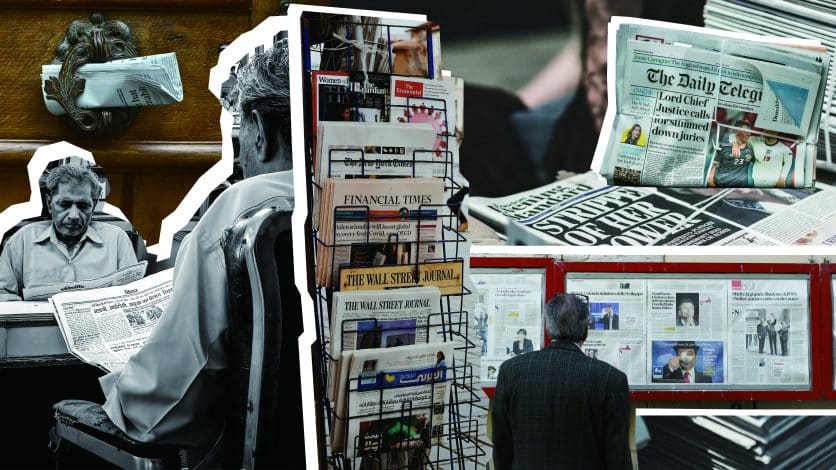
Production of print media has been slowly crumbling to its last legs. Back in 2010, tabloid giants like The Sun regularly shifted almost three million copies a day. Fast forward to 2024, and fewer than a million copies are hitting the shelves. And the Broadsheet counterparts aren’t doing any better – The Guardian’s 2010 average daily sales figure of 302, 000 towers over the current figure, where a comparatively meagre 85, 000 editions are sold on the daily.
“Print media has died, is still dead and is dying more,” a habitually optimistic former editor of mine recently told me.

And local news is one unfortunate casualty of this, in part, because print media and local news are, in the minds of many, irretrievably interlinked. If one is archaic and passé, the other must be too.
A shift in readers’ areas of interest
One thing we see in modern media is readers’ shifted interest towards the more far-reaching stories. The million-dollar international deal. The political squabble that people from all around the world tune in for. The growing popularity of free audible content, which analytically dissects these events, opened up an exciting new gateway, making it considerably easier to become informed on world events. Whether you prefer a more structured format like Politics Unpacked (by Times Radio), Westminster Inside or The Rest is Politics (which is currently ranked third in Spotify’s UK top podcasts), or a more conversational setup like Politics Joe, there is no lack of coverage of these top stories.
It is now incredibly mainstream, and, I would argue, societally expected to have some foundational understanding of international and national world affairs.
Even on a very basic level, there is an assumption that one should be able to pinpoint a particular plot on a map and say, “such and such is happening here” or “there was a big natural disaster here a few years ago”. Or more simply, “this probably isn’t the ideal holiday destination at the minute”.
This understanding, however, does not extend to local news. It’s a fairly regular occurrence to see someone whip out their Apple News app. But how often do you see someone browsing their local news website? There is a great hunger for national news coverage, in a way that is interestingly adverse to the current trajectory of local news.
Our shared fascination with ‘big picture stories’
Thousands of people outside New York anxiously awaited the results of the New York Mayoral elections and hurriedly celebrated when the Muslim Democrat Zohran Mamdani won the historic battle.
But I can’t help but wonder how many of those people voted in their own Mayoral or Councillor elections. Sure, they can spell out M-A-M-D-A-N-I. But how many of them can confidently name the mayor of their own area, or the political leaning of their region?
Our fascination with world events should never come at the detriment of local news. People are lured into this false dichotomy of thinking that you can’t possibly stay informed on both large-reaching and local issues. And, when picking a side, people are more likely to put local news on the back burner for several reasons.
Accessibly:
We like things that are easy. Simple things we get a notification for. Things that don’t take a lot of effort to search for, and are likely to come up as recommended before typing anything into a search engine. When you’re looking for a short distraction or planning a conversation starter, it’s the national stories that jump off the screen.
Defining ‘newsworthiness’:
This week, for instance, there is clearly going to be more coverage on Burnham’s bid to becoming an MP being blocked by the Labour party than coverage of Barnsley Council’s prevailing disruption on bin collection.
The former will be more likely be pertinent to UK residents, collectively speaking. It is also more likely to directly impact the average non-Barnsley resident.
But we should not use our acknowledgement of these facts to undermine the impact of local news stories. In comparison, the building of a new housing project down the road garners much less of an international stage. But this does not make these stories any less impactful, nor inherently less “newsworthy”.
The news relates to anything of significance to a certain demographic. For the average Barnsley resident, this story is highly significant. In fact, for the average Barnsley resident, knowledge of this information will probably have a greater impact on their week, including their general mood and their quotidien patterns of action, than hearing about Burnham getting blocked as an MP.
Who is the news for?
Local news is important. But its content is specifically important for the locals. There is a special sense of exclusivity surrounding local news. There is no basis for mass appeal here; it isn’t immediately brandable or readily generalizable. Its essence lies in its uniqueness. And the skill of a local news journalist therein lies in their ability to capture the distinct spirit of the region or localised area in which they’re reporting.
This is to say, what might seem insignificant or trivial to the oblivious skim-reader will be highly pertinent to the local businesses. Trying to downplay the significance of local news by talking generally about “impact” – as if, for anything to be “impactful” enough to care about means that it must have some sort of general relevance that can be applied to all groups of people – is plainly dismissive of the shared experiences that permeate certain cultures.
Some stories will have a particular niche pull for special interest groups, and it is symptomatic of a society that is constantly looking to generalise and show the wide-scale appeal of stories to increase readership, which partially explains this inclination to violently oust local news from the sphere of public interest.
Why it’s important to engage with local media
Spoiler alert: it doesn’t make you a better person for picking up a weekly copy of Generic-Small-Town-Press. And there is still quite a bit to be said about performative news consumption. But I think there are considerable benefits that come with consistently engaging with local news.
To clarify, I’m taking “local news” to pertain to reading content which is expressly generated for a specific regional basis. [It’s not enough to merely gloss over the local stories which occasionally happen to spill out into the national papers.]
Cost factor:
A variety of local libraries and municipal buildings proudly display weekly print editions for public viewing.
So much of what we consume – seminar readings, text messages, notes apps, musings, scary calendar reminders – these things are all viewed on our screens.
In a strange sort of romantic way, there’s something distinctly ‘other’ about seeing words committed to ink on paper. It can be a nice change of pace to read something physically graspable. And, personally, I find there to be something uniquely gratifying about indulging in a newspaper every so often. (Even if you only do this so you can vehemently annotate the parts you disagree with).
Plus, even if you still prefer the less aesthetically vintage way of getting your news, local press websites usually offer a standard level of content that is free to browse. National news outlets often stick their content behind some sort of pay wall. This goes some way to presenting local news as a more accessible alternative.
Positive focus
One of the most depressing things about the decline of local news is the fact that so much of it is positive. Wedged between the stories about new housing estates and updates on polemic planning permissions, local news websites are home to some of the most heart-warming features about local initiatives. Information on local charities is not out of place in local newspapers.
”The media”, as it is ominously referred to as an umbrella term, is commonly levied with the criticism of adopting a sensationalist, overly negative focus on the depressing, wrath-inducing stories.
But I guarantee that people who say this have either not read or are plainly choosing to ignore local news, which, on the whole, does a better job at balancing out the fun with the fury-inducing stories.
Local papers are bustling with charity-fundraising success stories and uplifting accounts of criminals getting justice. By purely interacting with the national stories, you wouldn’t necessarily get a true grasp of the extent to which great things are happening to ordinary people every day.
And on the flip side, you don’t understand the true devastation until you read people’s personal accounts.
Feeding into one’s understanding of national media
On a national level, there has a lot of recent discussion about business rates, and if the current Labour government is doing enough to support local businesses. But hearing the emotional plight of a local shopkeeper reminds us of the gravitas of politicians’ decisions. Reading about a shop on your high street and learning about how this business has been affected – a shop that you yourself regularly frequented in your after-school galivanting adventures – re-frames these national issues in a whole new context. Local news is important because it keeps you firmly grounded in the staunchness of reality.
Of course, this isn’t to say that national and international stories aren’t important. In fact, I’ve made it clear that I believe national news and local news should, in many ways, go hand in hand. Local news should add to, not replace, your standard morning routine of news browsing. A variety of media is always positive.
But my overall point is, if you’re a staunch supporter of the The New York Times, The Wallstreet Journal or Financial Times, and you consider yourself to be well-rounded, “educated” person of respectable political insight, I would also expect you to take an interest in your local media, and be able to speak confidently about the biggest issues facing the people in your neighbourhood.